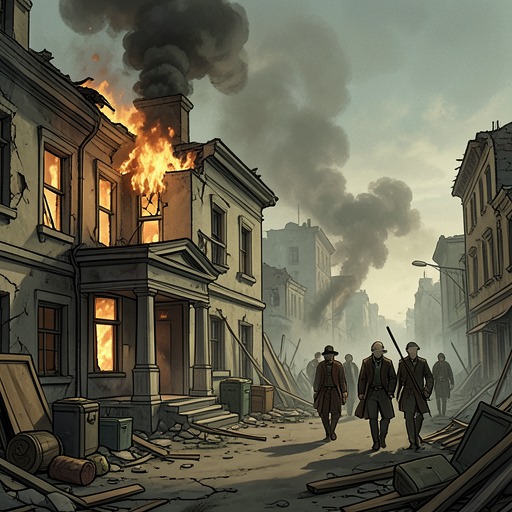
Advancing progress through destruction
A Gentleman in MoscowAdvancing progress through destruction is the rationale that makes rupture appear not merely regrettable but necessary: the old order must be swept aside so that a new society can be built. The novel tests that rationale against its costs. It appears in the retrospective naming of historical turning points, in the drive to industrialize and reorganize agriculture, and in Osip’s defense of revolution as a break with a supposedly backward past. Smaller scenes of administrative procedure and record-keeping echo the same tension: systems designed to make work legible and efficient can displace forms of human judgment and regard.
History and the language of turning points
The reflection titled Arachne’s Art questions the ease with which history turns upheaval into a sequence of decisive dates. From the security of a high-back chair, the historian points to a moment as a field marshal might mark a bend in a river: there, retrospectively, was the turning point. The image matters because it converts a complicated process into a clear, navigable line. The dates themselves are concrete: the launch of the First Five-Year Plan on January 3, 1928; Nikolai Bukharin’s removal from the Politburo on November 17, 1929; and the drafting of Article 58 of the Criminal Code on February 25, 1927. Each is presented as a point from which transformation or repression can be traced.
Yet the passage also unsettles the confidence such labels confer. Its final movement offers other possible dates and times, down to a morning hour, rather than allowing history to settle neatly around a single universally visible hinge. The tension is central to the concept: destruction may later be described as the necessary threshold of progress, but people living through it encounter a spread of decisions, pressures, and consequences, not one clean break. The retrospective map clarifies the process even as it risks making its human costs look inevitable.
Industrial ambition and agricultural costs
The First Five-Year Plan is introduced as an effort to transform Russia from an agrarian society into an industrial power. Tens of thousands of urban workers build power stations, steel mills, and heavy-machinery plants; the expansion of industry, in turn, demands more grain from the countryside. The plan links the factory to the field, making agricultural production part of a national project whose priorities are set far beyond any one farm or village.
The account of how that project proceeds sharply complicates the language of modernization. To clear the way, the authorities exile a million kulaks, described as profiteers and enemies of the common good, while the narrator points out that they were also the regions’ most capable farmers. Peasants resent the new agricultural methods, and tractors intended to inaugurate a new era remain scarce. Uncooperative weather compounds these practical failures, and the harvest collapses. Instead of reducing demands in response, the state raises quotas and enforces requisitions at gunpoint to feed the cities.
The narrator projects the consequence forward: in 1932, these forces bring widespread hardship to the agricultural provinces of old Russia and starvation deaths for millions of peasants in Ukraine. The sequence exposes a destructive feedback loop. The policy removes experienced farmers in the name of common benefit; resistance, limited machinery, and weather undermine production; and the shortfall is answered with greater coercion. The promised future of industrial abundance is therefore tied to the immediate deprivation of the people expected to supply it. Progress is not shown as a result that simply follows destruction: the means used to pursue it can intensify the crisis they are supposed to solve.
Osip’s case for rupture
Osip gives the idea its most sustained defense in a conversation with Count Alexander Ilyich Rostov. He compares Western heritage to the Maltese Falcon: a precious object whose symbolic value may conceal the rapacious institutions it represents. In his reading, the bird stands for church and monarchy, institutions that have underpinned European art and ideas. Their cultural achievements do not, in his argument, prove that inherited authority deserves reverence. What appears precious may also preserve the structures that hold a society back.
Osip sharpens that claim by describing Russia in 1916 as profoundly backward: illiteracy, a majority living in modified serfdom, wooden plows, violence against women, habitual drunkenness, and deference to icons all belong to his indictment. His portrait is deliberately sweeping, and it is his argument rather than a neutral inventory. He asks whether reverence for statues, cathedrals, and ancient institutions helped keep people in conditions unchanged for centuries. Revolution becomes, in this reasoning, an attempt to break not only political power but also a cultural attachment that makes inherited suffering seem venerable.
He then sets those conditions against the achievements he attributes to the Soviet project: the prospect of universal literacy, women elevated to equality, new cities, and industrial production surpassing that of much of Europe. When Rostov’s question turns the conversation to cost, Osip does not deny the price. He invokes the destruction of African communities under American power and the demolition of lovely neighborhoods to make room for skyscrapers and highways. The comparison is meant to show that modern development elsewhere also rests on deliberate clearance. But Osip distinguishes the declared ends: American destruction serves individualism, while Soviet destruction, as he presents it, serves the common good. The claim makes the moral problem unmistakable without resolving it. A collective purpose may explain the violence of transformation; it does not erase the people and places that bear it.
Procedure, legibility, and what gets lost
The novel also brings the logic of system-building into the Boyarsky Restaurant, where a new ordering and billing procedure is introduced. A waiter is to write each order on a pad, take it to a bookkeeper for entry in a ledger, carry a cooking slip to the kitchen, and wait for a confirmation slip and stamped receipt before retrieving the finished food. The order is documented at each stage, until the waiter can finally mark that the dish has reached the table. The sequence makes the work traceable, but it also interposes paperwork between the customer’s request and the person serving it.
That difference matters to Count Alexander Ilyich Rostov because, as headwaiter, he has cultivated another kind of order. At the Piazza, customers might expect a waiter to write at the table; at the Boyarsky, they expect the server to meet their eyes, answer questions, make recommendations, and remember preferences, all with hands behind his back. The contrast is not between writing and an irrational refusal of writing: the narration explicitly presents the Count as an admirer of the written word. It is between a procedure suited to one setting and a service relation whose value depends on attention and personal knowledge. Administrative efficiency can standardize the transaction while diminishing what made this particular service distinctive.
A later discovery in the hotel’s filing cabinets gives the problem a darker human form. The first cabinets contain operational reports on revenues, occupancy, staffing, maintenance, inventories, and discrepancies; the remaining files catalogue individuals, including hotel staff and guests. Their entries record specific failings—tardiness, impertinence, disaffection, drunkenness, sloth, and desire. The Count recognizes that the listed weaknesses may be accurate, yet sees how selectively the files make a person legible: he could assemble a much larger account of each individual’s virtues. This is not the same scale of destruction as forced requisition or the clearing of neighborhoods, but it shares a structural danger with them. A system that makes complex realities administratively manageable can elevate what it can count and classify while leaving out the qualities that resist its categories. Across these scenes, the novel neither treats every innovation as destructive nor accepts progress as its own justification; it asks what a promised improvement requires people to surrender, and whose losses disappear when the result is called necessary.