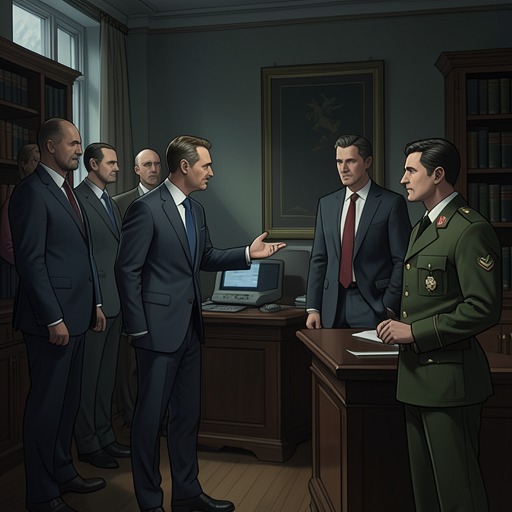
Alexander Rostov and Osip Glebnikov
A Gentleman in MoscowCount Alexander Ilyich Rostov and Osip Ivanovich Glebnikov develop a relationship that joins private instruction to public history. Beginning as a discreet arrangement to study Western languages and society, their monthly dinners become a long-running exchange about how nations understand one another—and how Russians should reckon with their own past.
An introduction shaped by distance
Osip introduces himself as a former colonel of the Red Army and an officer of the Party. His personal history is framed by an opposing pair of longings: as a boy in eastern Georgia, he dreamed of Moscow; at thirty-nine, living in Moscow, he dreams of eastern Georgia. The detail gives the Count more than a professional biography. Osip’s ambitions have carried him toward the capital, while distance from home has made the place he left newly vivid.
The Count responds by reaching across the table to shake Osip’s hand. Their meal continues, but the Count soon asks what Osip does as an officer of the Party. This question opens the way to the larger explanation Osip has come to make. He is not merely seeking a conversational companion: he has approached the Count because he believes the Count can offer a kind of knowledge that is useful precisely because it is difficult to acquire openly.
A discreet education in the West
Osip describes his country as standing at a turning point. Diplomatic relations with France and Britain have been open for seven years, and he anticipates relations with the United States. He sets this changing position against a longer history of Russian admiration for Western ideas and fashions, and predicts a future in which the country will export more grain and manufacture more steel than any other in Europe. In his account, ideological confidence and material ambition are bringing the Soviet Union toward a new place on the world stage. That prospect, he argues, makes clear speech and careful listening more important than before.
His aim is to learn French and English, but he insists that vocabulary alone will not suffice. He wants to understand the people who speak those languages, especially the privileged classes who remain influential: their view of the world, their sense of moral obligation, and what they value or disdain. He presents this as a form of diplomatic preparation, while stressing that someone in his position must cultivate such skills discreetly. The arrangement therefore rests on a tension: Osip seeks knowledge of societies whose power he is trying to interpret, but his official position makes the pursuit of that knowledge something to handle with care.
Osip proposes that the two men dine together once a month in the same room, speaking French and English and sharing impressions of Western societies. He lets the offer of an exchange trail off; the Count raises a hand to stop any discussion of payment or return. The gesture establishes the terms of their connection as something other than a simple transaction. The Count’s role is to teach and interpret, while the dinners create room for Osip to bring his questions and observations.
A curriculum across three societies
Since 1930, the Count and Osip have met on the third Saturday of each month to advance Osip’s understanding of the West. Their study proceeds country by country. For several years they concentrate on France, taking in its idioms and forms of address, figures such as Napoleon, Richelieu, and Talleyrand, the Enlightenment, Impressionism, and the French aptitude for je ne sais quoi. They then turn to Britain, where their subjects include tea, cricket, foxhunting, Shakespeare, and the importance of the pub.
The progression makes the lessons more than a sequence of language exercises. The Count introduces customs, historical figures, art, and social rituals as parts of a society’s way of seeing itself. The curriculum moves from formal speech and political history to everyday institutions and habits, treating the details of ordinary life as evidence of national character. Osip’s original request—to understand how Western people judge, value, and dismiss things—thus shapes what the pair study.
By the time their attention shifts to the United States, Osip prepares for a new text with the diligence of a student. Two copies of Alexis de Tocqueville’s Democracy in America lie beside their nearly empty plates. Intimidated by its length, Osip has spent three weeks reading through it after the Count recommends it as the best foundation for understanding American culture. He arrives eager to discuss it, having also exchanged the courtesies of the meal: he echoes the Count’s pleasure in summer nights, praises the sauce au poivre, and appreciates the claret’s nose. The ritual of dinner and the labor of study meet at the same table; Osip is prepared to move from hospitality to analysis.
Cultural study meets political candor
During a later dinner, their American studies take a more immediate form. As the image of the Golden Gate Bridge appears, the two men watch a sequence from The Maltese Falcon. Once the film has drawn them into its unfolding intrigue, the Count asks whether Russians are particularly brutish—whether they are essentially more brutal than the French, the English, or Americans. Osip, intent on the screen, whispers that he does not want to disturb the other members of the audience. The question interrupts the lesson without abandoning it: the subject is no longer simply how Americans tell stories, but how national character is judged.
When the Count observes that something has vexed Osip, Osip switches off the projector, turns on the lights, and returns to the table. The interruption gives the conversation a different weight. The Count then recounts his conversation with Mishka, presenting Mishka’s views on the burning of Moscow, the toppling of statues, the silencing of poets, and the slaughter of fourteen million head of cattle. Osip listens attentively and occasionally nods. Their study has become a setting in which an account of Western society can open onto a contested account of Russia itself.
The relationship’s defining movement is from instruction toward difficult exchange. Osip first comes seeking the knowledge required to understand foreign elites and prepare for a changing diplomatic world. The Count supplies a sustained course in culture, but their later conversations make clear that the work cannot be kept safely within lessons about other countries. Questions of Russian violence, memory, and destruction enter the room. Osip’s attentive listening, after the projector is shut off, marks the importance of that shift: the monthly table is not only a classroom but a place where the Count can relay an absent friend’s criticism and Osip can hear it without turning away.