American Embassy in Paris
A Gentleman in MoscowThe American Embassy in Paris is the intended refuge at the end of Sofia’s escape from the Salle Pleyel. Count Alexander Ilyich Rostov plots a route that will carry her away from the concert hall and toward the embassy before her absence is discovered. The narrative gives the embassy little architectural description; instead, it makes the place vivid through the map leading to it and the moment Sofia arrives barefoot, disguised, and asking for help.
Route and Approach
The embassy is the endpoint of a route drawn by the Count on a small piece of a Paris Baedeker. Sofia retrieves the folded map from beneath the brim of the Italian’s cap, opens it in a doorway, and follows its red line from the Salle Pleyel along the Avenue Hoche, past the Arc de Triomphe, and down the Champs-Élysées toward the Place de la Concorde. The map translates the Count’s plan into a sequence of streets and landmarks she can follow alone.
The route is deliberately indirect. A direct walk would have taken ten blocks along the Rue du Faubourg Saint-Honoré, but the Count instead sends Sofia on a slight detour. His calculation is practical: getting her away from the concert hall quickly matters more than choosing the shortest path, and the Champs-Élysées offers a chance to disappear into a crowd. The extra minutes are meant to be outweighed by the reduced risk that she will be recognized near the place she has just left. The route therefore represents both escape and concealment: it guides her toward the embassy while making her less conspicuous along the way.
Sofia’s journey does not proceed as mechanically as the Count expects. At twenty-one, she sees the Arc de Triomphe and the Louvre illuminated at night from the street for the first time. She has seen them from a bus window, but now encounters them on foot, after receiving an ovation, changing her appearance, and slipping out of the concert hall. At the Place de la Concorde she stops and turns slowly, allowing the sight to interrupt a timetable that leaves little room for delay. The embassy route thus passes through a moment of discovery: the city is not merely territory to cross, but an experience capable of altering the meaning of her escape.
Disguise and Arrival
Sofia’s appearance on the route is part of the plan. She leaves the concert hall barefoot, wearing the Italian’s cap and carrying a knapsack. Before leaving, she discards the dress Marina made for her and the shoes, since such conspicuously feminine possessions could expose her if her bag were searched. She keeps the necklace Anna gave her, slipping it into her pocket. The small, selective act of concealment shows that escape requires more than a destination: Sofia must also manage what her clothing and belongings might reveal about her.
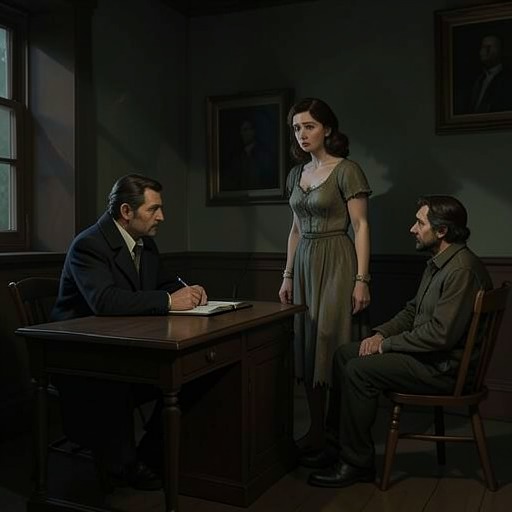
At the embassy, an attendant tells Richard Vanderwhile that a young man is asking for him and apparently seeking asylum. The report adds that the visitor has no shoes. Richard first asks what the young man needs asylum from; once he hears about the bare feet, he has the visitor shown in. The description proves deceptive. The person in the newsboy’s cap is Sofia, who removes it and holds it at her waist with both hands, polite but anxious. The change from an anonymous young man in the attendant’s account to Sofia in person makes the disguise’s success—and its limits—visible at the door.
The Embassy as Threshold
The embassy is presented through an encounter rather than a formal account of its operations. Richard and Mrs. Vanderwhile receive Sofia, and Richard quickly recognizes her hunger, even though he has just returned from a dinner. He asks his wife to find clothes for her, then takes Sofia into his study for a private conversation before they all meet in the kitchen. The sequence moves her from the exposed approach outside to an interior where she can speak and be cared for, without describing what decision will be made about her asylum request.
The conversation also connects Sofia’s arrival to her father’s arrangements. Richard explains that Count Alexander Ilyich Rostov had mentioned she might have something for him. Sofia, shy and hesitant, replies that her father had said Richard might have something for her first. The exchange establishes that the embassy visit is not simply an improvised appeal by a fugitive: the Count has prepared a connection between his daughter and Richard. The evidence does not disclose the item or the terms of any later arrangement, but it makes the embassy the meeting point of Sofia’s independent escape and her father’s prior planning.
Narrative Significance
The American Embassy in Paris marks the limit of the Count’s control over Sofia’s journey. He can devise the route, choose its detour, and calculate how long she may have before her absence is noticed; he cannot experience the city for her or prevent her from stopping at the Place de la Concorde. Her arrival completes the physical passage to the planned destination, but seeking asylum is not the same as having its outcome settled. The narrative leaves that uncertainty intact.
The embassy’s importance lies in the conjunction of precise preparation and an unsettled future. A map cut down to the size of a matchbook, a cap concealing Sofia’s appearance, and a path through recognizable Paris landmarks bring her to Richard’s door. There, the disguise falls away and the request for asylum becomes personal. The place is therefore both a practical destination in the Count’s escape plan and a threshold at which Sofia’s next life remains unresolved.