Anonymity and social invisibility
A Gentleman in MoscowAnonymity and social invisibility are linked in the novel as both a personal affliction and a historical condition. What begins as the familiar fantasy of becoming unseen is recast as a curse: Count Alexander Ilyich Rostov does not gain freedom from observation so much as lose recognition by the people around him. Later, amid thousands of unlabeled wine bottles in The Metropol’s cellar, anonymity takes on a larger meaning. Individually distinctive things have been made indistinguishable, and the Count recognizes in that loss a parallel to the erasure of his Russia.
Invisibility Recast as a Curse
The novel introduces invisibility through the folklore of talismans, potions, and divine intervention. Such stories typically dwell on the power’s practical rewards: an invisible hero can evade danger, overhear conspirators, enter a treasury, or steal a pie from a pantry. This catalogue gives the fantasy its ordinary appeal, treating invisibility as a tool that lets its possessor move freely through a world that cannot see him.
The Count’s experience reverses that promise. His invisibility is not chosen, and it does not make him more capable of acting upon the world. Instead, the spell cast by Anna Urbanova makes him vulnerable to being overlooked by friend and foe alike. The contrast is sharp: the folklore hero controls his concealment, while the Count suffers a change in how other people perceive him. Anonymity here is not privacy or escape but the loss of the social acknowledgment that makes a person present to others.
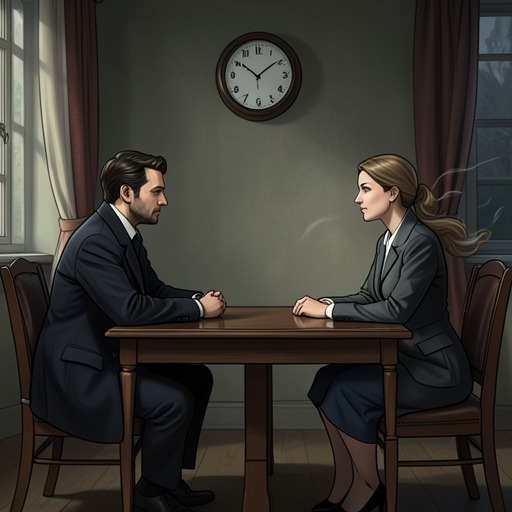
The spell’s timing gives that loss its particular force. On the night the Count dines with Anna Urbanova in her suite in 1923, she could presumably have made him disappear at once. Rather than do so, she sets the effect to unfold over the course of a year. The delay turns invisibility into a process the Count must notice as it advances. It also makes the affliction unsettlingly difficult to locate: no single instant marks the boundary between being seen and becoming socially absent.
The Count’s Gradual Disappearance
In the weeks that follow, the Count notices that he disappears from view for minutes at a time. At Piazza, a couple approaches his table as though it were available; near the front desk, a hurried guest nearly knocks him over. These incidents do not make him literally vanish from the room. Their significance lies in the behavior they provoke: people act as if he is not there, even when his body occupies the space directly before them.
By winter, even people who would ordinarily greet the Count with a wave or a smile fail to see him until he is ten feet away. A year after the spell begins, the delay has lengthened: when he crosses the lobby, his closest friends may take a full minute to notice him standing in front of them. The progression moves from occasional lapses to an increasingly consequential failure of recognition. Distance matters, but familiarity offers no reliable protection; even those nearest to him can leave him waiting to be acknowledged.
The moment with Vasily at the concierge’s desk gives the pattern a precise, ordinary form. Vasily puts down the telephone receiver, apologizes to Count Rostov for not having seen him, and asks how he can be of service. The Count answers with a delicate tap on the desk. The small gesture establishes his presence without spectacle. It also shows the peculiar labor imposed by social invisibility: the Count must call attention to what should already be evident. The scene makes a public service encounter carry the weight of the larger curse, translating an abstract loss of recognition into a brief failure between two people.
Unlabeled Wine and the Loss of Difference
The cellar of The Metropol extends the concept beyond the Count’s social life. Having followed Andrey through the dining room and kitchen and down a winding stair, he enters a part of the hotel even Nina has never visited. Its brick arches and cool darkness recall a catacomb, but its contents are not the remains of saints. Rows of wine racks hold almost ten thousand cases—more than a hundred thousand bottles—and not one bottle has a label. The scale makes anonymity material: this is not one overlooked person but a collection in which distinctions have been removed across an enormous number of individual things.
The Count studies the bottles at close range. In a single row he calculates that there are more than a thousand, virtually identical in shape and weight. He picks one up and observes how naturally its curve fits the hand and how its volume rests on the arm. Those outward similarities, however, reveal nothing about what the bottle contains. It could hold a Chardonnay suited to Camembert or a Sauvignon Blanc suited to chèvre; its neighbors may look the same while containing something decidedly different. The label’s absence has severed appearance from identity.
For the Count, wine makes individuality legible through its history. A bottle’s color, aroma, and taste express the geology and climate of its home terrain, as well as the particular conditions of its vintage: the timing of a winter thaw, the summer’s rain, prevailing winds, and cloud cover. In that sense, wine distills both time and place. Its identity is not an abstract category but the accumulated record of where and when it came into being. Without the label, those differences remain inside the bottle but are no longer readily knowable from the outside. The wine is returned, in the Count’s phrasing, to a sea of anonymity, where individual histories disappear into averages and unknowns.
Political Erasure and the Count’s Recognition
The cellar’s bottles provide the occasion for the Count’s moment of lucidity. The passage connects his recognition to Mishka’s understanding of how the present grows out of the past and shapes the future. Looking at the unlabeled wine, the Count grasps his own place in that passage of time. His reflection moves from the familiar belief that ways of life take generations to fade to the possibility that upheaval, political turmoil, and industrial progress can make social change occur with startling speed.
That historical argument gives the cellar scene its force without making the wine merely a decorative metaphor. The bottles are tangible evidence of distinctive origins whose identifying marks have vanished; the Count sees the same threat facing the world he remembers. For years he has spoken as if poetry, travel, and romance were behind him, yet he had privately imagined that they still lingered somewhere, available to be recalled. Now he understands that they are not simply waiting at the edges of his life. The Bolsheviks, intent on remaking the future, will not rest until every vestige of his Russia has been uprooted, shattered, or erased.
Anonymity thus connects an intimate experience of being overlooked with a collective loss of historical difference. The Count’s gradual disappearance from the attention of friends and strangers shows what erasure feels like at the level of daily encounter; the cellar reveals how identities can also be flattened when their histories and distinguishing marks are removed. Returning the bottle to its place, the Count goes to join Andrey, but he recognizes that almost everything belongs to the past and that one last duty remains. The narrative does not disclose that duty in this scene. It ends instead on the pause before it, leaving the Count’s realization of historical loss beside the fact that he still has something to do.