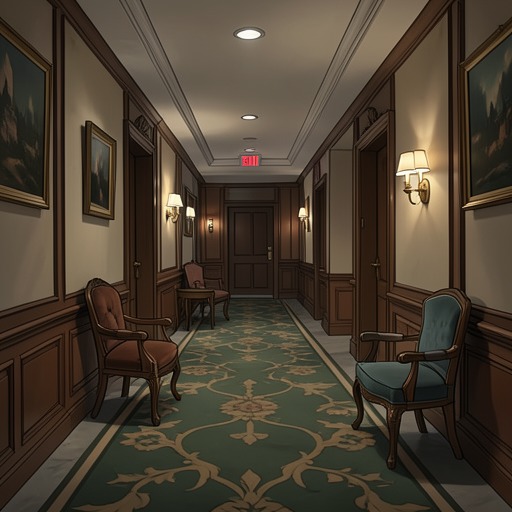
Arkady
A Gentleman in MoscowArkady, the Metropol’s desk captain, is one of the hotel’s familiar faces and a practical link between its guests, staff, and management. Usually described as unflappable, he appears both as a reassuring fixture at the front desk and as a messenger who can turn a disturbance into an account of the hotel’s increasingly strange affairs.
Identity and Place in the Hotel
When Count Alexander Ilyich Rostov returns to the hotel under armed escort, Arkady is manning the front desk. The Count greets him with a broad wave, as he has done a hundred times before; this time, however, Arkady responds with a wide-eyed stare. His surprise marks the rupture in an otherwise familiar routine: the Count has been taken away, and the staff have reason to think he will not come back.
Arkady belongs to a working community that includes Andrey, the Boyarsky’s maître d’; Vasily, the concierge; and Marina, recently promoted from chambermaid to seamstress. When the Count encounters them together, all share the same bewilderment. The moment places Arkady within the hotel’s close network of employees, whose knowledge of one another and of their guests is built through repeated encounters rather than formal announcements.
The Count’s Return
The Count explains to the assembled staff that officers at the Kremlin have sentenced him to spend the rest of his life in the hotel for the supposed crime of being born an aristocrat. The announcement turns the return from a private reappearance into a communal event. Arkady and the others cheer, and the Count shakes hands with them one by one, thanking them for their fellowship. Arkady’s initial stare therefore gives way, in the group’s welcome, to a renewed recognition of the Count as part of the hotel’s life.
The scene also gives Arkady a quiet place in the contrast between the state’s judgment and the staff’s response. The sentence defines the Count by his birth and confines him to the hotel; the welcome treats him as a familiar person returning to a community. Arkady does not make the speech or decide the sentence, but his presence at the desk and among the gathered staff helps make the hotel’s response visible.
Titles and Changing Etiquette
In a later conversation, the hotel manager tells the Count that staff members have continued to address him as Your Excellency and says they must stop using such honorifics because the times have changed. The exchange makes etiquette a matter of institutional adjustment: a form of address that once seemed natural has become politically troublesome, and the manager seeks the Count’s understanding of the new demand.
Arkady enters while this conversation is under way. The manager’s shoulders slump at the interruption, and he points out that he is speaking with a guest. Arkady apologizes and addresses the manager as Mr. Halecki and the Count as Count Rostov. The scene puts Arkady’s formal manner beside the manager’s request that old forms be abandoned. It does not establish that Arkady intends a challenge; rather, the respectful address shows how inherited courtesies remain embedded in the hotel’s daily speech even as its leadership tries to regulate them.
Messenger and Witness
Arkady’s composure is more visibly shaken when he interrupts the Count during a card trick. He leads the Count aside and recounts an incident from that evening: at half past six, a gentleman knocked at Secretary Tarakovsky’s suite, demanded to know who occupied it, and then forced his way inside when Tarakovsky refused him entry. The intruder searched the rooms, including the bathroom, where Tarakovsky’s wife was attending to her nightly toilette. The intrusion makes the dispute more than a disagreement over a room; it has crossed into the privacy of a guest and his household.
Arkady says that he arrived after being urgently summoned by phone. Tarakovsky, agitated and waving his cane, demanded to see the manager, describing himself as both a regular guest of the Metropol and a senior Party member. The man on the couch answered that he, too, had been about to summon the manager, and claimed to have belonged to the Party since before Tarakovsky was born. Arkady relays this detail with the pointed qualification that the claim seemed remarkable given Tarakovsky’s age of eighty-two. His account preserves both the sequence of events and the absurdity of the encounter without making Arkady its protagonist.
The Count listens closely but cannot understand why Arkady has chosen that moment to tell him the story. That mismatch gives Arkady’s interruption its narrative effect: to him, the report is an urgent piece of hotel business; to the Count, it is a colorful episode whose relevance is not yet apparent. Across these scenes, Arkady serves as more than a familiar face at reception. He is part of the hotel’s system of attention, carrying news from one threshold to another while the old courtesies, new political rules, and private disturbances of the Metropol meet.