Bolshoi Theatre
A Gentleman in MoscowThe Bolshoi Theatre stands across Theatre Square from the Metropol Hotel, close enough to be watched from the hotel’s windows and roof. In the novel, it is more than a famous performance venue: it is a visible measure of the Count’s changing relation to Moscow. From its steps and golden doors come memories of his younger social life; from a room overlooking the square, the theatre becomes a scene that Nina watches and imagines entering; from the roof, its view persists alongside a very different kind of activity. The same building accommodates spectacle, recollection, and observation at a distance.
Setting and Approach
On June 21, 1922, at half past six in the evening, Count Alexander Ilyich Rostov walks from Red Square toward Theatre Square and the Metropol. He passes through Resurrection Gate, turns his back on the Alexander Gardens, and continues to the hotel, which stands in all its glory near the theatre. The route places the Bolshoi within the geography of his arrival at the hotel, a public landmark encountered just before the hotel becomes the boundary of his permitted life. Even before the story makes the theatre a stage for memory, its position across the square links it to the Count’s new surroundings.
The relationship between hotel and theatre is unusually intimate for one of distance: the Bolshoi is not inside the Metropol, but its entrance and audience can be read from the hotel’s northwest windows. The square functions as a shared public space, crossed by those attending performances and framed by the rooms of people who watch them. That arrangement makes the theatre a recurring prospect rather than a single destination.
Memory of Performance and Youth
From the northwest corner of his suite, the Count recalls watching people arrive at the Bolshoi. In one remembered winter scene, a short, stocky silhouette passes under a street lamp while snow descends; at that moment in the present, a young Red Army officer hurries up the theatre steps after missing the first half-hour of the evening’s performance. The officer’s lateness prompts the Count to remember his own youthful habit of arriving at the interval.
The memory gives the theatre a social history specific to the Count. At the English Club, he would promise himself one more drink and stay for three; then he would leap into a waiting carriage, cross the city, and vault the theatre’s steps. He slipped through the golden doors while the ballerinas were already dancing, murmuring apologies as he made his way to his usual seat in the twentieth row. From there, he enjoyed a privileged view of the ladies in the loges. His recollection makes late arrival both a practiced maneuver and a youthful delicacy, a way of entering a performance already in motion. The theatre preserves that former world in the form of a remembered route, seat, and point of view, even as the Count now observes another young man arriving late from the hotel.
Room 317 and the Audience Across the Square
The theatre also becomes the object of a deliberate viewing expedition. Nina is interested in the Metropol’s private rooms not for their possessions but for their views, each shaped by a room’s height, orientation, season, and time of day. For watching guests arrive at the Bolshoi on a summer evening, the best vantage point is the northwest window of room 317, the Count’s former suite.
On July 12 at seven o’clock, Nina signals the Count in the lobby and leads him up the stairs, past rooms 313, 314, and 315, to room 317. She unlocks the door and slips inside; he follows with foreboding. The room still holds its red-upholstered couch and chairs, grandfather clock, and large Chinese urns from Idlehour. A folded copy of Pravda, silver service, and unfinished tea occupy the French coffee table. These details make the return to the suite a meeting of preserved furnishings and present use, before Nina directs attention to the window.
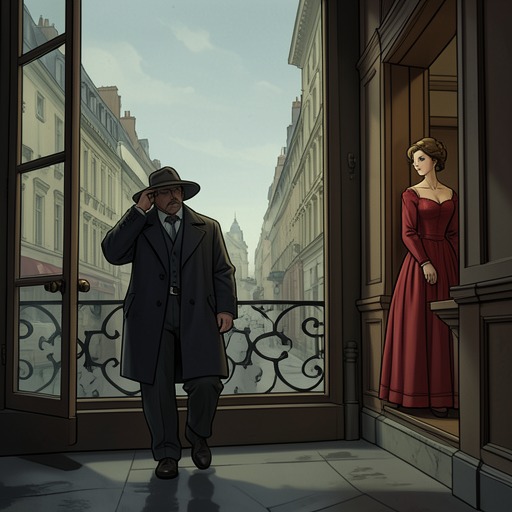
Across the square, the Bolshoi is lit from portico to pediment. The Bolsheviks mingle among its columns in the warm night air, then, as the lobby lights flicker, take their companions by the elbow and put out their cigarettes. Just as the last attendees are disappearing inside, a taxi draws up and a woman in red rushes up the steps, gathering her dress hem in her hands. Nina cups her palms against the glass and squints. She wishes the positions were reversed: that she were at the theatre and the woman were watching from the hotel. The scene turns the window into a boundary between witness and participant. Nina can see the woman’s urgent entrance in detail, but can only imagine occupying her place.
A View from the Roof
The Bolshoi remains a point of orientation beyond the Count’s rooms. On the Metropol roof, an old handyman has made a camp between two chimneys, with a three-legged stool, a brazier, and a steaming coffeepot. He has chosen a sheltered place that still affords a view of the theatre, though crates stacked at the roof’s edge partly obstruct it. In the predawn light, the Count notices activity above the crates and learns that the movement is a swarm of bees.
The roof scene places the theatre’s public spectacle beside the quiet work of the rooftop apiary. The Bolshoi is still visible, but it no longer commands an unobstructed frame: crates and bees occupy the same field of view. This recurring prospect gives the novel a way to hold different kinds of life in one urban landscape. From below, the theatre offers remembered performances and arriving crowds; from above, it becomes a familiar landmark alongside a makeshift camp and a colony at work. Its significance lies partly in this persistence: the Count’s circumstances change, but the Bolshoi remains across the square, available to memory and to anyone who finds a place from which to look.