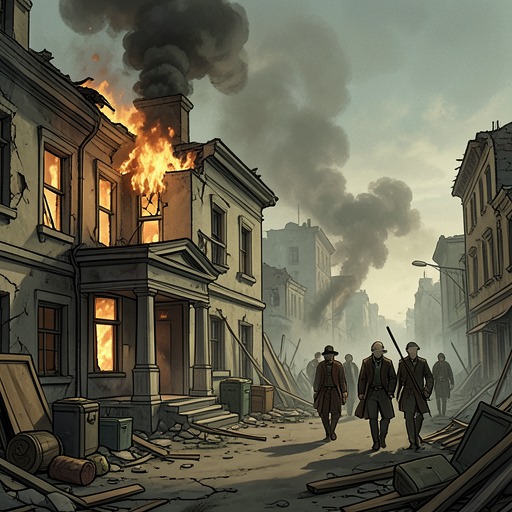
Burning of Moscow in 1812
A Gentleman in MoscowThe Burning of Moscow in 1812 is presented as more than a military catastrophe: Mishka describes it as a vivid instance of Russians destroying what they have made. Recalled in conversation with Count Alexander Ilyich Rostov, the fire becomes both a dramatic episode in the encounter with Napoleon and an argument about a recurring pattern in Russian history.
Background and Recollection
Mishka introduces the fire as a fifth contribution to a discussion of Russia’s history. He tells Count Alexander Ilyich Rostov that he had thought of it one night some years earlier, framing the historical episode as part of a personal conversation rather than as a detached chronicle. The Count is taken aback and asks whether Mishka means the events of 1812; Mishka confirms that he does.
The City Set Ablaze
Mishka asks the Count to imagine Napoleon being roused at two in the morning and stepping from his newly made bedroom in the Kremlin. Napoleon had claimed Moscow only hours before, yet the city had been set on fire by its own citizens. The contrast is central to the account: possession of the city has just been asserted, but the city itself is already being destroyed.
Mishka’s Interpretation
Mishka calls the burning especially Russian, not because it stands alone, but because it exemplifies what he calls a form of event. In his interpretation, it is one instance drawn from a much longer history in which Russians have proved unusually capable of destroying what they have created. The claim turns the fire from a single episode into a lens through which he reads a broader national pattern; the passage offers that interpretation as Mishka’s, rather than establishing it as an independent historical conclusion.
Narrative Significance
The scene’s force comes from the collision of triumph and ruin: Napoleon has claimed the city, but its citizens’ act of destruction makes that claim precarious. Mishka’s quiet laugh as he imagines Napoleon’s expression gives the recollection a wry edge, while his distinction between a discrete event and a recurring form makes the fire serve as a compact argument about Russia’s history. The Count’s surprise marks the moment when the conversation shifts from an individual historical episode to Mishka’s larger interpretation of national self-destruction.