Commissioning of the Obninsk Nuclear Power Plant
A Gentleman in MoscowThe Commissioning of the Obninsk Nuclear Power Plant is presented as both an industrial milestone and a carefully staged spectacle: at a state dinner, officials watch Moscow’s lights go dark and return as the new plant begins supplying the capital. The ceremony makes technological progress visible across the city, but its dramatic blackout also brings the achievement down to domestic scale, registering in stopped clocks, silent radios, frightened children, and a typist’s accidental mistake.
Announcement and inauguration
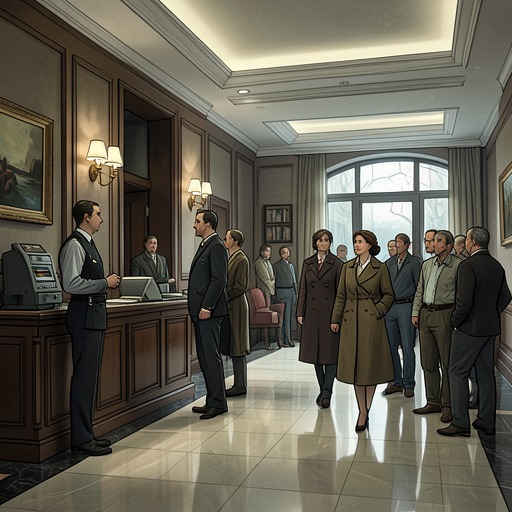
Three and a half years after construction began, Minister Malyshev announces that the Obninsk facility became fully operational on Monday afternoon, six months ahead of schedule. He delivers the news at the Metropol Hotel, addressing the assembled state officials after Nikita Khrushchev has invited them to the windows overlooking Theatre Square. The plant’s readiness is thus announced not at its site but before an audience gathered in the capital, with the city itself soon to serve as the demonstration’s backdrop.
Malyshev adds that the plant will begin providing power to half of Moscow at precisely eleven o’clock that night, less than two minutes away. The announcement gives the gathering a deadline and turns a technical change into a watched event. As Malyshev faces the windows, Count Alexander Ilyich Rostov and Martyn quietly extinguish the candles on the table. Inside, the room’s light is deliberately removed just as the city outside is about to become the focus of attention.
The blackout and return of light
At first, Moscow appears unchanged. Its lights continue to glimmer in their familiar fashion while the officials wait, shift on their feet, and exchange remarks. Then an entire neighborhood, ten blocks square in the far northwest, goes dark at once. The blackout spreads into an adjacent quarter and moves across the city like a shadow over a plain. At roughly 11:02, the Kremlin’s normally illuminated windows go black; a few seconds later, the Metropol Hotel is dark as well.
The darkness changes the mood in the room. Mutters of expectation become louder and take on a note of surprise and consternation. Malyshev, however, neither speaks nor moves; his silhouette remains fixed at the window. The lights then begin returning from the northwest, with illumination travelling back across Moscow. The Kremlin windows flash on, followed by the chandelier above the dinner. The gathered officials applaud. The sequence makes the power transfer legible as a citywide movement from darkness to light, and the electricity from what the narration identifies as the world’s first nuclear power plant seems to make the city’s lights burn brighter.
Political spectacle and civic cost
The dinner’s finale is described as an exceptional piece of political theater: the officials’ attention, Malyshev’s stillness, the extinguished candles, and the advancing darkness combine to make the plant’s operation a public performance for the assembled leadership. Yet the account immediately turns from the audience inside the hotel to citizens outside it. It asks whether anyone was inconvenienced when the lights went out, puncturing the triumphal scene with the practical consequences that the ceremony’s staging leaves beyond the windows.
In 1954, Moscow was not yet a capital filled with electrical appliances, but the brief outage still stops at least 300,000 clocks, silences 40,000 radios, and darkens 5,000 televisions. The interruption is also rendered through the small mishaps of ordinary life: dogs howl, cats meow, standing lamps topple, children cry, and parents bang their shins against coffee tables. Drivers who look up through their windshields at the abruptly dark buildings collide with the cars ahead. These details give the blackout a human scale that the officials’ applause cannot contain; the same coordinated switching that creates a magnificent view from the hotel unsettles homes and streets across the city.
The report that goes wrong
The outage reaches beyond household inconvenience. In a small gray building on Dzerzhinsky Street, a typist tasked with recording waitresses’ eavesdroppings continues working through the loss of light. His practiced ability to type without seeing the keys initially keeps the report moving. But when someone stumbles in the hallway and startles him into looking up, his fingers shift one column to the right. The second half of his report becomes either unintelligible or, depending on how it is read, a code.
The episode supplies an unintended coda to the official demonstration. The plant’s new power briefly extinguishes the city’s visible lights, but the typist’s work continues until darkness and a sudden noise disrupt its routine. A ceremony designed to present technological control therefore produces an error inside the machinery of surveillance as well as inconvenience in private life. The lights return, and the officials applaud; the report, however, remains compromised in a way that the staged finale does not resolve.