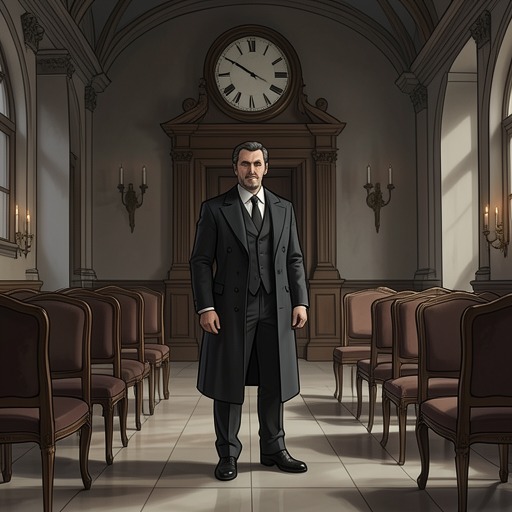
Count Rostov returns to Russia and chooses to remain
A Gentleman in MoscowCount Rostov returns to Russia shortly after the Revolution and chooses to remain, a decision he later explains not as an endorsement of the new order but as a personal limit on violence. In conversation, he recalls leaving for Paris in 1914, returning home after the Revolution, and refusing to take up arms against the Bolsheviks. The account turns on a striking contrast: he had shot Lieutenant Pulonov because Pulonov was an aristocrat, yet he would not shoot Bolsheviks because, whatever their politics, they were his countrymen.
Departure and Return
A colonel reconstructs the sequence by asking Count Rostov about his last departure from the country. The Count had gone to France in 1914, leaving on May 16, only a few days after the incident with Lieutenant Pulonov. The date places the departure close to the shooting, making the earlier violence part of the immediate context for the Count’s life abroad rather than a remote episode.
The conversation then moves from departure to return. The colonel observes that Count Rostov was in Paris at the time of the Revolution and made his way home shortly afterward; the Count confirms the sequence. The return is therefore presented as a deliberate reversal of his earlier journey away from Russia. The exchange gives no account of the route or practical circumstances of that homecoming, but it establishes its timing and that the Count came back after the political upheaval had begun.
The Question of Why He Stayed
The colonel proposes that Count Rostov hurried back to help his grandmother leave the country safely, then asks why he remained after arranging her escape. That explanation belongs to the colonel’s interpretation of the Count’s actions; the exchange does not independently detail the grandmother’s departure. Asked why he stayed, the Count first answers, “For the cuisine.” The joke briefly turns a question of danger and political commitment into one of appetite, but the colonel insists on a serious answer.
Count Rostov then says that his days of leaving Russia were behind him. The statement is concise, but it distinguishes the decision to return from the decision to remain: coming home after the Revolution did not mean he intended to resume his former life elsewhere. The conversation does not specify what practical future he expected in Russia. Instead, it makes his settled refusal to leave the central fact, while leaving the reasons for that attachment partly unstated.
The Shooting and the Refusal to Fight
The colonel recalls that Lieutenant Pulonov was an aristocrat like Count Rostov and asks why the Count shot him. Count Rostov answers, “I shot him because he was an aristocrat.” The reply gives the shooting an explicitly class-based rationale. The colonel laughs, then acknowledges that the idea is one the Bolsheviks should understand. Their exchange places the Count’s aristocratic identity and the Revolution’s politics in direct contact without turning the conversation into a simple accusation or defense.
The colonel next tests whether Count Rostov’s refusal to fight arose from fear. He notes that the Count did not join the Whites, then says that the Count does not seem a coward. Count Rostov replies that he should hope not. When asked why he did not enter the fray, he pauses before giving a different kind of answer: “When I left for Paris in 1914, I swore I would never shoot another one of my countrymen.” The pause precedes a stated principle, not a claim of incapacity. His explanation connects the return to the earlier departure by making the 1914 journey the moment from which he dates his promise.
Political Belonging and the Meaning of Staying
The colonel asks whether Count Rostov counts the Bolsheviks as his countrymen. The Count answers, “Of course I do.” That answer makes the boundary of his refusal national rather than partisan: he does not claim agreement with the Bolsheviks, but he does include them within the community to which his promise applies. His decision not to fight thus follows from the principle he states, while the exchange leaves his broader political views unelaborated.
The scene also holds two explanations of violence side by side. Count Rostov says he shot Pulonov because he was an aristocrat; later, he says he will not shoot Bolsheviks because they are fellow countrymen. The contrast does not erase the earlier act or reconcile the two judgments. Instead, it reveals the terms Count Rostov gives for each: social identity in the first case, shared national belonging in the second. His return and continued presence in Russia are consequently framed less as a declaration of political allegiance than as a choice governed by attachment to the country and a refusal to kill its people.