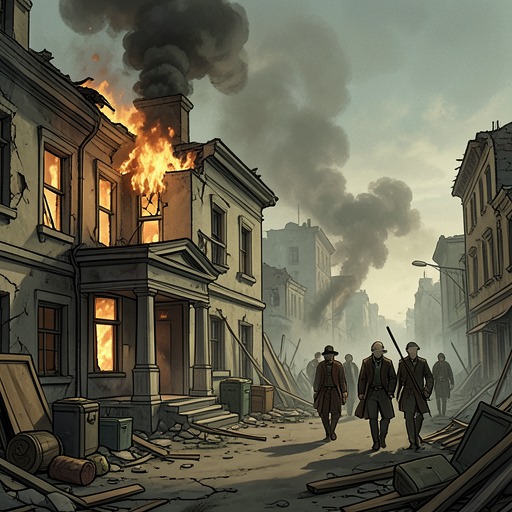
Ivanovo Province
A Gentleman in MoscowIvanovo Province is the setting for a campaign to remake rural life in the name of collective production. The region is introduced through figures that make it legible to planners—its area, population, agricultural character, machinery, and mills—then through the lived landscape Nina Kulikova encounters on arrival. Its beauty and promise stand in uneasy contrast to the coercive policies and agricultural crisis gathering around it.
Region and Agricultural Profile
A young Komsomol cadre describes Ivanovo Province as covering more than three hundred square miles and having a population of half a million. Though largely agricultural, it has only eight machine tractor stations and six modern mills. The numbers present a place whose rural production is expected to support national ambitions despite limited infrastructure.
The Kady District, an ancient agricultural center in the heart of the province, becomes the immediate destination of the collectivization effort. The narrative gives the region both administrative scale and physical presence: after Nina’s train reaches its far reaches, she sees young wheat bending in the breeze across the fields. The landscape overwhelms her with its beauty and the sense that her life has just begun.
The Collectivization Campaign
Nina and three companions leave with ten other local Komsomol cadres to assist the shock workers in collectivizing the district. Their assignment is part of a rapid transformation: at the end of 1928, only 10 percent of Ivanovo’s farms operated as collectives; by the end of 1931, nearly all would. The contrast between those dates conveys the campaign’s extraordinary speed.
The effort is framed as necessary to the First Five-Year Plan. Urban centers are building power stations, steel mills, and heavy-machinery plants, while grain-producing regions are expected to increase output and supply more bread to the cities. Nina presents collectivization as an historical necessity, arguing that land should serve the common good rather than the interests of the kulaks. Her precise, fervent language reflects the seriousness with which she approaches the ideological work, as well as the commitment she previously brought to mathematics.
Material Strain and Consequences
The campaign’s promised modernization collides with the circumstances of farming. A million kulaks are exiled to clear the way for the new system, although they are also described as the regions’ most capable farmers. Peasants who remain view new agricultural methods with resentment and suspicion and resist even small innovations. Tractors, intended to lead the change, are in short supply; unfavorable weather compounds these problems and contributes to collapsing agricultural output.
Despite the falling harvest, the need to feed the cities brings increased quotas and requisitions enforced at gunpoint. The account connects these decisions to widespread hardship in the agricultural provinces of old Russia and to the deaths by starvation of millions of peasants in Ukraine in 1932. Ivanovo’s collectivization is therefore situated within a national drive whose demands for production outstrip the available machinery, agricultural cooperation, and harvest.
Nina’s Departure and the Province’s Significance
Nina’s journey east gives the provincial campaign a personal point of entry. In Moscow, she is among cadres preparing to work in a region she understands as a serious political undertaking; on arrival, she is struck by the fields and feels that her own life is beginning. The narrative preserves both responses rather than allowing the later catastrophe to erase the initial force of her hope.
Ivanovo Province thus appears as more than a destination on a train route. Its agricultural land is made the object of a national plan, its farms rapidly reorganized, and its harvests burdened with demands intended to sustain industrial growth. The distance between the campaign’s confident language and the shortages, resistance, and coercion on the ground gives the setting its central tension.