Marina Samarova
A Gentleman in MoscowMarina Samarova is a seamstress and friend of Count Alexander Ilyich Rostov who becomes important to Sofia at two consequential moments: during her recovery, when Marina agrees to stay with her, and in the preparations for her concert, when Marina designs and makes her dress. Her actions show care not as an abstraction but as something organized through presence and skilled work. When the Count’s criticism threatens to overshadow that work, Marina answers with the certainty of an artist defending what she has made.
Identity and Place in the Story
Marina Samarova enters the recovery scene as a middle-aged woman who appears bewildered and frightened. A uniformed matron accompanies her, and she first looks anxiously toward Osip, whom she has never met. Then she sees Count Alexander Ilyich Rostov sitting nearby and runs to him. The quick change in her attention gives the scene its emotional outline: Osip is a stranger, while the Count is someone whose presence she recognizes and trusts.
Osip introduces her as Comrade Samarova and explains that he and Count Alexander Ilyich Rostov are friends. The Count must return to The Metropol, he says, and asks Marina to remain with Sofia until she is well enough to go home. Marina does not wait for the Count to finish making his appeal. She tells him, “Not another word, Alexander. Of course I will stay.” Her response establishes both her familiarity with him and her willingness to take on the practical responsibility he cannot fulfill himself.
Care for Sofia
Marina’s agreement changes the immediate circumstances for both Sofia and the Count. He has just said that he cannot leave Sofia; Osip’s arrangement offers a substitute presence, and Marina makes that arrangement dependable by accepting without qualification. Her care allows the Count to return to the hotel while Sofia continues to have someone with her through her recovery. The scene makes her loyalty concrete: she arrives at a vulnerable moment, recognizes the person she knows, and steps into the work that needs doing.
The manner of her acceptance matters as well. The Count begins to explain the difficulty of his request, but Marina cuts him off before he can finish. The interruption is not presented as a negotiation over whether she will help; she has already decided. Her directness contrasts with the careful appeal and introduction around her, and gives the decision its force. Marina’s friendship is expressed through action rather than an extended declaration: she stays because the Count asks and Sofia needs her.
The Concert Dress
Marina’s other substantial appearance centers on her craft. In late January, the Count commissions her to make a new dress for Sofia’s concert. The design meeting includes Marina, Anna Urbanova, and Sofia, but not the Count; the narration notes his bewilderment at being excluded. The arrangement places Marina among the people shaping Sofia’s presentation, while the Count, despite his investment in the concert, is kept outside this particular act of creation. At his request, Vasily goes to TsUM to buy a bolt of blue taffeta for the garment.
The dress later becomes the subject of a disagreement. Looking at Sofia in it, Count Alexander Ilyich Rostov calls it a dressless dress and suggests it must have come from one of the convenient magazines. Before Anna can answer, Marina stamps her foot and claims responsibility: it is her design, made by her hand for Sofia. Her response is immediate and physical before it is verbal. The stomp interrupts the Count’s judgment and makes clear that his remark has not merely evaluated an outfit; it has misidentified its author and dismissed the work behind it.
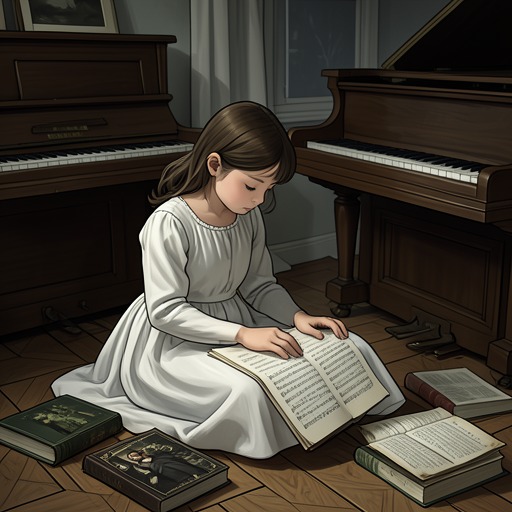
The Count sees Marina’s anger in her expression: one eye rolls upward in exasperation while the other fixes on him. Recognizing that he may have insulted an artist, he changes his tone and praises the dress. His concern, however, remains that its open back might draw the audience’s attention away from Sofia’s performance of Rachmaninov at the Palais Garnier. The exchange therefore leaves two concerns in view: Marina’s right to have her handiwork taken seriously, and the Count’s wish for the music, rather than the dress, to command attention. The evidence does not resolve the disagreement; it records Marina’s authorship and the Count’s attempt to repair his criticism.
Character and Narrative Significance
Marina is drawn through a small number of decisive acts rather than a narrated biography. The account gives no extended history of her life, but it makes her role legible through two forms of labor: staying with Sofia during recovery and making a dress for her concert. Both are acts of care, yet neither is passive. In the first, Marina takes responsibility without waiting for persuasion; in the second, she openly defends the artistic work that care has produced.
Her presence also marks a limit to the Count’s authority within Sofia’s preparations. He has arranged the dress and supplied the fabric, but he was excluded from the design meeting, and Marina—not the Count—claims the finished garment as her creation. When he judges it, she does not let his status or concern for the performance erase that fact. Marina’s brief confrontation makes the scene a portrait of practical loyalty and artistic self-respect: she helps Sofia, but she also insists that her own contribution be seen accurately.