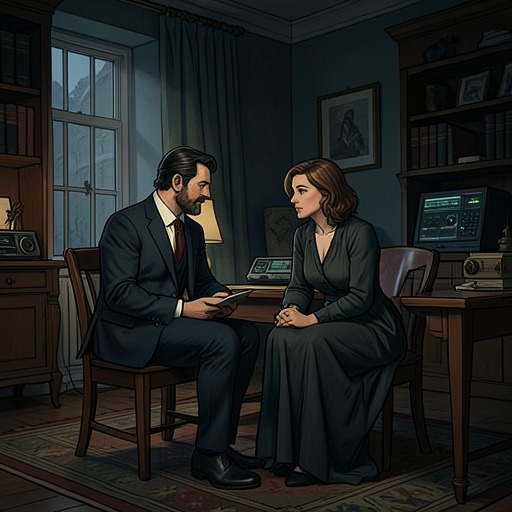
Mastering one's circumstances
A Gentleman in MoscowMastering one's circumstances is the governing principle of Count Alexander Ilyich Rostov’s life under constraint: not the power to control events, but the discipline to meet them without surrendering to them. Passed to him by Grand Duke Demidov in childhood, the principle returns in his adaptation to confinement, his acceptance of social change, his advice to Sofia, and his recovery from a dangerous mistake. Its measure is practical: a life may narrow, but attention and action can still give it shape.
Origins and meaning
The principle begins as counsel in a family crisis. In 1900, when Rostov’s parents died of cholera within hours of each other, Grand Duke Demidov took the young count aside and told him he must be strong for his sister. Adversity, the Grand Duke explained, could present itself in many forms; if a man did not master his circumstances, he would be mastered by them. The lesson joins self-command to responsibility: endurance is not merely a private virtue but a way of remaining capable of caring for another person.
The inherited desk in Rostov’s room gives the teaching a physical history. Built in the Paris of Louis XVI, with gilded accents and a leather top, it had been left to Rostov by his godfather. Demidov was a multilingual, widely read representative of his country at the Treaty of Portsmouth, an estate manager who prized industry, and a former cavalry cadet who had served alongside Rostov’s father. The desk’s dimpled surface held the traces of more than forty years of concise instructions to caretakers, arguments to statesmen, and counsel to friends. Rostov’s hand passing over those indentations makes the object a record of the very practice the Grand Duke had taught: thought converted into useful action.
Confinement made practical
When Rostov considers how to endure a life of confinement, he weighs familiar heroic models and finds that none fits him. Revenge, epic ambition, and dreams of restored empire are not his means of survival. Instead, he chooses the example of an Anglican cast ashore: the castaway who sets aside fantasies of immediate rescue and attends to shelter, fresh water, fire, the island’s terrain, and signs of possible return. The analogy makes mastery modest and sequential. It begins with what can be done now, without requiring certainty about what will happen later.
Rostov turns that idea into concrete requests. He gives an old Greek three notes to deliver; within hours, one messenger brings fine linens and a suitable pillow from Muir & Mirrielees, another brings four bars of his favorite soap from Petrovsky Passage, and a light blue box containing a single mille-feuille arrives from a third respondent. These small provisions do not undo the sentence of confinement. They establish comfort and continuity within it. The castaway’s attention to necessities becomes, in Rostov’s hands, a method for organizing the life still available to him.
The principle also changes the meaning of time. Rostov’s confinement is not made bearable by an assurance that it will soon end; rather, he gives it tasks and expectations. The arrival of the requested objects, and the anticipated appointment marked by the chime of twelve, create a rhythm within restrictions he cannot remove. Practical preparation does not erase longing. It gives longing something to wait upon.
Changing with the times
Mastery, for Rostov, does not mean defending every inherited custom. When a hotel manager explains that he must tell his staff to stop using certain terms of address, the hesitation in his account suggests pressure from the new order, though its precise cause is left unstated. Rostov answers, “It is the business of the times to change, Mr. Halecki. And it is the business of gentlemen to change with them.” The manager responds with profound gratitude, as if Rostov has supplied the understanding he could not quite articulate himself.
The scene’s argument is made visible in the objects around them. Rostov studies engravings of a foxhunt: a brass horn, dressed hunters, purebred horses, and trained dogs arranged in the service of cornering a fox. Their beauty and craftsmanship do not, in his judgment, make them essential to the modern world. He generalizes from the prints to silver summoners, mother-of-pearl opera glasses, and other carefully made objects that have outlived their usefulness. Change is relentless, but adaptation need not mean contempt for the past: Rostov recognizes the objects’ craft even as he questions their present purpose. To master circumstances is to distinguish what can still serve from what survives only as ceremony.
Advice, error, and renewed action
Rostov later gives Sofia two pieces of parental advice. One is the old injunction to master one’s circumstances; the other is Montaigne’s maxim that the surest sign of wisdom is constant cheerfulness. Yet he does not reduce his farewell to instruction. He tells Sofia exactly how sad he will be in her absence and how joyful even the thought of her adventure will make him. He has deliberately offered practical advice and admitted his heartache the night before her journey, so that the dinner before she leaves can be filled with lighthearted family stories rather than burdensome counsel or tears. Mastery here includes restraint: choosing when to speak seriously, and when to let shared memories offer comfort.
The principle is tested when the Bishop discovers that a map connected to Sofia’s escape has been left in Rostov’s drawer. Rostov recognizes the consequences at once: six months of careful planning may be undone by a single misstep, and Sofia may pay for his carelessness. Fury, disbelief, self-recrimination, and fear freeze him—but only for five seconds. Resolve displaces them. He follows the Bishop down from the belfry, takes the main staircase, and uses Nina’s passkey to enter the locked office. The scene does not present mastery as freedom from fear or error. It is the decision to act after both have arrived.
Rostov’s planning for Sofia’s escape provides a final, precise instance of the principle. His route from the Salle Pleyel toward the American Embassy in Paris is not the most direct: instead of sending her ten blocks straight along the Rue du Faubourg Saint-Honoré, he has marked a zigzagging course past the Avenue Hoche and the Arc de Triomphe toward the Place de la Concorde. The detour is meant to get her away from the concert hall quickly and let her disappear into the anonymity of the Champs-Élysées, while still giving her time to reach the embassy before her absence is discovered. His plan accounts for movement, visibility, and time; Sofia’s experience of seeing the city at night nevertheless exceeds its calculations. Mastering circumstances can prepare a path, but it cannot dictate what that path will mean to another person.
Significance
Across these episodes, the principle moves from inheritance to practice and then to a more modest, humane form of guidance. It does not promise Rostov victory over political upheaval, confinement, or risk. Instead, it asks him to recognize what has changed, preserve what remains useful, and take the next workable step. The desk’s accumulated marks, the pillow and soap ordered for a restricted life, the obsolete hunting horn, the five seconds before resolve, and the deliberately indirect escape route all give the abstract maxim material form. Its force lies not in mastering the world once and for all, but in refusing to let circumstance dictate every action that follows.