Mikhail Mindich's Death
A Gentleman in MoscowMikhail Mindich’s death is disclosed not through an account of his final hours but through the woman who had been with him during the last six months of his life. Katerina Litvinova comes to tell Count Alexander Ilyich Rostov in person, one week after Mikhail’s death, and to fulfill his request that she bring the Count something. The news ends the Count’s connection to everyone who had known him as a younger man; what remains is a book, an old photograph, and the obligation to remember.
The news and its silences
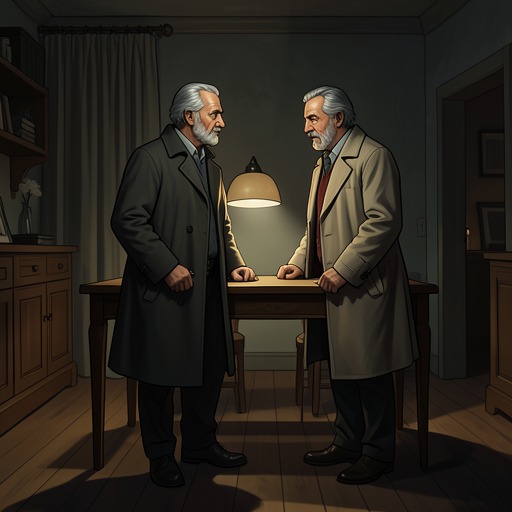
The meeting begins with a small gesture of hospitality: the Count offers Katerina a chair. She sits with her satchel in her lap, then removes her kerchief to reveal light brown hair cut as short as a man’s. After a moment, the Count recognizes her and asks whether Mikhail is dead. Katerina confirms it. When he asks when, she answers that it was a week ago that day.
The exchange is remarkably spare. The Count does not ask how Mikhail died, and Katerina does not volunteer an explanation. The narration says it was plain that Mikhail had been betrayed by his times, but it gives no specific cause or circumstances of death. That distinction matters: the loss is certain, while its particulars remain unspoken. The Count’s quiet acceptance suggests that he had expected the news for some time, though the scene does not explain what had led him to expect it.
When he asks whether Katerina was with Mikhail, she first answers a question about children curtly, then softens and explains that she received word from Mikhail in January, went to him in Yavas, and had been with him for the last six months. She adds that he spoke of the Count often. Her account places the death within a continuing relationship rather than presenting Mikhail as wholly alone, but leaves their final days undescribed.
A request carried to the Count
Katerina’s visit is not only a notification. When the Count expresses gratitude for her coming, she dismisses the thanks and explains that she came at Mikhail’s request. From her satchel she takes a rectangular parcel wrapped in plain brown paper and tied with twine. The Count can tell from its weight that it is a book.
The package turns Mikhail’s last known intention into an action completed after his death. Katerina has crossed the distance to the Count because Mikhail asked her to bring him something; the object reaches its recipient through her, rather than through a letter or an account of what Mikhail meant by it. The scene does not state exactly when or how he made the request. Its force lies instead in the fact that he had thought of the Count and arranged for a final communication between them.
Before leaving, Katerina responds to the Count’s offer with a brief instruction: “Remember him.” She then goes out. The words make remembrance the encounter’s explicit obligation, but the object she has delivered gives that obligation a material form. The Count returns to his chair and, after sitting in silence for several minutes, unties the parcel.
The book and the shared past
Inside is a small leather-bound volume titled Bread and Salt. Its simple geometric tooling and roughly cut pages, with loose threads at the binding, show that it was made by a dedicated amateur. The book is not merely a possession handed over after Mikhail’s death: its handmade construction carries the evidence of sustained labor, and the Count recognizes in its pages the characteristic feistiness of Mikhail’s project.
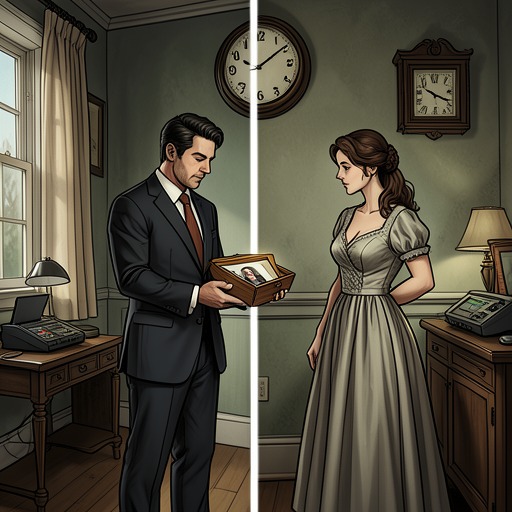
Tucked into the seam of the title page is a photograph taken in 1912 at the Count’s insistence, much to Mikhail’s chagrin. The young Count stands on the left in a top hat, with an evident glint in his eye and a moustache extending beyond his cheeks; Mikhail stands beside him, looking as if he is about to sprint out of the frame. Mikhail had kept the picture all these years. The old image makes their shared youth visible at the moment the Count learns that its last surviving witness has died. The photograph’s preservation also complicates the old irritation surrounding its taking: what Mikhail once resented became something he retained.
As the Count reads, the book’s citations connect Mikhail’s work to other texts and to a specific memory of vulnerability. After a passage from “The Grand Inquisitor,” the book cites The Brothers Karamazov and the story of Ilyushechka, the boy hounded by schoolmates who falls gravely ill. A request associated with the boy’s death—that bread be crumbled on his grave so sparrows will come—leads the Count to break down and weep. The book does not simply preserve Mikhail’s thoughts; through its citations, it brings the Count to a passage in which the dead are not to be left alone.
Grief, memory, and the final pages
The Count weeps for Mikhail, whom he remembers as generous yet temperamental, and as someone who had only briefly found his moment in time. He also weeps for himself. Despite his friendships with Marina, Andrey, and Emile, his love for Anna, and the extraordinary blessing of Sofia, Mikhail’s death means that the last person who knew him as a younger man is gone. Katerina’s instruction to remember Mikhail therefore carries a double weight: the Count can preserve his friend in memory, but he can no longer share that memory with another person who lived the same earlier years.
After taking a deep breath, the Count tries to compose himself and continues reading the final pages of Mikhail’s final discourse. Its citations span more than two thousand years but stop in June 1904, with sentences cut from a letter by Anton Chekhov. In that passage, Chekhov describes enjoying bread while traveling in Berlin. The Count supposes that, given the hardships of the 1930s, a censor such as Shalamov or his superiors might have removed the lines on the assumption that they could provoke discontent. Yet the censorship has produced an irony: Chekhov’s observation is no longer accurate, because the Russian people now know better than anyone in Europe how good a piece of bread can be.
The book’s endpoint makes Mikhail’s death resonate beyond private mourning without supplying a cause for it. A work assembled from citations ends on a passage that has itself been cut; its final subject is bread, a basic measure of pleasure made newly charged by deprivation and censorship. The Count encounters both the friend’s intellectual temperament and the history that has narrowed the conditions in which his words can be read. Mikhail is gone, but his book reaches the Count, and the act of reading becomes the form their friendship can still take.