Montaigne’s Essays
A Gentleman in MoscowMontaigne’s Essays is the book Count Alexander Ilyich Rostov has long meant to read but repeatedly postponed. When he finally takes it up in the reduced quarters of his room, the volume becomes more than a piece of inherited property: it gives shape to an unexpected interval of solitude, tests his discipline against the distractions of daily life, and even finds an unintended use as part of the room’s furniture.
An inherited book, long deferred
The volume is the one book Count Alexander Ilyich Rostov retains from his father’s collection when he moves most of his belongings down the hall. His father had held it dear, and Rostov has promised himself for roughly a decade that he would devote a month to reading it. Each time he marked out such a month, however, life intervened: romantic interest arrived, a banker called, or a circus came to town. The list is lightly comic, but its pattern matters. The book’s delay does not arise from any stated rejection of its contents; rather, it stands for an intention repeatedly displaced by the claims and diversions of ordinary life.
That history gives the act of opening the volume a particular weight. Rostov finds that circumstance has at last supplied what earlier plans could not: time and solitude. The book’s arrival in his hands is therefore a reversal of the distractions that had kept it waiting. He has not simply chosen another pastime; he is attempting to make good on a promise whose fulfilment has been deferred for years.
A book fitted to the room
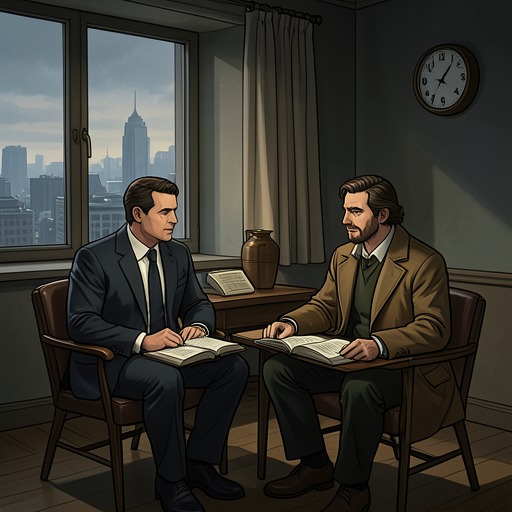
The setting of the reading underscores that change. Rostov has pared his room down to a desk and chair, a bed and bedside table, a high-backed guest chair, and a ten-foot passage for walking. His furniture and almost all of his father’s books have gone down the hall; this single volume remains. In a room deliberately reduced to essentials, the book occupies an unusually prominent place, both as the object he has preserved and as the work to which he now turns.
The physical arrangement is also comic. Rostov balances his chair on its two rear legs, one foot resting on the corner of a three-legged bureau, and begins to read. The habit of tilting back in a chair reaches further into his past: at Idlehour Estate, he read aloud from Pushkin while Helena Rostov embroidered. On those spring afternoons, he balanced his chair with a foot against a fountain or an elm, while Helena’s needle moved stitch by stitch. The remembered posture connects the solitary reading in his room to an earlier, shared practice of reading aloud, without making the present scene a repetition of it.
When Mikhail Fyodorovich (Mishka) later notices the volume beside the three-legged bureau, his remark that the Essays do not seem to have agreed with Rostov receives a deliberately practical answer: Rostov says they were the perfect height. The joke turns the book from an object of study into a makeshift prop. It also leaves the two uses side by side: the work is still being read, but its usefulness can be measured, with Rostov’s characteristic wit, by how well it supports a piece of furniture.
The work and the effort to read it
Rostov’s first encounter with the book’s scale gives his undertaking a daunting dimension. As a single volume, it has the density of a dictionary or Bible, and its contents list 107 essays on subjects including constancy, moderation, solitude, and sleep. He judges it a book for winter: for evenings when the birds have flown south, the wood is stacked, the fields are snow-covered, and neither reader nor friends are inclined to venture out. The comparison is his practical estimate of the attention the book demands, not evidence that he has abandoned it. He starts instead with the first essay, By Diverse Means We Arrive at the Same End.
That opening meditation concerns how a person who is at another’s mercy may move an adversary through submission and an appeal to pity, while also considering audacity and steadfastness as contrary means that can sometimes reach the same end. Rostov understands its argument as recommending a plea for life when one is at another’s mercy. The subject gives his reading a pointed emphasis: the book’s first question is how a person behaves when power lies elsewhere. Yet the scene does not turn that observation into a simple lesson about Rostov; it presents him trying to read the argument attentively, amid the ordinary interruptions of his own mind.
The struggle becomes visible on the following day. Rostov takes up the book shortly after ten, but every fifteenth line his gaze drifts toward the clock. The volume that had seemed suited to long winter nights proves difficult to attend to even within the quiet he had wanted. He tries to steady himself by treating the first meditation like a journey whose departure time should be recorded, then presses on through its waves of historical examples. The metaphor of travel makes persistence concrete: progress in the book has to be undertaken, not merely intended.
Distraction, progress, and comic reversal
Rostov’s effort to control his attention takes a more literal form when he shifts his chair left to put the clock out of view. Even then, he cannot readily recover his place. He thinks the passage lies in the fifth paragraph of the fifteenth page, but finds that paragraph and the ones before it unfamiliar; he has to turn back three pages before locating words he remembers well enough to resume. His complaint to Montaigne about moving one step forward and two steps back turns a lapse of concentration into a contest over who is mastering whom.
He answers the setback with a vow not to look up again until he reaches the twenty-fifth essay. The resolve briefly produces momentum: he gets through essays four, five, and six, then essays seven and eight with greater speed. The ambitious target is still ahead, but progress is no longer only a plan. The sequence holds the book’s role in miniature: it offers Rostov a field on which he can practise discipline, while the clock, his uncertain place on the page, and the sheer extent of the collection keep that discipline from becoming effortless.
Across these episodes, Montaigne’s Essays carries several meanings without settling into just one. It is a cherished remnant of Rostov’s father, a promise delayed by the diversions of life, a demanding work of 107 meditations, and an object that can literally fit beneath a raised foot. The contrast is central to its narrative use: Rostov treats reading as a serious undertaking, yet the book enters his life through bodily habits, interruptions, jokes, and adjustments to the room. Its importance is shown not by an easy mastery of its contents, but by the renewed effort to return to the page.