Moscow
A Gentleman in MoscowMoscow is presented as both a physical city and a system of shared experience: a place of fashionable streets, public spectacle, crowded homes, and queues that seem to stretch beyond any single destination. Its landmarks register political and historical change, but everyday life supplies the more intimate measure of that change. In the city, new displays and transport promise access and improvement, while scarcity and waiting persist; after the war, the old streets and monuments frame a rueful vision of endurance.
Streets, shops, and changing access
The city’s material transformation is visible in a scene on Kuznetsky Most. Two young women walk in brightly colored, fitted dresses, one wearing a yellow hat, as the rumble of the new Metro carries beneath them. They stop before TsUM, the Central Universal Department Store, whose windows display pyramids of hats, watches, and high-heeled shoes. The carefully arranged goods make the street a theatre of modernity: objects once reserved for a privileged clientele now appear before ordinary passersby.
That apparent opening has limits. The women still live in crowded apartments and wash their dresses in a common sink. TsUM had served foreigners and senior Party officials before opening to the citizenry in 1936, but entry into its new public life depends on payment in foreign currency, silver, or gold. On the lower level, a discreet office offers store credit for half the value of a grandmother’s jewelry. The scene sets the promise of access against the price of access: the department store’s windows are open to view, while the means to buy what they display remain sharply constrained.
The contrast gives the narrator’s account of improving life its characteristic irony. Fashion, consumer goods, and the new Metro offer visible signs of change, but they sit beside domestic crowding and the conversion of family valuables into purchasing power. Moscow’s modern surface is real, yet it does not erase the conditions beneath it.
The city as a network of queues
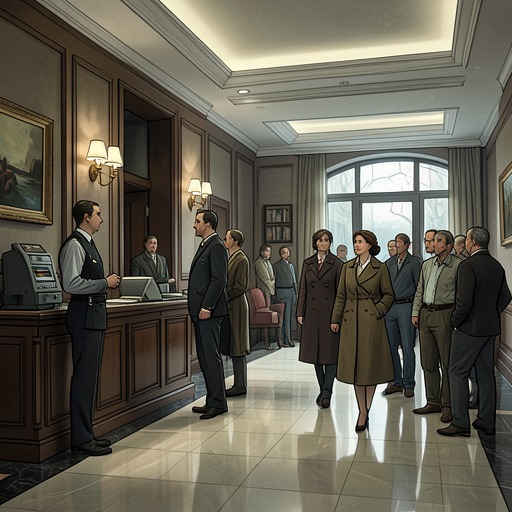
In the 1946 episode, Red Square is crowded with visitors and ordinary city life gathers around its monumental center. A line of 150 people leads from the entrance of Lenin’s tomb. The lone man who has entered the square pauses to admire the orderly waiting: Uzbeks in silk coats stand at the front, followed by girls from the east in embroidered caps, then Georgian peasants. The queue gathers people from different regions into a single, patient arrangement.
The account then expands the image beyond the square. Tram stops, grocers, and agencies for labor, education, and housing all have lines, but the narrator recasts these as parts of one all-encompassing line, extending across the country and through time. In that account, waiting is not merely an inconvenience attached to a particular service. It becomes a common social condition in which friendships and romances form, patience is learned, civility is practiced, and even wisdom may be acquired. The city’s routines thus carry both hardship and a kind of social order.
The man’s reflection connects this system of waiting to the crowd at Lenin’s tomb: after enduring long hours to buy bread, he considers an hour or two in line to see a national hero’s remains a modest price. The comparison makes reverence and necessity part of the same urban habit. Moscow’s queues do not only obstruct movement; in the narrator’s telling, they shape how its people encounter one another and their history.
Red Square and the remembered city
The 1946 walk gives Moscow a precise geography. On Saturday, June 21, a lone figure climbs from the Moskva River embankment, passes St. Basil’s Cathedral, and enters Red Square. His ragged winter coat and hobbling walk might once have made him conspicuous in summer, but the narration places him among the many men across the capital and Europe still limping in borrowed clothes. The city’s postwar appearance is therefore measured not only through buildings, but through the damaged bodies moving among them.
The square is busy with women in floral dresses, schoolboys climbing on two decommissioned tanks, and soldiers stationed before the gates of the Kremlin. The crowd at the tomb forms another part of this public scene, while the disabled tanks and the visitors’ ordinary clothes bring the consequences of war into the same frame. The city is neither presented as untouched nor reduced to ruin: everyday gathering continues amid visible remnants of conflict.
After leaving the square, the figure passes the site where Kazan Cathedral once stood and turns into Theatre Square. His gaze moves from the Palace of Unions to the Bolshoi Theatre, the Maly Theatre, and finally the Metropol Hotel. He marvels that so many old facades remain unspoiled. The route makes architectural survival a form of remembered continuity, but the absent cathedral prevents that continuity from seeming complete. Moscow is a city where the old can endure beside what has vanished.
Narrative significance
Across these scenes, Moscow is made legible through contrasts rather than a single image. Kuznetsky Most displays novelty and consumer aspiration, but crowded housing and the exchange of heirlooms qualify the promise of prosperity. Red Square gathers citizens into an orderly public ritual, while the wider network of queues makes waiting an ordinary condition of life. Theatre Square preserves familiar facades, even as the missing cathedral marks a break in the city’s past.
The movement between street-level detail and sweeping historical commentary gives the city more than a setting function. Shop windows, a Metro rumble, a bread queue, decommissioned tanks, and surviving facades each show how political change enters daily experience. Moscow’s persistence lies not in remaining unchanged, but in the way its inhabitants continue to walk, wait, gather, and look at what has endured.