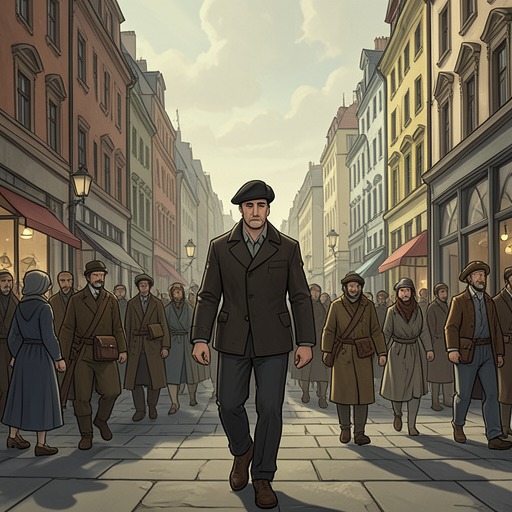
Nevsky Prospekt
A Gentleman in MoscowNevsky Prospekt is a street transformed by successive names and private memories. In the life of Mikhail Fyodorovich (Mishka), it first becomes the setting for a walk with Katerina Litvinova; years later, retracing that route at dawn, he finds the avenue still charged with the love and loss attached to it. For Count Alexander Ilyich Rostov, reading the account of that walk makes the street a passage through both Russian literary history and his friend’s unforgotten past.
Name and Setting
In the account of Mishka’s later walk, the street has acquired the official name October 25th Prospekt, commemorating a day that claims its place on a storied avenue. Yet at four in the morning, Mishka experiences it as the street he remembers. He crosses the Moika and Fontanka Canals and passes shops and the rose-hued fronts of old homes, moving through a familiar landscape that seems briefly removed from its present time.
A Route Shared with Katerina
The street’s personal history begins after the 1923 congress, when the Count recognizes Mishka’s interest in Katerina Litvinova. One autumn afternoon she comes to Mishka’s alcove in the old Imperial Library seeking a confidant. They talk there for an hour; when the closing bell sounds, they carry their conversation onto Nevsky Prospekt and wander as far as Tikhvin Cemetery. At a spot overlooking the Neva River, Katerina takes Mishka’s hand. The avenue thus becomes the approach to the moment when his admiration becomes a shared intimacy.
The Avenue as Literary Geography
Years later, Mishka’s solitary walk turns the length of Nevsky Prospekt into a passage through Russian literature. He recalls Pushkin’s house on the Moika embankment, the rooms where Gogol began Dead Souls, and the National Library where Tolstoy searched its archives. Behind the walls of Tikhvin Cemetery lie Dostoevsky and Tchaikovsky, close to one another beneath the cherry trees. The route is not simply a list of literary landmarks: it joins the street’s public cultural history to Mishka’s own remembered conversations, including late-night debates with the Count about Dostoevsky and Tchaikovsky.
Memory and Loss
The later walk follows the same route Mishka once took with Katerina, but the circumstances have changed. Four years after moving to Kyiv with her, one year after she left him for another man, and six months after his return to St. Petersburg, he finds himself on Nevsky Prospekt without having planned a destination. At sunrise, the street brings him back to the day she first took his hand. The affirmation that overwhelms him is a promise to shine everywhere and through the last days—a promise the narrative connects to what love asks of anyone who has experienced it.
When the Count reads Mishka’s letter, he understands from its opening that his friend has returned to the route of that lost romance. The street’s renamed surface cannot undo its emotional geography: Mishka will never again walk it without feeling loss. In this account, heartbreak is not proof that love was merely temporary; it is what remains to refute love’s ephemerality. Nevsky Prospekt therefore holds two histories at once: the changing public names of a city street and the private route along which an enduring attachment is remembered.