Nikita Khrushchev
A Gentleman in MoscowNikita Khrushchev emerges as a blunt, bald apparatchik whose rise after Joseph Stalin’s death helps shape a precarious new balance of Soviet power. The novel presents him both as one of several plausible successors and as a practiced political actor: at a formal dinner in the Metropol, he waits for others to settle before taking his place beside Premier Malenkov, then turns the gathering’s attention toward a major announcement.
Identity and Political Position
Khrushchev is introduced in the aftermath of Joseph Stalin’s death as one of eight men with a reasonable claim to lead the Soviet Union. The list includes senior figures from the security, armed forces, foreign trade, foreign affairs, and party leadership, as well as former Moscow mayor Khrushchev. The narrator characterizes him as blunt, brutish, and bald, and notes that he had recently perfected the five-story concrete apartment building. These details place him among the state’s practical administrators, while his inclusion among the possible successors establishes that he is already a figure of national consequence.
His position is not presented as the outcome of a settled succession. Stalin had held both the premiership and the leading position in the Party’s Central Committee, but after his death the upper ranks quickly agreed that one person should not again hold both offices at once. That decision created a divided arrangement rather than an uncontested transfer of authority. Khrushchev’s importance therefore lies not simply in his personal advancement, but in the institutional contest over how power would be distributed after Stalin.
Succession and the New Balance of Power
In the immediate aftermath of the funeral, Malenkov appeared most likely to prevail. He was a progressive internationalist and an outspoken critic of nuclear arms, and he initially held both the premiership and the general secretaryship. Yet the Party’s senior figures moved against concentrating both posts in one man. Ten days after the funeral, Malenkov was compelled to pass the chairmanship of the Secretariat to Khrushchev, the conservative choice in this account.
The result was a duumvirate: Malenkov and Khrushchev shared authority while holding contrary views and maintaining alliances whose durability was unclear. The novel describes this as a delicate balance that would keep the world guessing for several years. Khrushchev’s ascent thus does not close the succession crisis; it gives that uncertainty a new structure. The offices separate, the leading figures remain in tension, and political stability becomes a matter of managing rivalry rather than announcing a single successor.
The account also places this uncertainty against the public mourning for Stalin. Citizens had lined up for miles to see his body, and the narrative distinguishes among those mourning a wartime leader, those mourning the state’s transformation into a world power, and those grieving the uncertainty of what would follow. Khrushchev’s new position belongs to that unsettled aftermath: a transfer of institutional authority inside a country whose citizens were confronting the end of one era without knowing what would replace it.
Conduct at the Metropol Dinner
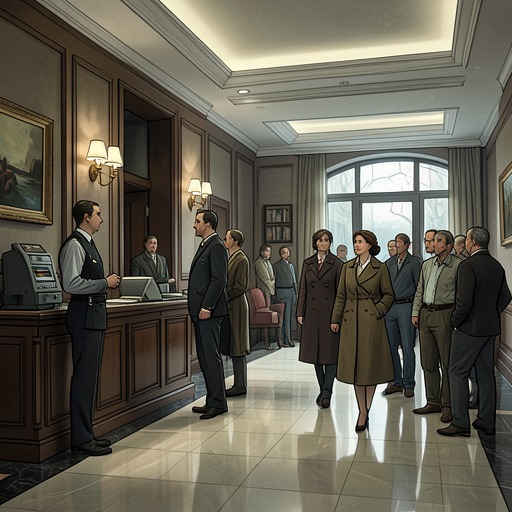
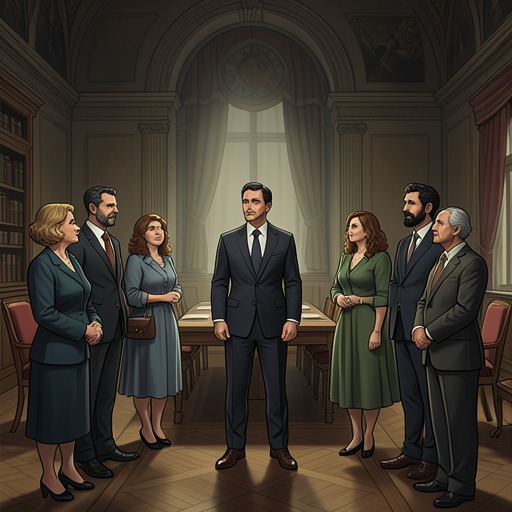
At a later gathering in suite 417, forty-six men of different ranks take seats appropriate to their station. The six most eminent Party figures occupy the head of the table, with the central places reserved for Malenkov and Khrushchev. The arrangement appears almost spontaneous, but its precision makes the hierarchy legible. Khrushchev does not immediately head for the place reserved for him. On entering, he first exchanges a few remarks with Vyacheslav Malyshev, the Minister of Medium Machine Building, who is seated near the end of the table. Only after the others are comfortable does Khrushchev pat Malyshev on the shoulder and make his way to the last empty chair, beside Malenkov.
The Count, serving the dinner, watches Khrushchev’s habits as well as his movements. Malenkov toasts only occasionally and drinks white wine; Khrushchev gives four toasts over the course of the evening, always with vodka. He never rises from his chair during the meal. At ten minutes to eleven, when dinner is nearly over, he raps on his glass with the blade of his knife. The contrast between his stillness through the meal and this deliberate signal gives his intervention a public, ceremonial force.
Khrushchev recalls that the Metropol had been the setting for an earlier political episode: in 1918, Sverdlov had locked the constitutional drafting committee in a suite two floors below until its work was complete. The anecdote draws on the hotel’s political past before Khrushchev introduces the evening’s own announcement. He invites the other men to the windows overlooking Theatre Square, where Malyshev is waiting. Malyshev reports that the Obninsk power plant, whose construction had begun three and a half years earlier, has become fully operational six months ahead of schedule. Khrushchev’s role is to give the news a setting and an audience, transforming a technical achievement into a shared political occasion.
Characterization and Narrative Role
The dinner scene makes power visible through procedure rather than argument. The attendees find their designated places with little overt direction; Khrushchev, despite his seniority, waits until the others are settled before occupying the chair beside Malenkov. His pause does not erase the rank encoded in the seating plan. Instead, the choreography shows how authority can be exercised through apparently casual gestures: a conversation near the table’s end, a hand on Malyshev’s shoulder, a move into the last available seat, and finally a knife against a glass.
The scene is filtered through the Count, whose work as a waiter allows him to observe the men without taking part in their deliberations. He attends to the contrasts among their table manners and overhears their private exchanges, while continuing to present courses and replenish glasses. Khrushchev is therefore characterized partly through what can be watched: his vodka toasts, his refusal to stand, his timing, and his command of the room’s attention. The novel does not offer a private account of his motives; its evidence is the public performance and the political consequences attached to it.
Across the succession narrative and the dinner, Khrushchev’s role changes in scale. First he is one name among several possible claimants, then the holder of the Secretariat chairmanship in a divided leadership, and finally the senior figure who can convene the room around an announcement. The progression links his ascent to the novel’s wider interest in hierarchy: authority is neither simply inherited nor settled by title alone, but continually displayed and negotiated through institutions, seating, ceremony, and control of attention.