Nina Kulikova and Sofia
A Gentleman in MoscowNina Kulikova and Sofia are mother and daughter whose close bond is tested when Nina leaves the six-year-old in the care of Count Alexander Ilyich Rostov while she tries to reach her imprisoned husband. In a meeting lasting less than fifteen minutes, the novel shows their attachment not through a history of domestic life but through the practical arrangements, tender gestures, and shared promise that must sustain them through separation.
Family Under Pressure
Nina arrives at the Metropol with Sofia after a sequence of events that has abruptly unsettled their family. Recalled from Ivanovo to a conference on agricultural planning, Nina learned on the first day that her husband had been arrested. She traced him to the Lubyanka but was refused permission to see him; the next day she heard that he had been sentenced to five years of corrective labor and would be sent that night to Sevvostlag. Nina intends to follow him, but cannot take Sofia with her while she searches for work and a place to live.
The separation is presented as temporary, though its duration is uncertain. Nina estimates that it may take a month or two to establish herself before she can return for her daughter. Sofia, meanwhile, is expected to stay at the hotel with Rostov. The family’s immediate circumstances therefore divide the parents: the father is being transported to a labor camp, Nina is preparing to follow him, and Sofia must remain behind. Nina’s request for help is inseparable from this precarious geography and timing.
A Mother’s Request and a Daughter’s Trust
Nina approaches Rostov as someone accustomed to relying on herself, but now grips his arm and tells him she has no one else to turn to. Her request makes the relationship between mother and daughter visible as a responsibility Nina cannot fulfill alone under the circumstances. She asks Rostov to watch over Sofia while she establishes a new home, entrusting him with the care of the person she is leaving behind.
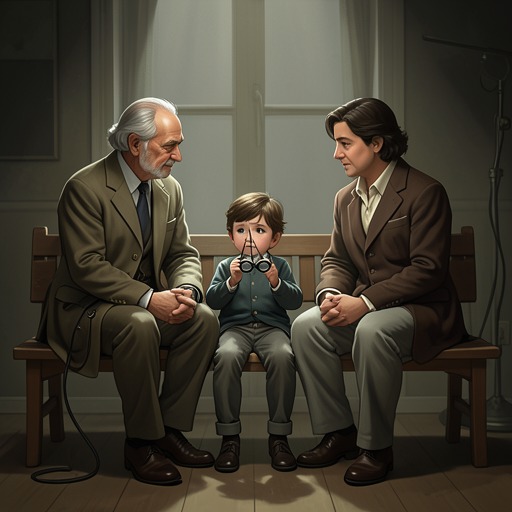
Before speaking to Sofia, Nina kneels until she is at her daughter’s eye level and rests a hand on the girl’s knee. Rostov notices a tenderness in her voice that he has never heard before. The gesture and altered tone mark a shift from the composed, self-reliant Nina he knows: with Sofia, she speaks as a mother trying to make an impending separation bearable. She introduces Rostov as the uncle she has often told Sofia about, and the child recognizes him as the person who gave her mother the pretty binoculars. Their exchange establishes that Rostov is already present in Sofia’s understanding through Nina’s stories and through a remembered gift.
Sofia is about five or six. Her simple clothes, boyishly short hair, and undressed linen doll suggest the practical conditions in which Nina has been raising her, without diminishing the child’s place at the emotional center of the scene. Nina tells her that she will stay at the hotel for a few weeks, be strong and respectful, and listen to her uncle. Sofia responds by repeating the plan: she and her mother will take the long train to her father. Nina confirms it. The repeated promise connects the separation from her mother to an anticipated reunion with both parents, even though the circumstances that will determine when that journey can happen remain unsettled.
Separation and Composure
Sofia tries to match her mother’s fortitude. She does not question the arrangement, plead, or visibly protest, but tears run down her cheeks as she nods to show that she understands. Her restraint is not indifference: the tears disclose what her composure cannot contain. Nina wipes one side of her daughter’s face with her thumb while Sofia wipes the other with the back of her hand. They perform the same small action at once, each caring for the tears on her own side of Sofia’s face.
Nina holds her daughter’s gaze until she is sure the tears have stopped, then nods and kisses her forehead. The sequence gives the farewell its shape: Sofia tries to accept the explanation, Nina helps her regain composure, and the kiss marks the moment before Nina leaves. Their brief exchange does not erase the child’s distress; instead, it shows the mother attending to it while still carrying out the decision demanded by the family’s circumstances.
What Nina Leaves Behind
Nina gives Rostov a canvas pack containing Sofia’s things, then hands him an unframed photograph of herself with Sofia’s father. She says little about how he should handle the photograph, leaving the decision to Rostov. The pack makes the immediate practical consequence of the separation concrete: Sofia’s possessions go with the person who will care for her. The photograph, in turn, places the absent father within the handover and supplies Rostov with a detail about Nina’s past that he had misunderstood.
After gripping Rostov’s arm once more, Nina crosses the lobby and leaves at a pace that gives her little room for second thoughts. She heads across Theatre Square, as she had on an earlier visit eight years before. In the photograph, Rostov recognizes that Sofia’s father was not the handsome Komsomol captain he had once seen waiting for Nina, but the young man in a sailor’s cap who had eagerly retrieved her coat. The correction distinguishes an old impression from Nina’s actual marriage; the photograph connects that earlier encounter to the family now being separated by arrest and forced travel.
The encounter from Nina’s first use of Rostov’s name to her exit takes less than fifteen minutes. Its brevity leaves no room for an extended discussion of what the separation will mean, and Rostov has only a moment to consider the commitment she has placed in his hands. For Nina and Sofia, the scene makes their attachment legible through the work of leaving: Nina prepares her daughter, attends to her tears, provides her belongings, and entrusts her to someone Sofia already knows through her mother’s account. The promise of the long train to her father offers a destination, but the immediate bond the scene records is the one between a mother departing and a daughter trying to be brave enough to let her go.