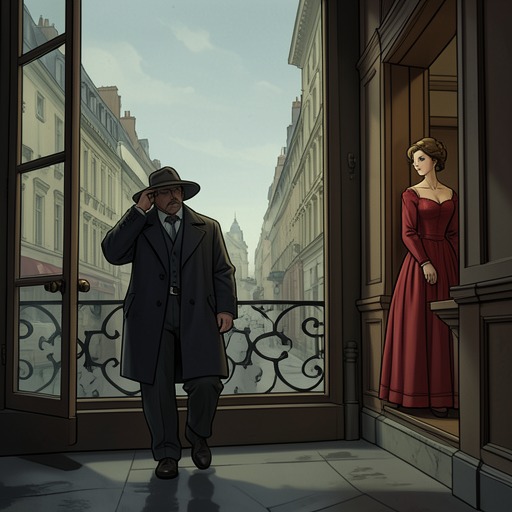
Prince Nikolai Petrov
A Gentleman in MoscowPrince Nikolai Petrov is introduced as a character readers supposedly need not remember, only for the narrator to retract that advice and announce that he will have great bearing on the tale’s outcome. His brief appearance establishes a life shaped by the collapse of aristocratic privilege and the impersonal reach of political authority: a working violinist returns to his family’s former residence to find Cheka officers waiting outside his room. The contrast between his modest, accommodating manner and the consequences of a single overlooked portrait makes his introduction both quietly comic and ominous.
Identity and Background
Prince Nikolai Petrov belongs to a family whose old household has been broken apart. He was sixteen when the Hermitage fell. By the time the story introduces him, his mother and sisters are in Paris, his grandparents are dead, and the family servants have scattered. The family residence on Pushkin Square has been divided among new residents. Prince Nikolai Petrov sees practical sense in this redistribution: with his family gone, he has no use for thirty rooms. A bed, a washbasin, and the opportunity to work are enough.
His work is musical. After a quartet finishes its engagement at midnight, Prince Nikolai Petrov buttons his overcoat, tightens his scarf, and walks home carrying his violin. The careful details of that return establish him not as a political actor but as a young man trying to make an ordinary life under radically altered conditions. He has neither read a political tract nor harbored a grudge; he says he would not remember how to play the imperial anthem.
Searches and Arrest
The family mansion has become a shared dwelling, and its new residents provide a small-scale picture of the social change around him. On the second floor, Prince Nikolai Petrov encounters a middle-aged woman living in the nursery and a bus operator with a family of four living in his mother’s boudoir. He wishes them goodnight with the unassuming smile associated with the house. They do not answer. On the fourth floor he understands why: three Cheka officers are waiting to search his room.
This is the third search in six months, and Prince Nikolai Petrov recognizes one of the officers. Rather than protest or make a scene, he lets the men in and sits at a small table by the window while they search. His calm is presented as familiarity and weariness, not evidence that the intrusion is harmless. He has taken pains to remove portraits, crests, and royal insignia from his room; nevertheless, an officer opens a grammar book and finds a portrait of Tsar Nicholas II on its front plate. Possession of the image is a crime. Prince Nikolai Petrov laughs at the discovery, an inadvertent remnant of the world he has tried to clear away.
The captain cuts the page from the grammar book with a knife, writes the time and place on its back, and has Prince Nikolai Petrov sign it. The precise procedure turns an overlooked image into a documented offense. There is no need for a hidden political allegiance: the book supplies the incriminating evidence, and the officers take him to Lubyanka for questioning about his loyalties.
Sentence and Life in Tuchkovo
Prince Nikolai Petrov is held for several days and questioned again. On the fifth day, he avoids both execution and deportation to Siberia, but he is not simply released to resume his former life. Instead, he receives a Minus Six, an administrative sentence permitting him to travel through Russia except for its six largest cities: Moscow, Saint Petersburg, Kyiv, Kharkov, Yekaterinburg, and Tibilisi.
He resumes his life in Tuchkovo, about fifty miles from Moscow. The narration emphasizes that he does so largely without resentment, indignation, or nostalgia. At this distance, the ordinary continuities of grass, blossoming fruit trees, and young women coming of age remain available to him, while the political consequences of his earlier life are less visible. His relative remoteness spares him knowledge of what happens to his old instructor the following year. A trio of Cheka officers comes to the instructor’s small apartment, where he lives with his aging wife, and takes him before a troika. Evidence that he had repeatedly hired Prince Nikolai Petrov, a Former Person, to play in his quartet despite a clear prohibition seals the instructor’s fate and sends him to the camps. The same musical work that sustains Prince Nikolai Petrov thus becomes part of the case against someone who employed him.
Narrative Role and Significance
The narrator makes Prince Nikolai Petrov’s importance a deliberate reversal. A long opening reflection on the difficulty of remembering Russian names prepares readers to dismiss this new prince as one more name among many. The narrator initially says there is no need to remember him, then insists that his future importance makes him worth keeping in mind. That shift turns a seemingly incidental arrest into an advance signal of later consequences without disclosing what those consequences will be.
Prince Nikolai Petrov’s first appearance also compresses the pressures of the changed era into concrete details: a residence of thirty rooms reduced to a place for a bed and washbasin; an old family home occupied by strangers; a portrait hidden in the front of a grammar book; and a sentence that allows movement across most of the country while excluding its major cities. His lack of overt resentment does not undo the force of these changes. Instead, his quiet accommodation makes the political machinery’s reach more striking: even a young musician who has no remembered imperial anthem can be searched, arrested, and marked by the household he came from. The narrative’s final instruction to remember him gives this subdued episode the shape of a promise.