Proving resilience by keeping time
A Gentleman in MoscowProving resilience by keeping time is the idea that counting the days of confinement can turn an apparently undifferentiated hardship into evidence of having endured it. For Count Alexander Ilyich Rostov, marking a year inside The Metropol is neither a denial of his lost freedom nor a claim that confinement is easy. It is a small act of recognition: the year has passed, he has lived through it, and that survival deserves to be marked.
The Meaning of Counting
People isolated at sea or confined in prison, the narration observes, may carve 365 notches into wood or scratch them into a cell wall. They do so even when the ordinary markers of life have disappeared: seasonal changes and recurring celebrations have been replaced by days that seem indistinguishable. Counting restores a distinction between one day and the next, and makes a long ordeal legible as a sequence that has been traversed.
The practice also turns attention outward. A person keeping count may imagine how the lives left behind have advanced: a child can climb a tree, another may be entering an academy, and someone once young may soon be old enough to marry. The count therefore measures more than the isolated person’s own duration. It registers a world continuing beyond the walls, changing in the keeper’s absence.
Yet the deeper purpose is not simply to follow that lost world. Each mark records another year of hardship endured, survived, and bested. The passage frames this achievement through three different scales: attentiveness belongs to minutes, discipline to hours, and indomitability to years. A record of time becomes a record of persistence. The marks do not remove the hardship; they make it possible to see that hardship has not had the final word.
Rostov Marks an Anniversary
On June 21, 1923, at five in the afternoon, Rostov stands before his closet with his hand on a plain gray blazer. He is preparing for his weekly visit to the barbershop and a meeting with Mikhail Fyodorovich at the Shalyapin. But the date gives the ordinary outing a second meaning: one year has passed since Rostov last set foot outside The Metropol. The confinement imposed on him has acquired an anniversary.
Rostov hesitates over whether to acknowledge it. House arrest is an infringement of liberty, and humiliation is among its intended effects. Pride and common sense therefore seem to recommend leaving the date unmarked. The hesitation matters: celebrating the anniversary cannot be treated as uncomplicated happiness, because the circumstance being commemorated is still a restriction on his freedom. But refusing to mark it would leave the passage of that year unrecognized as well.
He chooses to mark it. Instead of the gray blazer, he puts on his finest smoking jacket, custom-made in Paris from burgundy velvet, and heads downstairs. The clothing makes the decision visible without changing the facts of his confinement. Rostov has not recovered the freedom to leave the hotel; he has chosen how to meet the anniversary within the limits of his situation. The act resembles the prisoners’ notches: modest in practical effect, but significant as a deliberate account of time endured.
Clocks, Appointments, and Attention
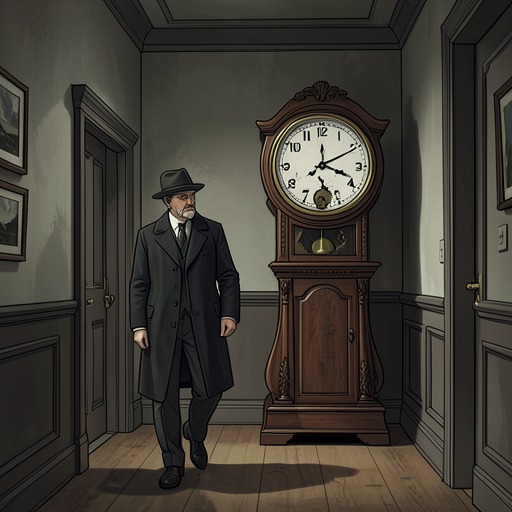
The anniversary sits within a wider pattern of attention to measured time. Earlier, Rostov’s anticipation of an appointed meeting makes the noon chime of his father’s Breguet twice-tolling clock welcome in an almost extravagant way. While reading Montaigne’s Essays, he repeatedly finds his gaze drawn to the clock and becomes acutely aware of its ticking. Time is not only an abstract duration here: a chime can announce an awaited encounter, while a tick makes a moment perceptible as it passes.
That attentiveness complicates the idea that Rostov simply values punctuality. As a young man he prided himself on being unmoved by ticking clocks. He disdained wearing a watch and preferred a leisurely lunch or a stroll to the pursuit of appointments and trains. In his view, the apparently frivolous time spent over tea or in friendly conversation might deserve more immediate attention than the necessities modern life declares urgent. The later act of marking a year in confinement is therefore not mere submission to the clock. It reflects a changed use of time: the count gives shape to endurance, rather than driving him toward an externally appointed hour.
From Years to Instants
The language of measured endurance recurs in a different register when Kutuzov, the hotel’s one-eyed cat, is chased across the lobby by two borzois. The dogs pursue him around the chairs; the cat reverses course, and their momentum carries them off the carpet and skidding across the marble. The narration adapts the scale of minutes, hours, and years to this brief contest, observing that the gaining of the upper hand is measured in the instant. Rostov’s idea of endurance thus belongs to a flexible vocabulary of time: years register survival, while a decisive second can determine the outcome of a struggle.
The juxtaposition does not make a chase equivalent to a year of house arrest. Rather, the repeated scale draws attention to how different forms of action have different temporal measures. The lobby episode compresses reversal and advantage into seconds; the anniversary asks Rostov to look back across a full year. In both cases, time is made meaningful through what happens within it, not through duration alone.
Endurance and the Order of Time
Other scenes give time a more institutional face. At a dinner in Suite 417, forty-six political guests take their places at nine o’clock, with the leading figures settling into seats arranged according to rank. The ordered arrival and seating make time part of public procedure: a precise hour opens the event, while the placement of the guests displays the hierarchy governing it. This kind of measured order differs from Rostov’s private anniversary. One organizes a gathering; the other gives an isolated person a way to acknowledge survival.
The contrast clarifies the concept’s emphasis. Keeping time does not automatically signify freedom, resilience, or human connection; a clock can coordinate a formal occasion just as days can disappear into the sameness of confinement. Its meaning depends on how the measure is used. Rostov’s anniversary turns an imposed duration into something he can consciously recognize. He cannot choose that the year happened inside the hotel, but he can choose to count it, mark it, and claim its survival as his own achievement.