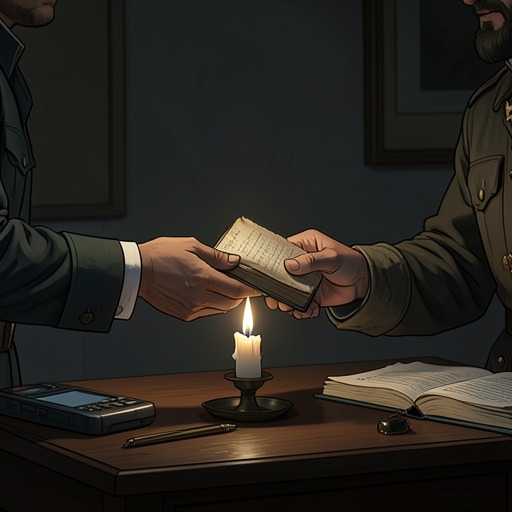
Restoring order through small acts
A Gentleman in MoscowRestoring order through small acts is the idea that even a modest gesture can recover some sense of order from confusion. Its clearest expression comes not in a speech but in a few frames of Casablanca: after violence erupts in Rick’s Café Américain, Rick rights a toppled cocktail glass without breaking stride. Viktor Stepanovich Skadovsky recognizes the gesture as the point of an earlier conversation with Count Alexander Ilyich Rostov, giving the small movement moral weight without making it a grand act of rescue.
The Moment of Recognition
Almost a year after speaking with Count Alexander Ilyich Rostov in a railway-station café, Viktor watches Casablanca. He pays particular attention to the scene in which the police close in on Ugarte. Rick’s response appears cool: he disregards Ugarte’s pleas, remains aloof as the police drag him away, and tells the band to continue playing.
Then Rick crosses the unsettled room toward the piano player. As he passes a customer’s table, he sets upright a cocktail glass knocked over in the commotion. The gesture occupies only a few frames and does not interrupt his movement or his assurances to the crowd. Viktor’s recognition is immediate: this, he understands, is precisely what the Count’s earlier observation had been getting at.
A Small Gesture Against Disorder
The scene places the glass amid a larger crisis. Casablanca is a distant refuge in wartime, and Rick’s café offers the beleaguered a place to gamble, drink, listen to music, conspire, console one another, and hope. The arrest unsettles this temporary haven, while Rick’s composure and instruction to the band can look like indifference to individual fates.
Setting the glass upright complicates that appearance. It does not undo the arrest or halt the danger around the café; its effect is deliberately limited. Yet the gesture shows attention to what has been disturbed and a willingness to correct one small thing. The idea is therefore not that a minor action can repair a world in crisis, but that it can restore a measure of order within the immediate scene.
Meaning and Narrative Function
Viktor’s response connects the film scene to his conversation with Count Alexander Ilyich Rostov: he sees in Rick’s unobtrusive act a form of care compatible with composure. Rick’s restraint and the small repair coexist, so apparent detachment does not settle the question of his regard for others. The glass becomes evidence of a different kind of response to disorder—quiet, practical, and proportionate to what one can actually do.
The novel makes the principle legible through the delay between seeing and understanding. Viktor remembers the Count’s conversation, watches Rick closely, and finds its meaning in an action that could easily pass unnoticed. The episode turns an incidental object into a measure of attention: amid the café’s danger and noise, a glass is set upright, and for a moment the room’s disorder is answered rather than merely endured.