Richard Vanderwhile
A Gentleman in MoscowRichard Vanderwhile is an American diplomat, a captain and former aide-de-camp whose friendship with Count Alexander Ilyich Rostov becomes a rare bridge between private loyalty and political intelligence. First encountered as a sympathetic stranger at the Metropol bar, he later refuses to let an intelligence inquiry override their friendship. When Sofia reaches the American Embassy in Paris, however, Richard becomes the trusted recipient of Rostov’s carefully concealed report and a message confirming her safe arrival.
Identity and Introduction
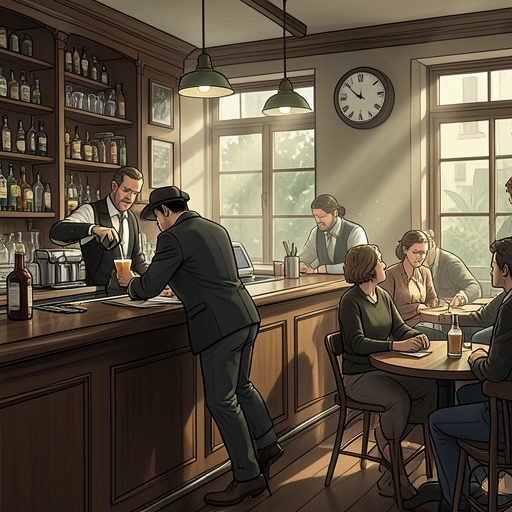
Richard first appears at the bar while Rostov is reflecting on American character and the argument that Hollywood’s entertainments during the Depression had distracted the public from revolutionary pressures. Rostov considers whether jazz and skyscrapers might be better understood not as narcotics, but as signs of a spirit that hardship could not suppress. As he swirls his brandy, Richard takes a seat three stools away. The bartender, Audrius, recognizes him as Captain Vanderwhile and welcomes him back.
Richard is about to leave Moscow for home, having been left behind while others departed. He tells Rostov that he is quite content with this experience: being left behind gives him a new perspective on the place he thought he was leaving. He introduces himself by extending his hand, and the two men exchange names. The moment establishes the frank, easy manner that defines their later conversations; a stranger’s handclasp becomes the beginning of a lasting friendship.
The Stranger at the Bar
Richard notices that Rostov has been swirling his brandy for roughly half an hour. With comic concern, he imagines the resulting vortex drilling through the floor and into the basement. The joke gives Rostov permission to acknowledge that something is troubling him. Richard then offers several possible subjects—women, money, or writer’s block—and insists that strangers can be unusually sympathetic listeners. His attention is alert but not intrusive: he makes an opening, then lets Rostov choose what to disclose.
Rostov tells him about two friends’ conflicting accounts of Russia’s tendency to destroy what it has made. One sees self-destruction as a recurring national impulse; the other regards the demolition of monuments and masterpieces as necessary to progress. Richard accepts that Russia has a history of dismantling and that the loss of a beautiful old building can bring both sorrow for what is gone and excitement about what may come. But he doubts that destruction settles the fate of what people create.
To explain why, Richard invokes Socrates, who shared his thoughts in the marketplace without writing them down and later died by his own hand. The Roman era, the barbarian invasions, the Middle Ages, plagues, poisonings, and book burnings all followed; nevertheless, Socrates’ ideas endured. Richard’s point is that people are poor judges of what will survive. A generation cannot reliably predict how its descendants will see a person or an achievement, just as it cannot know what those descendants will eat on an ordinary Tuesday. What passes to posterity may do so unexpectedly, beyond the reach of those trying to control its legacy. His response shifts Rostov’s debate away from whether destruction is necessary and toward the limits of anyone’s authority to declare what is lost forever.
A Friendship at the Metropol
Richard and Rostov meet in 1946 over a cocktail made by Audrius. Richard had challenged the bartender to create a drink for each of the colors of St. Basil’s Cathedral, giving rise to the Goldenrod, Robin’s Egg, Brick Wall, and Christmas Tree. The bar develops its own playful test: anyone who drinks all four in succession earns the title of Patriarch of All Russia once consciousness returns. The invented ritual captures Richard’s instinct for turning an evening into a shared joke rather than a formal occasion.
By the time they toast as old friends, Richard is attached to the State Department. When in Moscow he generally stays at the embassy, but still visits the Metropol for an occasional nightcap with Rostov. Although they have known each other for only four years, their friendship feels older. The narrative attributes that affinity partly to their common ground and effortless conversation, and partly to their similar upbringing: both were raised in grand homes in cosmopolitan cities, educated in the liberal arts, given idle hours, and exposed to fine things. Born ten years and four thousand miles apart, they nevertheless have more in common with each other than with most of their respective countrymen.
Their affinity is also connected to the kind of international world represented by grand hotels. The Plaza in New York, the Ritz in Paris, Claridge’s in London, and the Metropol in Moscow share a history of central heating, hot water and telephones in guest rooms, international newspapers, international cuisine, and bars off their lobbies. These establishments were built for travelers like Richard and Rostov, who could find familiar comforts and a sense of kinship in a foreign capital. Their friendship belongs to that shared world, even as Rostov’s confinement makes the hotel his restricted home rather than a stop on a journey.
Loyalty and the Intelligence Proposal
During a later visit, Richard arranges to speak with Rostov privately in a sitting room lent by Professor Sirovich, an old friend. He is in Moscow for only a few days and does not know when he will return. He explains that Joseph Stalin appears close to death and that Moscow’s future could turn either toward openness to the world or toward tighter isolation. Richard’s concern is both international and immediate: the political succession may change the lives of people in the city.
Richard says that the group he will lead in Paris belongs to the intelligence field, describing it as a research unit seeking people who might occasionally provide information. He presents the proposed exchanges as cosmopolitan gossip rather than spying, suggesting that seemingly trivial accounts of who met, who was excluded, and who was angry could be useful; he also implies that the group would reward its contacts generously. Rostov understands the request as an invitation to spy on his country. He refuses both the proposed gossip and the idea of spying, and asks that they not discuss it again so they can remain friends.
Richard accepts the refusal. Rather than press the matter, he clinks glasses with Rostov in a toast to their friendship. For the next hour they leave the subject of intelligence aside and speak about their lives. Rostov tells him that Sofia is progressing at the Conservatory and remains thoughtful and quiet. Richard reports that his boys are thriving in the nursery, though they are neither thoughtful nor quiet. They also talk about Paris, Tolstoy, and Carnegie Hall. The contrast between the confidential proposal and this unforced conversation makes their friendship’s boundary clear: Richard can ask for information, but he does not treat refusal as betrayal.
Sofia’s Arrival and Rostov’s Report
When Sofia arrives in Paris, Richard is at his apartment in the embassy. A domestic detail introduces the scene: his bow tie sits at an angle of twenty-five degrees, a familiar slant his wife says it always has. The arrival first confuses an attaché, who mistakes the visitor’s presentation; Richard recognizes Sofia and greets her with relief. He knows she is coming because Rostov had told him, but the Count has withheld when, where, and how she would arrive. Richard is surprised that she has come disguised as a barefoot boy and carrying only a knapsack.
Richard’s welcome combines concern for Sofia with an awareness that she has brought something important. His wife offers to find clothes, and Richard assumes Sofia is hungry and suggests they meet in the kitchen after he has spoken with her. He says Rostov had mentioned that she might have something for him. Once Sofia has left, Richard uses a penknife to open a seam expertly sewn along the top of her knapsack’s shoulder strap. A tightly rolled paper has been hidden in the narrow space behind the strap.
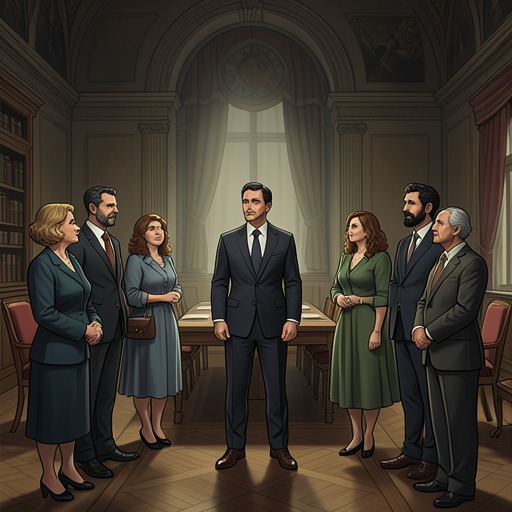
The paper contains Rostov’s account of the June 11, 1954 dinner for the Council of Ministers and Presidium. Its diagram shows a U-shaped table with forty-six names, each accompanied by a title and a three-word personality description; the reverse gives a detailed account of the evening. Rostov reports the announcement of the Obninsk nuclear power plant and the theatrical demonstration of its connection to Moscow’s electrical grid, but gives particular attention to the political and social choreography. Most guests expect to dine in a formal room at the Boyarsky and are surprised to be directed instead to suite 417. Nikita Khrushchev is the exception: he knows where the dinner will be and appears satisfied that everything is in order. At ten minutes to eleven, he makes a toast referring to the history of the suite two floors below.
Rostov reads the positioning at dinner as political theater. Khrushchev’s alignment with Malyshev, against the backdrop of Malenkov’s objections to a nuclear arms race, turns the display of nuclear power into a public image of progress. As the city lights shine and the guests move around the room, Malyshev confers with Khrushchev and takes the empty chair beside him. Malenkov is left standing behind them while he waits to reclaim his seat, and the other guests appear not to notice. The report therefore offers Richard more than a record of the plant announcement: it gives him Rostov’s reading of the evening’s alliances, gestures, and shifting status.
After reading, Richard thinks he could use a hundred men like Alexander Rostov. He then notices a second, slightly curled paper on the desk, apparently rolled with the report. Recognizing Rostov’s handwriting, he finds a direct instruction for confirming that Sofia has reached the embassy safely, followed by a long sequence of seven-digit numbers. Richard jumps to his feet and calls for Billy. The scene closes not with an explanation of the numbers, but with Richard acting at once on the message. His earlier refusal to solicit espionage has not prevented Rostov from entrusting him with consequential information; by receiving both the political report and the means to verify Sofia’s safety, Richard becomes a trusted intermediary in the escape.
Narrative Role
Richard’s importance lies in the way he joins candor to restraint. At the bar, he listens to Rostov’s anxiety and offers an argument against premature judgments about what history has erased. In the private meeting, he tests whether that friendship can accommodate an intelligence request, then respects Rostov’s refusal. Later, he receives the report and the concealed instructions that Rostov chooses to send. These moments do not make Richard a simple representative of American intelligence: he is also a friend whose loyalty is expressed through hospitality, humor, conversation, and prompt attention to a message whose full significance he has yet to explain.
His recurring presence also links the Metropol’s intimate social world to the larger pressures of diplomacy. The colored cocktails and familiar nightcaps create a setting in which two men can speak freely; the private room and intelligence proposal show how quickly such personal trust can acquire political stakes. At the embassy, the same trust takes material form in the opened shoulder strap, the hidden report, and the note on Richard’s desk. Richard’s role is thus not to decide what Rostov should do, but to receive what Rostov chooses to share—and to respond when the friendship calls for action.