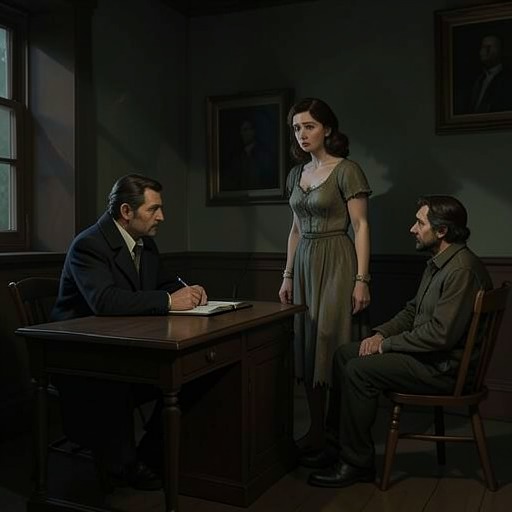
Rostov’s confinement sentence
A Gentleman in MoscowRostov’s confinement sentence returns Count Alexander Ilyich Rostov to The Metropol under threat of death if he ever steps outside again. Issued by a revolutionary committee after hearing his testimony, it makes the hotel both his assigned place of residence and the boundary beyond which the state claims the right to shoot him. His arrival under military escort shows that the order is not merely a declaration: soldiers accompany him to the hotel and insist on seeing him to his rooms.
Judgment and Terms
The committee’s ruling follows a twelve-minute recess and weighs two competing assessments of Rostov. It judges that the clear-eyed spirit behind his poem Where Is It Now? has succumbed to the corruptions of his class and now threatens the ideals he once espoused. On that reasoning, the committee says it could have him taken from the chamber and put against a wall.
The sentence is nevertheless moderated by his earlier standing. Some senior Party members count Rostov among the heroes of the prerevolutionary cause, and the committee cites that regard as the reason for returning him to the hotel rather than executing him at once. The reprieve is conditional and sharply stated: should he ever set foot outside The Metropol again, he will be shot. The hotel restriction thus substitutes for immediate execution without removing the threat of execution.
Enforcement at The Metropol
On June 21, 1922, Rostov is escorted through the gates of the Kremlin onto Red Square and proceeds to Hotel Metropol. At the threshold, he thanks the two soldiers for delivering him safely and says he will no longer need their assistance. One soldier rejects that reading of the situation: they have orders to see him to his rooms, and he keeps a hand on his rifle. Their exchange gives the sentence its practical form. Rostov can speak as though the escort has ended; the armed men make clear that his return is still under supervision.
Inside the lobby, Rostov greets the staff with his familiar broad wave, but Arkady at the desk and Valentina, dusting a statuette, answer with wide-eyed stares. The contrast between his habitual, almost sociable manner and the guards’ insistence on accompanying him marks the change in his status. The ruling names the hotel as his permitted destination; the escort makes that boundary immediate.
Significance and Limits
The sentence turns political judgment into a concrete geography: Rostov may be returned to the hotel, but he may not cross its threshold again without risking death. The committee’s decision also preserves a contradiction at the heart of his position. His past association with the prerevolutionary cause protects him from one outcome, while its assessment of his present character supplies the justification for confining him.
The order specifies the prohibited act and its consequence, but the supplied account does not set out a duration or other detailed conditions of confinement. Its essential rule is absolute in its stated terms: remain inside The Metropol, or be shot. The escorted return on June 21 shows the sentence taking effect at the moment it is announced.