Rostov’s confrontation with Bishop Leplevsky
A Gentleman in MoscowRostov’s confrontation with Bishop Leplevsky is the moment a carefully prepared escape nearly collapses into discovery—and the moment Rostov converts that danger into a reversal of power. When the Bishop finds a map marking a route from Palais Garnier to the American Embassy in Paris, he has evidence of Rostov’s plan and sees the Count’s horror as an admission of guilt. Rostov answers not by pleading or fleeing, but by using the hotel’s hidden spaces, a concealed pair of pistols, and the Bishop’s own files to contain the threat and protect Sofia.
The plan exposed
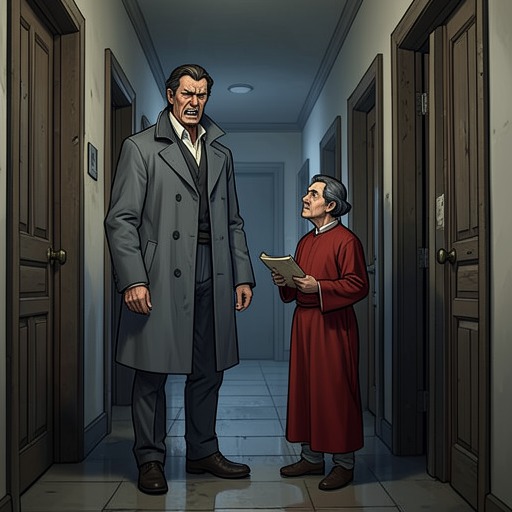
The confrontation begins in Rostov’s bedroom. Returning from a carefully staged errand, he finds Bishop Leplevsky sitting at the Grand Duke’s desk, a drawer open and a sheet of paper in his hand. The intrusion is already an insult: the Bishop has entered without invitation and placed his elbows on a surface once used for persuasive arguments to statesmen and counsel to friends. But the paper changes the meaning of the intrusion. It is not one of Rostov’s recently written letters of friendship, which might appear unusual but are not inherently suspicious. It is the first of the Paris Baedeker maps, marked with a bright red route from Palais Garnier to the American Embassy in Paris by way of Avenue George V.
The map makes visible what Rostov had kept hidden. His plans have been six months in the making, and the route concerns Sofia’s escape as well as his own. The Bishop has not yet accused him, but he has seen the transition in Rostov’s expression from indignation to horror. In that instant, the Count understands that his face has supplied the confirmation the Bishop might otherwise have lacked. The discovery also changes the stakes: Rostov’s carelessness may put Sofia in danger, not merely undo his own preparations.
The Bishop’s presence has a history. He is an accountant of discrepancies and a stripper of wine labels, and his attention to the map extends the same impulse to scrutinize and classify into the Count’s private life. The danger comes not only from the Bishop’s authority but from his ability to turn a fragment of paper into an accusation. The map is a practical guide, but in his hand it becomes evidence of intent.
From shock to counterstroke
For a few seconds, Rostov is overcome by fury, disbelief, self-reproach, and fear. He recognizes that he should have burned the map instead of slipping it into a drawer, and that one mistake has threatened months of planning. Those feelings do not last. Resolve displaces them, and he acts with the same precision that the exposed plan had required.
Rostov waits at the head of the belfry until the Bishop has descended the first two flights. He follows in stocking feet, then leaves the stairwell on the fifth floor and runs down the main staircase, as Sofia once did at thirteen. He reaches the executive offices unseen, but the Bishop’s office is locked. Nina’s hotel passkey, still in his pocket, lets him in. The route through the room is equally deliberate: he counts from the portrait of Karl Marx, presses the center of the second panel to its right, and opens a concealed compartment in the wall. Inside is an inlaid box holding two pistols.
He loads both weapons and takes the manager’s chair behind the desk. Before the Bishop returns, Rostov uses the few available seconds to moderate his breathing, lower his heart rate, and calm himself. The preparation matters: when the Bishop enters and insists that the headwaiter has no business in the office, Rostov is no longer acting from the confusion of the bedroom discovery. He is in control of the room and directs the Bishop to sit.
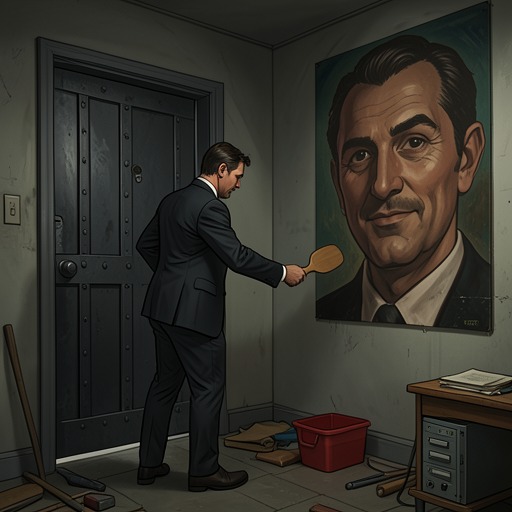
The Bishop reaches for the telephone to summon the authorities. Rostov shifts his aim and fires at the portrait of Joseph Stalin, striking it between the eyes. The shot makes the danger unmistakable; the Bishop jumps back and drops the receiver. Rostov then levels the second pistol at the Bishop’s chest, replaces the receiver, locks the office door, and returns to his seat. He has demonstrated that he is willing to use violence, but he has not shot the Bishop. The distinction is central to the standoff: the Count needs time and control, not the Bishop’s death.
The files and the reversal of power
When the Bishop characterizes his confinement as detention against his will and demands to know what Rostov intends, Rostov’s answer is that they will wait. The pause turns the Bishop’s own command of hotel procedure against him. The Count eventually takes the ring of keys, which the Bishop had dropped, and uses its smallest key to open the filing cabinets. The Bishop’s composure has already altered; his authority, Rostov observes, seems to have rested on possession of those keys.
The first three cabinets contain ordinary operational records: revenue, occupancy, staffing, maintenance expenses, inventories, and discrepancies. The remaining files are devoted to people who have stayed or worked at the hotel. Rostov finds dossiers on Arkady, Vasily, Andrey, Emile, and Marina, among others. Their contents record failings such as tardiness, impertinence, disaffection, drunkenness, sloth, and desire. Rostov does not dismiss the entries as wholly false; instead, he recognizes their one-sidedness. For every weakness recorded, he could have assembled a far larger file of each person’s virtues. His own dossier is among the thickest.
This discovery expands the confrontation beyond the map. The Bishop’s records show that scrutiny at the hotel is systematic: ordinary human weaknesses have been collected and ordered into material that can be used against individuals. Rostov gathers the files of his friends and places them on the desk, then checks the cabinets for his own. The moment is not a simple vindication of the people in the dossiers; it is a rejection of the power to define them by a selective catalogue of their faults.
At 2:30 in the morning, Rostov looks at the Bishop’s watch, reloads one pistol, tucks it through his belt, and points the other at the Bishop. He orders him to carry the files. The Count’s intervention therefore has a practical as well as symbolic aim: he removes the dossiers from the office and makes their custodian bear them out. In the boiler room, he opens the furnace with a handkerchief and orders the Bishop to feed the files to the flames. The Bishop does so without speaking. Rostov’s counterstroke destroys the material he has just discovered, rather than merely taking possession of it.
The basement and the escape
After the files have been burned, Rostov leads the Bishop through the empty offices and down an enclosed stairwell to the basement. The Bishop’s command of hotel minutiae has not given him familiarity with this part of the building; he looks around with fear and disgust. Rostov takes him through the heavy steel door into the boiler room, then farther into the basement to a bright blue door. Using Nina’s key, he opens it and tells the Bishop to go inside.
The Bishop asks what Rostov will do with him. The Count says that he will do nothing to him and explains the practical limit of the confinement: the Bishop attends the Boyarsky’s daily meetings, and a banquet is scheduled in the ballroom on Tuesday night. Rostov is confident that someone will find him then. He locks the Bishop in the room, described by the narration as the place where pomp bides its time. The Count leaves him alive and sets a foreseeable limit on his isolation, but denies him immediate access to the authorities or the hotel’s ordinary channels of power.
The timing of the sequence is exact. At three in the morning, Rostov enters the belfry on the lobby floor and climbs. He retrieves a stolen passport and Finnish marks from his pocket and places them in the Baedeker. The office encounter has not ended his attempt to leave; it has delayed it, and his escape materials remain with him. Yet the final image checks his apparent control. On the fourth-floor landing, he encounters the one-eyed cat, which looks down at the Former Person standing in stocking feet with pistols at his belt and stolen goods in his hand.
Time, records, and the scene’s significance
The confrontation draws together two systems of accounting. The Bishop’s authority depends on keys, dossiers, operational ledgers, and the conversion of discrepancies into records about people. Rostov counters that system through exact knowledge of the hotel: he uses a passkey, locates a concealed compartment, tracks the Bishop’s route, and turns the basement into temporary confinement. The episode also recalls the Count’s earlier impatience with rigid schedules and his former pride in being unmoved by clocks. Here, the crisis is measured in seconds, and the decisive actions are timed against the Bishop’s descent and return.
Timekeeping has long been more complicated for Rostov than mere punctuality. His father’s Breguet twice-tolling clock, with its enamel face and lapis lazuli body, once drew his attention away from Montaigne; in confinement, the passage of a year could be marked as proof of endurance. Now the Count checks the Bishop’s watch at half past two and reaches the belfry at three. The precision is not surrender to the clock but a means of acting within circumstances he cannot fully control.
The encounter’s reversal is therefore concrete rather than absolute. The Bishop has uncovered a route to Paris and exposed Rostov’s plan, but he does not leave with the map, the dossiers, or the power to summon help. Rostov takes the immediate initiative, destroys the files, and continues carrying the passport and money needed for his escape. The cat’s silent appearance prevents the ending from becoming a clean triumph: the Count is still a Former Person moving through a watched hotel, armed and burdened with stolen goods, while the danger to Sofia and the uncertainty of the escape remain.