Rules of being a princess
A Gentleman in MoscowRules of being a princess is a lesson in manners that Count Alexander Ilyich Rostov gives Nina Kulikova, but its substance reaches beyond courtly polish. The Count links posture and forms of address to character, and grounds respect not only in rank but in the sacrifices of ordinary people. Nina listens closely, tests his reasoning against her own, and accepts only the parts she finds justified; the lesson becomes a small negotiation between inherited etiquette and independent judgment.
The lesson and its scope
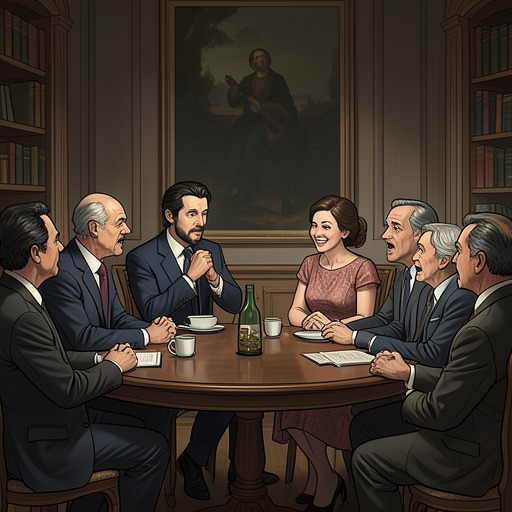
Nina asks the Count to share some rules of being a princess. The request follows an earlier discussion of the liberal arts, which he sets aside before turning to manners. His list includes how a princess should comport herself in society, terms of address, table manners, and posture. The range makes etiquette both public and physical: it governs what a person says at a table, how she addresses others, and how she occupies her own body.
Posture prompts Nina to stop him and ask whether it is really a kind of manners. The Count answers that a slouch can suggest laziness and indifference to others, while an upright bearing can convey self-possession and engagement. Nina appears persuaded enough to sit straighter. The exchange presents bodily discipline not as a decorative requirement alone, but as a visible signal through which other people may read a person’s character and attention.
Respect beyond rank
The Count next says that a princess should be raised to respect her elders. Nina bows her head toward him, taking the instruction literally and treating him as its immediate example. He clarifies that he meant the gray-haired, not himself: he regards himself as practically a youth like her. Nina then identifies grand dukes and grand duchesses as the relevant elders, but he extends the category beyond aristocratic titles.
His examples include shopkeepers, milkmaids, blacksmiths, and peasants as well as grand dukes and grand duchesses. He explains that each generation owes some gratitude to the previous one because its members planted fields, fought in wars, advanced the arts and sciences, and made sacrifices for those who came after. The rule thus refuses to make deference the exclusive property of rank. A princess may owe respect to people of every social class, because their labor and sacrifice—not simply their position—have earned it.
The cake and Nina’s qualification
The discussion becomes more contentious when the Count uses cake to distinguish asking from receiving. A princess, he says, should say please when asking for cake and thank you when it is offered. Nina accepts the first case: please is suitable when the person wants to persuade someone to give her what she wants. She disputes the second. If the princess did not request the cake and is merely accepting an offer, Nina sees no reason she must express thanks.
The Count answers with an image of manners as bonbons: they cannot be selected only when they appeal, nor can a half-bitten one be put back. Nina does not accept the analogy as decisive. As she makes her case, she puts a lemon tartlet in her mouth, turning the example into an immediate action rather than an abstraction. The Count concedes that her argument has some merit, though he invokes his own experience; Nina counters that his claim to a lifetime of experience may be premature. The exchange gives the lesson its characteristic balance: the Count offers a general rule, while Nina insists on examining the circumstances that rule is supposed to cover.
What Nina accepts—and what the lesson leaves open
Nina ends by committing to work on her posture and to say please and thank you when she asks for things. She draws a firm boundary around unrequested gifts: she will not thank people for things she never asked for. Her response is neither simple obedience nor wholesale rejection. She retains the practices whose reasons persuade her and rejects the convention she considers unearned, making the lesson a contest over justification as much as a lesson in etiquette.
Later, when Nina returns to the Metropol after her husband Leo has been sentenced to corrective labor and sent to Sevvostlag, she asks the Count to watch over their young daughter, Sofia, while she follows him. The request gives the earlier language of princesses a different context: the Count’s responsibilities now concern a real child’s health and comfort, not an imagined princess’s social training. He recognizes that those practical needs will fall to him even though he will not be responsible for her education, moral instruction, or religious upbringing.
His later actions make care concrete. At the hotel’s sewing room, Marina corrects his account of the predicament: the central difficulty is Sofia’s, not his. When Sofia is injured, the Count carries her down the remaining flights and out of the Metropol to seek medical help; at the hospital, he is instructed to leave her there while another person stays with her. These later events do not restate Nina’s etiquette lesson, but they sharpen its distinction between outward rules and attention to another person’s needs. The lesson’s enduring interest lies in that contrast: manners may make respect visible, while the choices that matter most require someone to notice who actually needs care.