Russia
A Gentleman in MoscowRussia in the novel is at once a country repeatedly remade by political violence and a homeland whose claim on private life cannot be reduced to politics. It is crossed in flight, revisited in grief, and encountered through a Moscow hotel that shelters its inhabitants even as the state makes that shelter a form of confinement. The contrast between vast national upheaval and small, decisive human attachments gives Russia its central significance: it is the place from which people flee, the place to which they return, and the place where a life can acquire its meaning unexpectedly.
Routes of exile and return
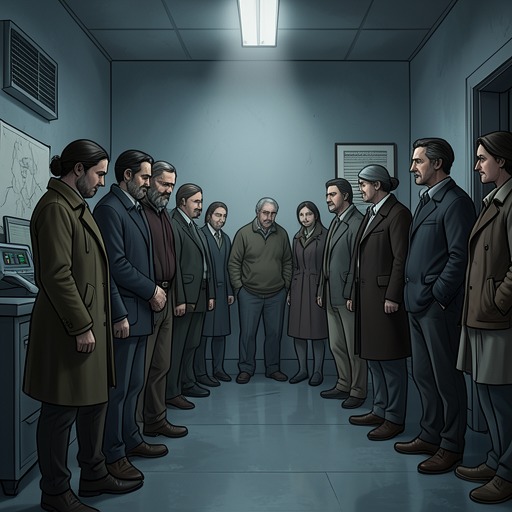
For Count Alexander Ilyich Rostov, Russia first appears in the evidence of an interrogation. Asked why he returned in 1918 after years in Paris, he says he missed the climate. The answer is comic, but it sits against a history that makes return perilous. He had left Russia after the publication of his 1913 poem, Where Is It Now?, which had been written at Idlehour Estate in Nizhny Novgorod and read by many as a call to action. At the committee hearing, Rostov insists that all poetry calls people to action, while refusing to present his own return as a political mission.
The country is also a route measured in danger. After hearing of the Tsar’s execution, Rostov set out from Paris at once. He crossed six nations and skirted eight battalions fighting under five different flags before reaching Idlehour Estate on August 7, 1918, carrying only a rucksack. The household was distressed and the countryside was nearing upheaval; his grandmother, the Countess, remained composed. Rostov arranged for her to leave the country with two servants, although all were prepared to accompany her. She understood why her grandson and only heir, whom she had raised from the age of ten, would stay behind. Return thus does not mean restoration: it means choosing to remain as the old household and the country around it come apart.
Revolution, sentence, and the hotel refuge
Russia’s political transformation turns the returning aristocrat into a prisoner within the city he has chosen. In the hearing, Rostov gives his address as Suite 317 at the Metropol and says he has lived there since September 5, 1918. The committee weighs his testimony against his earlier poetic reputation: it declares that the writer of Where Is It Now? has succumbed to the corruption of his class, yet notes that senior Party figures still regard him as a hero of the prerevolutionary cause. Rather than execute him, it orders him back to the hotel and threatens to shoot him if he ever sets foot outside again.
That sentence makes Russia’s political boundary intimate and exact. The prohibition is not merely an abstract loss of freedom; it gives the hotel door the force of a national border. Rostov remains in Russia, but his permitted world is narrowed to the Metropol. The room becomes refuge and enclosure at once, a place where the old life survives in objects and habits while the authority outside determines where his body may go.
A country measured by upheaval
The novel sets individual survival against a compressed history of national disasters. At a gathering in the Metropol, the guests toast the country after Rostov’s narrow escape. His thoughts move back to the Treaty of Portsmouth, signed in September 1905 to end the Russo-Japanese War, and forward across the seventeen years since: Russia has endured a world war, a civil war, two famines, and the Red Terror. The toast is not presented as the triumph of one political faction over another. Whether people are Red or White, left or right, their circumstances have all been altered; the gathering makes national endurance a shared, if unsettled, reason to raise a glass.
The city itself registers how such upheaval changes what can be seen. In the late 1930s, Tverskaya Street was widened for official parades ending in Red Square. Some fine buildings were lifted and set back, while most were demolished and replaced with towers under an ordinance requiring buildings on first-rate streets to stand at least ten stories high. When Rostov is carried away in a van, familiar landmarks blur past its small square window. He recognizes the old English Club and the ancient road leading from the Kremlin toward Saint Petersburg, a route he had walked a thousand times; then he stops trying to identify what remains familiar. The altered street turns political modernization into a personal experience of loss: the city recedes, and so does the landscape by which he once knew his way.
Moscow in a changing world
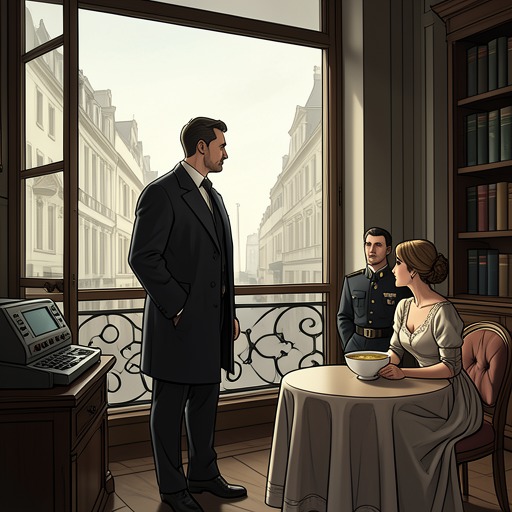
Russia is not sealed off from the world the novel depicts. The Metropol is treated as kin to the Plaza in New York, the Ritz in Paris, and Claridge’s in London. These grand hotels, built within fifteen years of one another, shared central heating, hot water and telephones in guest rooms, international newspapers, international cuisine, and bars off their lobbies. The comparison places Moscow within a transnational world of travel and privilege. For Rostov and the American Richard Vanderwhile, the hotel’s familiar comforts can make a foreign capital feel like home; for Rostov, that international interior also exists inside a country whose authorities have confined him there.
The hotel’s routines likewise give the novel a way to register national events at different scales. During a blackout, a typist in a small gray building continues recording waitresses’ eavesdroppings, while at the Metropol people collide in corridors, spill drinks, or wait trapped in an elevator. At the Boyarsky, whose atmosphere has long been defined by candlelight, service continues without interruption. The brief contrast places ordinary disorientation beside an established practice that can absorb it: the country goes dark, but one familiar room retains its own order.
Succession, attachment, and escape
After Joseph Stalin dies, Russia faces a succession crisis with no agreed plan or obvious heir. Eight men within the Presidium could plausibly claim leadership, among them Beria, Bulganin, Malenkov, Molotov, and Nikita Khrushchev. Malenkov initially appears likely to prevail, but the Party’s upper ranks decide that no one person should again hold both the premiership and the general secretaryship. Ten days after Stalin’s death, Malenkov gives up the Secretariat chairmanship to Khrushchev, establishing an uneasy balance between antagonists. The national future is presented not as a settled transition but as uncertainty distributed among competing men and offices.
For Rostov, however, the decisive measure of Russia is also private. When Sofia asks whether he regrets returning after the Revolution, he tells her that the one occasion on which Life needed him in a particular place at a particular time was when her mother brought her to the Metropol lobby. He says he would not exchange being in the hotel then for the Tsardom of all the Russias. The country’s largest political prize is thus set against a single encounter and the family life that followed it. Russia’s history remains immense, but his answer locates its deepest personal consequence in the place where he met his daughter.
The novel’s later escape plot makes the country’s borders physical once more. Investigators reconstruct the theft of a Finnish passport and currency from a Finnish guest, followed by the theft of a raincoat and hat from an American journalist. A man wearing the clothes was seen boarding the overnight train to Helsinki; the garments turned up in Vyborg with a Finland travel guide whose maps had been removed. Because the railway crossing was tightly guarded, investigators suppose that Rostov left the train there to cross the border on foot. Their report shows both the reach of state surveillance and its limits: the authorities can trace objects and routes, but acknowledge that he may already have slipped through their fingers. Russia remains the place of his confinement, yet its edge offers the possibility of departure.