Salle Pleyel
A Gentleman in MoscowSalle Pleyel is the Paris concert hall where Sofia’s public triumph and private escape meet. It is the setting of her finest performance yet, but also the point from which she leaves the concert world behind, changing her appearance and following a route arranged by Count Alexander Ilyich Rostov toward the American Embassy in Paris. The hall’s importance lies in this double role: it is at once a prestigious musical venue and the threshold of a new, uncertain life.
Identification and Setting
Sofia initially recalls the venue only as a hall, using the French word salle. When the Count identifies it as Salle Pleyel, she confirms that he has guessed correctly. His relief is immediate: he knows the place well and describes it as a historic venue with fine acoustics, situated in the 8th arrondissement. This exchange establishes the hall as a recognisable Paris landmark and makes the Count’s familiarity with it practically useful. He can plan around a location whose exits and surrounding streets he knows.
The hall also fixes the geography of the escape. The Count’s plan begins at its doors and leads toward the American Embassy in Paris. Although the most direct route would have run ten blocks along Rue du Faubourg Saint-Honoré, he chooses a zigzagging path that carries Sofia away from the concert hall quickly and then toward the anonymity of the Champs-Élysées. Salle Pleyel is therefore not merely a destination for a performance: it is the precise starting point from which the Count’s map turns into action.
Sofia’s Performance
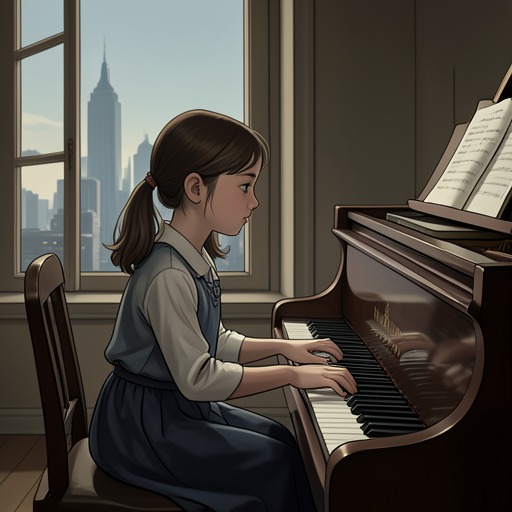
At the same time that the Count descends to the Metropol’s lobby, Sofia concludes her performance on Salle Pleyel’s stage. She rises from the piano in a state of wonder, having become so completely absorbed in playing that she has forgotten the audience. The applause returns her to the public moment. She acknowledges the orchestra and conductor with a gracious gesture, then takes one final bow. The scene gives the escape its immediate counterpoint: while the Count prepares to leave his hotel, Sofia is receiving recognition in a hall full of listeners.
Immediately after leaving the stage, Sofia receives formal congratulations from the cultural attaché and an embrace from Director Vavilov. He calls it her finest performance yet. Their attention then shifts back to the stage, where a violin prodigy takes his place before the conductor. The hall settles into silence; the conductor’s baton taps, and the Conservatory’s orchestra begins its next performance. That transition gives Sofia a short interval in which to act without abruptly interrupting the concert.
The orchestra performs Dvorak’s concerto in just over thirty minutes. Sofia allows herself only fifteen minutes to reach the exit. The difference between the length of the performance and the time she can spare makes the hall’s backstage spaces and the timing of the music part of her plan. She goes straight to a bathroom reserved for musicians, locks the door, and changes there while the concert continues around her.
From Stage to Exit
In the bathroom, Sofia replaces the visible signs of her concert appearance with clothes intended to help her pass unnoticed. She removes the blue dress made by Marina and the necklace Anna gave her, then puts on slacks and an Oxford shirt that the Count had taken from an Italian gentleman. Using scissors the Count had given her, she cuts her hair. The implement is small and poorly suited to shearing; its rings cut into her fingers as she works. She begins to cry in frustration, but stops, wipes her face, and resumes in smaller, systematic cuts.
The preparation is not entirely successful or complete. Sofia discovers that no one had accounted for her shoes: the only pair available is the high-heeled pumps Anna helped her choose for the Conservatory competition the year before. She throws them away and is left barefoot. She also discards Marina’s dress, reasoning that it could expose her if she were stopped and her bag searched. She puts Anna’s necklace in her pocket instead. The distinction matters: the disguise requires her to abandon conspicuous clothing, but she does not relinquish the necklace altogether.
As the strings begin to swell toward the end of the third movement, Sofia secures her knapsack, pulls the Italian’s cap onto her head, and listens before opening the bathroom door. She turns away from the dressing rooms and heads for the rear of the building. Passing directly behind the stage, she hears the music grow louder; with the opening notes of the final movement, she goes out through the hall’s rear exit and into the night. The timing lets the music cover her departure, while the route through the back of the building keeps her separate from the public entrance.
Route and Narrative Significance
Once outside, Sofia walks quickly but does not run. She circles Salle Pleyel to Rue du Faubourg Saint-Honoré, where the concert hall’s well-lit entrance is located, crosses the street, and steps into a doorway. There she removes the Italian’s cap and retrieves the small map the Count cut from the Paris Baedeker. Folded to the size of a matchbook, it carries the red line he drew for her. She orients herself and follows it along Faubourg Saint-Honoré, down Avenue Hoche to the Arc de Triomphe, then left onto the Champs-Élysées toward Place de la Concorde.
The Count’s route is deliberately less direct than the ten-block walk along Faubourg Saint-Honoré. He wants Sofia to get away from Salle Pleyel as quickly as possible and then disappear among the people on the Champs-Élysées. The detour costs only a few minutes, and he calculates that she should still reach the embassy before her absence is discovered. The map transforms his planning into a route Sofia can follow alone; the hall’s rear exit and the red line are successive parts of the same design.
The plan, however, cannot account for the effect of seeing Paris on foot. Sofia has seen the Arc de Triomphe and the Louvre before, but only from a bus window. At the beginning of summer, after an ovation, a disguise, and a flight into the night, the illuminated buildings appear different. She risks minutes she cannot spare and stops at Place de la Concorde, turning slowly as if recognising something. The narrative thus makes the route more than a mechanism for reaching the embassy: the escape begins at Salle Pleyel, but the city itself briefly interrupts the timetable. The hall remains the scene of Sofia’s public achievement and the launch point of her flight, while the journey from it gives her a first, direct encounter with Paris that the Count’s careful calculations had not anticipated.