Sofia
A Gentleman in MoscowSofia enters the story at a moment of forced separation: after Leo is arrested and sentenced to five years of corrective labor, Nina leaves to follow him and entrusts their daughter to Count Alexander Ilyich Rostov. Sofia is first presented as a child of five or six, but her smallness does not define her. Across the scenes shown, she moves from a carefully introduced charge to a child who can quietly defeat the Count at his own game, and, years later, to a thirteen-year-old absorbed in her work who calls him Papa.
Identity and Background
Sofia is Nina and Leo’s daughter. Nina tells Count Alexander Ilyich Rostov that she has little time: she and her husband had been recalled from Ivanovo for a conference on agricultural planning, and on the first day Leo was arrested. Nina tracked him to the Lubyanka but was refused permission to see him. After learning that he had been sentenced to five years of corrective labor and would be sent by train that night to Sevvostlag, she decides to follow him. Before leaving to prepare a new home, she asks someone to watch Sofia while she gets settled.
The child waiting in the hotel lobby is five or six, with black hair, ivory skin, and dark blue eyes. Her clothes are simple; her hair is cut almost as short as a boy’s; and she holds a linen doll by the neck, a doll without even a dress. These details present Sofia through the practical austerity of her upbringing, but the scene also makes room for tenderness. Nina kneels to meet her daughter’s eyes and speaks in a gentler tone than the Count has heard from her before.
Entrusted to the Count
Nina introduces the Count as Sofia’s Uncle Sasha, a familiar figure from her stories. Sofia immediately associates him with the pretty binoculars he gave Nina, so their connection predates this meeting even though Sofia is only now being placed in his care. Nina explains that her daughter will stay at the hotel for a few weeks while Mama prepares their new home. She asks Sofia to be strong and respectful and to listen to her uncle; Sofia understands that afterward they will take the long train to Papa.
The handover is not casual. The Count recalls that Nina had crossed the Piazza without hesitation when she was a child in order to become his friend, and that she had shown him the hotel’s hidden corners and given him the key to its mysteries. Her request for help therefore carries the weight of a longstanding friendship. He slips a photograph into his pocket, composes himself, and turns to his new charge. His first practical offer is food. Sofia shakes her head, leaving the Count to begin their life together without an easy domestic cue.
Play and the Thimble
A later game reveals a different side of Sofia’s quietness. The Count gives up, and Sofia accepts his surrender without gloating. She jumps down from her chair and walks toward him. He steps aside, assuming she is going to the bookcase, where he thinks she has hidden the thimble. Instead, she stops in front of him, reaches into his jacket pocket, and takes the thimble out.
The reversal depends on the Count’s confidence in his own explanation: he has imagined a hiding place and expects Sofia to confirm it. Her solution is both simpler and more audacious, since the object is on his person. The scene makes her composure part of the joke. She does not announce her victory or make a show of it; the Count is left aghast and sputtering. Their play gives their relationship a texture beyond the formal roles of guardian and child, with Sofia able to surprise and disarm the adult entrusted with her.
Years Later
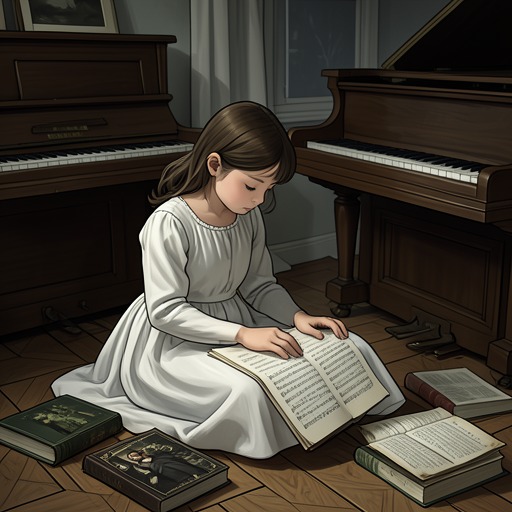
The later glimpse of Sofia is set apart by the change in her age and manner. At thirteen, she is seated at Grand Duke Demidov’s desk, leaning diligently over a tome. The Count has just entered his rooms after wondering how a girl could have managed an implausible feat involving three adult geese; the passage cuts from his bafflement to Sofia already at work. The text does not establish that she moved the geese, so the scene’s supported point is the comic contrast between his bewilderment and her unhurried concentration.
Without looking up from her book, Sofia greets him as Papa. The address marks the intimacy that has developed since Nina first called him her uncle and entrusted her daughter to him. It also contrasts with her childhood introduction, when she was a small girl holding an undressed linen doll and waiting for her mother’s return. Now she occupies the desk and gives her attention to a book, while the Count is the one who must adjust to her priorities. In these brief scenes, Sofia’s place in the household is conveyed less through explanation than through the changing terms of address, the small contests she wins, and the ease with which she makes the Count’s rooms her own.