Sofia Rostova's Escape to the U.S. Embassy in Paris
A Gentleman in MoscowSofia Rostova’s escape to the U.S. Embassy in Paris is both a practical flight and a rupture with the life prepared for her: after a performance at the Salle Pleyel, she cuts and dyes her hair, abandons most of her recognizable belongings, and crosses the city in disguise. Her father, Count Alexander Ilyich Rostov, has planned the route and supplied the means, but the final decisions—and the risks of carrying them out—belong to Sofia. The escape succeeds in bringing her to Richard Vanderwhile, even as Soviet officials begin asking after the missing Conservatory student.
Preparation and Decision
On the night before the escape, the Count lays out the items gathered for Sofia beside her empty suitcase and knapsack. He has already explained what she must do, but she challenges the delay: she objects to the plan and asks why he waited until so late to tell her. The Count admits that he feared she would resist. Their disagreement is not a passing hesitation; it gives the plan its personal stakes. He asks her to trust him, and she ultimately does, listening as he reviews each step in detail.
The decision requires Sofia to accept a course of action whose immediate cost is clear while its eventual outcome remains uncertain. The Count’s appeal rests on a longer view: what seems objectionable at the first step may still be the best course. Once Sofia agrees, father and daughter move from argument to preparation. The night before the escape, he explains the procedure; on the night itself, he checks the assembled belongings again, making sure nothing has been overlooked. The preparations are practical, but the repeated explanation also marks a transfer of responsibility: Sofia must remember and execute the plan herself.
Departure from the Salle Pleyel
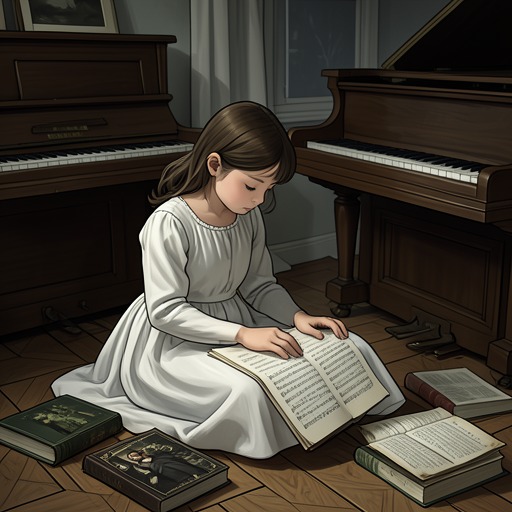
The escape unfolds alongside Sofia’s public success. At the Salle Pleyel, she gives what Director Vavilov calls her finest performance yet. She has been so immersed in playing that the audience’s applause brings her back to the fact that she is being heard. She acknowledges the orchestra and conductor, takes a final bow, and then leaves the stage for the dressing room. The ovation is real, but it cannot become the next chapter of her life. Her departure has been arranged to begin while the concert is still in progress.
In a bathroom reserved for the musicians, Sofia changes out of the beautiful blue dress made by Marina and removes the necklace Anna gave her. She puts on slacks and an oxford shirt that the Count purloined from an Italian gentleman. The scissors he supplied, shaped like an egret and treasured by his sister, prove ill-suited to cutting long hair. The rings bite into Sofia’s fingers as she struggles to shear it. She begins to cry with frustration, stops, wipes her face, and works methodically in smaller cuts. Following her father’s instruction, she flushes the severed hair away.
She then uses a small black bottle once used by the Metropol barber to dye gray hair. Sofia brushes its dye over the white streak that has defined her appearance since she was thirteen, turning it black. The transformation is made from humble objects and deliberate actions: scissors, a bottle, borrowed clothes, and a cap. Only after packing away the scissors and dye does she discover a flaw in the plan: no one considered her shoes. The only pair she has is the elegant high-heeled pumps Anna helped select for the Conservatory competition. She throws them away and leaves barefoot.
Sofia also discards the blue dress, because its conspicuous femininity could identify her if her bag were searched. She puts the necklace into her pocket instead. That small exception complicates the otherwise strict logic of concealment: the dress is too dangerous to carry, while the necklace remains with her. She secures the knapsack, pulls the Italian’s cap low, listens at the bathroom door, and times her exit to the music. As the strings swell toward the end of the third movement, she leaves the dressing-room area and heads behind the stage. With the first notes of the final movement, she passes through the rear exit into the night.
The Route Through Paris
Sofia does not run. She circles the Salle Pleyel to the well-lit entrance on the Rue du Faubourg Saint-Honoré, crosses the street, and steps into a doorway. There she removes the Italian’s cap and retrieves the small map the Count cut from a Baedeker and folded to the size of a matchbook. The red line directs her along the Avenue Hoche to the Arc de Triomphe, then left onto the Champs-Élysées toward the Place de la Concorde.
The route is a calculated detour. The Count could have sent her straight along the Rue du Faubourg Saint-Honoré, but instead chose a path that would get her away from the concert hall quickly and let her disappear into the anonymity of the Champs-Élysées. It adds only a few minutes, and he calculates that she should still reach the embassy before her absence is discovered. The plan treats time and visibility as practical dangers: speed matters, but so does having a crowd and a changing urban setting in which to become less noticeable.
The map cannot account for the city’s effect on Sofia. She has seen the Arc de Triomphe and the Louvre before, but only through a bus window. Now she encounters Paris on foot, at the beginning of summer, after an ovation and a transformation of her appearance, with the night opening around her. At the Place de la Concorde, she stops and turns slowly, allowing herself a moment with the illuminated city even though the schedule leaves little time to spare. The pause briefly interrupts the route without undoing it: she is not merely being moved through a plan but seeing, and recognizing, the world in which she is newly free to act.
Arrival and Immediate Consequences
At the U.S. Embassy in Paris, Richard Vanderwhile recognizes Sofia beneath the disguise. His attaché initially mistakes her for a young man; Richard identifies her and approaches, and Sofia answers him with evident relief. Richard explains that he and his household had expected her because the Count had told him she was coming. He had not, however, been told when, where, or how she would arrive. The secrecy that frustrates Sofia earlier has also kept the operational details from Richard, leaving the encounter to depend on recognition at the destination.
Richard remarks on her arrival disguised as a barefoot boy and asks whether the knapsack contains everything she brought. The question gives the escape its visible measure: her former clothes, shoes, and most of the possessions that could expose her are gone, while her entire travel burden is reduced to what she can carry on her back. Her relief at seeing Richard confirms that she has reached the intended refuge; the scene does not make the journey’s emotional cost disappear, but it changes her immediate situation from a solitary flight through Paris to a meeting with people who were expecting her.
The consequences also begin to appear in Moscow. An official receives word early the next morning that a student on the Moscow Conservatory’s goodwill tour has gone missing in Paris. Asked whether the student is male or female, the lieutenant reports that the missing student is a young woman. The inquiry turns the personal escape into an official absence, but the report as presented has not yet supplied the student’s name. The passage thus cuts between Sofia’s escape and the first administrative signs that her disappearance has been noticed.
Confinement, Service, and the Escape’s Method
The Count’s planning draws on a life spent learning how identities are performed and read. When the Metropol manager tells him that staff have continued to address him as Your Excellency, the Count accepts that times have changed and that a gentleman must change with them. His former title is not simply erased; he adapts his conduct to the role imposed on him. This history gives the escape’s disguise a wider resonance: Sofia’s changed clothes and hair are an urgent means of survival, while her father has spent years learning how to act within a social identity no longer of his choosing.
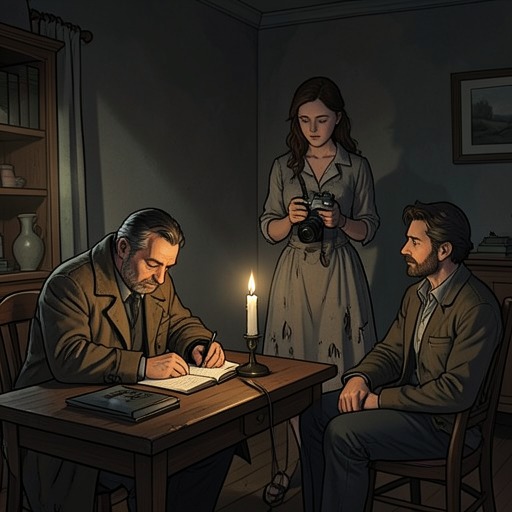
The Count’s years of hotel service also sharpen his attention to the spaces between public speech and private intention. When invited to sit with a solitary diner, he hesitates because, dressed to wait on the table, sitting seems a breach of decorum. He accepts the chair but leaves the napkin off his lap. Later, while serving at a political dinner, he hears every word exchanged around the table. The narrative presents overhearing as part of competent waiting: the servant’s apparent background position gives him access to what more prominent people say when they think attention is elsewhere. These details do not establish a particular conversation as the cause of Sofia’s flight; they show the accumulated habits of observation, discretion, and procedural care that accompany the Count’s preparations.
The escape therefore joins two forms of adaptation. Sofia changes her appearance and moves through Paris according to a route designed to conceal her; the Count’s own life has taught him that survival can depend on knowing how a role is read, when to remain unobtrusive, and how to adjust to altered circumstances. The result is not a flight without feeling or risk. It is a carefully organized passage whose most memorable details—the matchbook-sized map, the discarded pumps, the hair flushed away, and the necklace kept in a pocket—make concealment concrete while preserving the attachments and choices that the disguise cannot entirely remove.