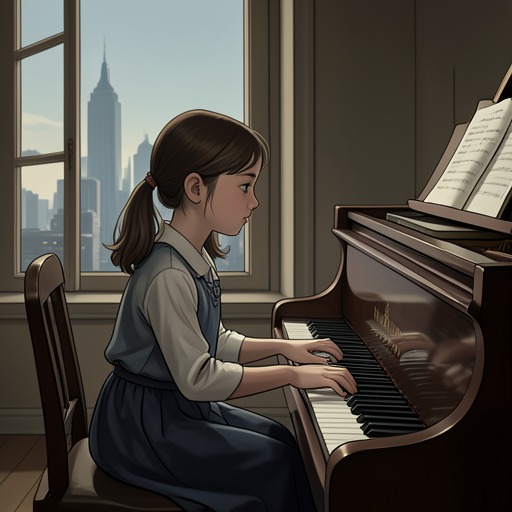
Sofia's Conservatory Competition Victory
A Gentleman in MoscowSofia’s Conservatory Competition Victory is presented not through a view of the stage but through the excited account Anna gives after bringing Sofia to Count Alexander Ilyich Rostov. The telling makes the result plain: Sofia’s Mozart performance turns a formal competition into a shared recognition of her achievement, while the announcement draws from her father a shout he has not given in twenty years.
Announcement and framing
The news arrives as a surprise. A closet door swings open in the Count’s study, and Anna charges in, bringing Sofia with her and announcing that Sofia has won. The sudden entrance gives the victory the force of an interruption: the private stillness of the study is broken by news too important to deliver quietly. The Count’s immediate response is a shout of laughter, marking how far the moment carries him beyond his usual composure.
The scene then slows to make room for the story. The Count offers the two visitors chairs, but settles himself on the edge of The Ambassador, watching Sofia expectantly. Sofia smiles shyly and defers to Anna. When her father presses for the details, Sofia asks him to let Anna tell them. That small exchange establishes both the Count’s eagerness and Sofia’s modesty, while allowing Anna, who witnessed the competition, to shape the account.
The competition and Sofia’s performance
Anna places Sofia’s appearance in the context of a substantial program. Five performers preceded her: two violinists, a cellist, a French-horn player, and another pianist. They played works by Tchaikovsky, Rimsky-Korsakov, and Borodin, and, in Anna’s telling, all represented the Conservatory professionally and with precision. Sofia’s success therefore follows a full evening of capable performances; it is not described as a victory over incompetence, but as the moment that changes the audience’s attention.
Before Sofia plays a note, her entrance has already made an impression. Anna recalls an audible gasp as Sofia crossed the stage to the piano without the slightest rustle of her dress, seeming to float. Sofia credits her aunt with teaching her that manner of entering, but Anna distinguishes a learned lesson from an individual quality: the manner of Sofia’s entrance, she says, cannot be taught. The Count agrees. The exchange treats the performance as more than a matter of notes: Sofia’s command of the stage is part of what the audience sees, while her presence remains recognizably her own.
The choice of Mozart’s Piano Sonata No. 1 initially meets resistance. When the director announces the piece, some listeners mutter and shift in their chairs. Anna’s account emphasizes the contrast between that unsettled reception and the response once Sofia begins. The audience is overcome; Sofia plays with tenderness and joy, and faces across the hall turn into smiles. The crowd’s change of feeling supplies the clearest measure of the performance’s effect: the skepticism does not need to be argued away, because Anna describes it giving way as the music unfolds.
Reception and victory
The applause after Sofia finishes is so strong that Anna remembers it shaking dust from the chandeliers. The image makes the response physical as well as social: the sound seems to travel through the hall itself. The Count claps and rubs his hands together while listening, sharing in the excitement before the account has even reached its conclusion.
Anna says the competition was already over in everyone’s mind. The boy scheduled to perform after Sofia had practically to be dragged onstage, a sharp contrast to the attention Sofia had commanded. At the reception she became the belle of the evening, toasted from every corner. The evidence of victory thus extends beyond applause: the audience’s response displaces the remaining contest, and the reception gives Sofia public recognition among those gathered.
Family response and narrative significance
The victory is also a family event. Anna tells the story as Sofia’s aunt and as the actress who accompanied her, while Sofia is present to listen and occasionally correct her father’s interruptions. The Count’s questions reveal how avidly he wants the details; his eagerness is affectionate, but the scene does not make him the source of the achievement. Anna narrates what she saw, and Sofia’s performance remains at the center of her account.
The shift from the Count’s initial silence to his laughter and animated attention gives the announcement a particular emotional weight. His shout is identified as his first in twenty years. The competition’s result therefore alters the atmosphere of the study as well as Sofia’s standing at the Conservatory: public acclaim reaches into a private relationship and elicits an unusually unguarded response from her father. The scene ends not with a formal award or a stated judging procedure, but with the force of the audience’s verdict, the toasts at the reception, and the Count reaching for champagne to celebrate.