Sofia's Decision to Join the Conservatory's International Tour
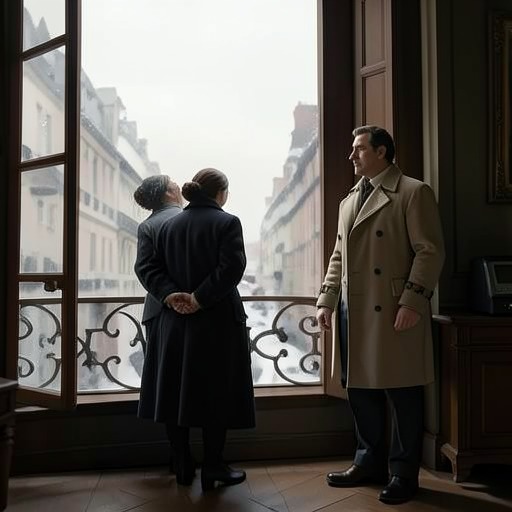
A Gentleman in MoscowSofia's decision to join the Moscow Conservatory Orchestra's international tour makes artistic opportunity inseparable from family separation. After she initially declines the invitation, Count Alexander Ilyich Rostov learns that the choice was hers, not an order he had given or a retreat from stage fright. With the orchestra's itinerary about to be announced, he urges her to defend her own talent. The conversation leads toward the Paris journey that she will undertake without him: for Sofia, the tour means stepping into a future she has the power to choose; for her father, it means helping her go where his own confinement prevents him from following.
Opportunity and Stakes
The opportunity takes shape through VOKS, the All-Union Society for Cultural Relations with Foreign Countries. The Count confirms that, six months later, on June 21, Sofia is expected to be in Paris. The itinerary places the Moscow Conservatory Orchestra in Minsk, Prague, and Paris, where she is to perform Rachmaninov at the Palais Garnier. The plan belongs to a larger program of international cultural travel: a ballet company is to go to New York in April and a dramatic ensemble to London in May. The prospect is therefore both a personal opening for Sofia and part of a state-organized presentation of Soviet artists abroad.
The news unsettles those around her. Emile Zhukovsky asks whether the country really has cultural relations with foreign countries, giving the announcement an air of improbability. Viktor Stepanovich Skadovsky, by contrast, treats Sofia's place on the tour as important to her prospects. He tells the Count that she will graduate in six months and that refusing the invitation could hamper her chance of securing a worthy position. In his view, the tour is not simply a prestigious engagement: it is an opportunity that could affect the professional future for which she has trained.
The Refusal and the Deadline
The immediate crisis begins when Viktor Stepanovich Skadovsky reports a call from Director Vavilov: Sofia has declined the invitation. He had assumed the Count instructed her to withdraw, and had secured twenty-four hours before the director appointed someone else. The delay is tied to a firm deadline. The orchestra's itinerary and musical program are to be announced on Friday, and its performers must be settled beforehand. If Sofia has made the decision herself, the Count must speak with her that night; there will be no leisurely period in which she might reconsider.
The Count is genuinely unaware of the refusal. He tells Viktor Stepanovich Skadovsky that he agrees Sofia's future depends on performing on the tour, and the two men are left dumbfounded by the discovery that neither has directed her choice. The distinction matters: Sofia has not been withdrawn by a protective father, nor is the invitation being rejected on his behalf. She has acted for herself, and the adults who wish to preserve the opportunity must confront her decision rather than assume its cause.
At table ten in the Boyarsky, the Count initially appears ready to continue their usual game of Zut. He has prepared a category on common uses for wax, but instead sets it aside and begins telling Sofia a story from his past about Ribbon Day at the academy. The change of subject makes the meal a setting for persuasion rather than play. When he wonders whether anxiety lies behind her refusal, Sofia makes clear that she is not afraid to perform before an audience. She is also not persuaded by the Count's first explanation: she says plainly that anxiety has nothing to do with her choice, and that she simply does not want to go. The narrative gives no further reason for that reluctance, leaving it as her own stated preference rather than supplying a motive on her behalf.
Persuasion and the Meaning of Acclaim
The Count's response draws on an earlier turning point in Sofia's life: the Conservatory competition she won with Anna Urbanova. He says that his greatest pride did not arrive when Sofia and Anna brought home news of victory. It came earlier, when he watched Sofia leave the hotel for the concert hall. For him, the essential act was venturing out before anyone could promise applause. His argument therefore does not reduce her decision to a calculation of honors or professional advancement. He presents courage as the willingness to perform when acclaim remains uncertain.
That distinction gives the exchange its force. Viktor Stepanovich Skadovsky stresses the practical consequences of missing the tour; the Count instead speaks of the moment before success, when Sofia chose to leave the hotel without knowing how she would be received. He is not asking her to prove that she can win another competition. He asks her to recognize that the uncertainty she once accepted is part of what made the earlier act meaningful. Sofia listens and nods, but the conversation does not erase the independence of her initial refusal. Her eventual course is framed as a choice she must make herself, not as obedience to either man's authority.
After a moment, Sofia says that if she is to play the piano in Paris, she wishes her father could be there in the audience. The wish turns the professional opportunity into a question of separation: Paris is valuable to her, but she imagines the performance in relation to the person who will not hear it beside her. The Count smiles. The scene does not report a formal declaration of acceptance in that exchange; instead, the subsequent itinerary and Sofia's later presence in Paris establish that she goes. Her decision thus emerges through the movement from refusal, through an honest account of what the refusal is not, toward the possibility of performing despite the cost of leaving her father behind.
Paris, Exile, and the Cost of Going
The tour's promise carries particular weight for the Count because his own life is defined by confinement in Moscow. In a later reflection from the hotel's roof, he looks across the city, identifying the Boulevard and Garden Rings around the Kremlin, and considers exile at home: a person can remain within his native country yet be cut off from the life and places he longs for. He describes the Russian form of exile as more than removal from one location; it makes the inaccessible homeland an object of intensified attention. The contrast with Sofia's journey is sharp. She can travel to Paris, while her father, looking out over a city that is and is not his, cannot simply accompany her.
The Count's practical help gives that separation a further consequence. When Sofia later leaves a performance at the Salle Pleyel, she goes out through the rear exit as the final movement begins. She carries a small map her father has cut from a Paris Baedeker and folded to the size of a matchbook. Its route leads away from the concert hall and toward the American Embassy in Paris. Instead of taking the direct road, the Count has drawn a detour designed to get her away from the venue quickly and let her disappear into the anonymity of the Champs-Élysées. The episode shows that his involvement in her journey extends beyond encouraging her to perform: he has prepared for her movement through a foreign city, where the opportunity to travel is also bound up with a dangerous escape.
The later scene gives the earlier decision a double edge. The daughter who once said she did not want to go eventually enters the world beyond the hotel; her father supports that passage even though he cannot be present as the audience she wished for. The tour is at once a public artistic undertaking, a private step toward independence, and the setting for their separation. Its emotional center is not applause itself, but the difficult act of going forward when neither acclaim nor reunion can be guaranteed.