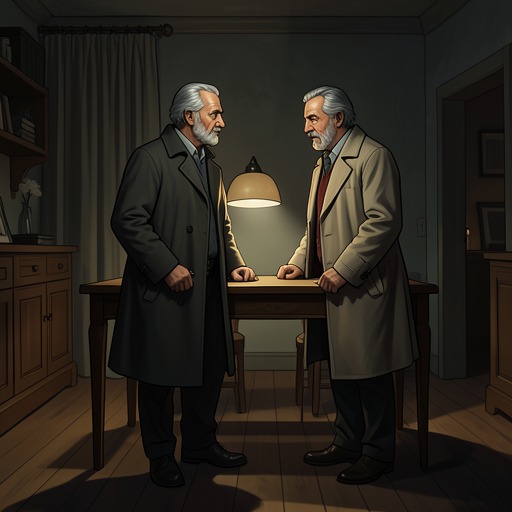
The Age of Steel
A Gentleman in MoscowThe Age of Steel is Mishka’s name for a new historical era in which industrial technology promises to transform both society and poetry. His speech links steel-built infrastructure to the prospect of liberation from ignorance and oppression, then imagines written art becoming an instrument of action. The Count’s response makes the expression more than a slogan: although he can recognize the conventions behind Mishka’s rhetoric, hearing his friend speak fills him with joy.
Naming a New Era
Mishka presents the Age of Steel as a decisive break with the Age of Iron. He points to power stations, skyscrapers, and airplanes as evidence of what the new age can build. The phrase therefore names not simply a material but a historical confidence: steel stands for technological capacity on a scale that can alter ordinary life.
The Shukhov radio tower gives that confidence a concrete image. Mishka describes its spiraling steel structure, two hundred feet high, as a means of carrying news, intelligence, and Tchaikovsky’s music into homes within a hundred miles. The tower makes communication part of the era’s promise: its reach extends from information to art, joining public infrastructure with private listening.
Technology and Social Promise
Mishka’s account gives technological development a political and moral direction. He argues that the engine, the press, and the pistol, though developed by the Bourgeoisie for their own interests, helped the Proletariat free itself from labor, ignorance, and tyranny. In his vision, the advances of the Age of Steel continue that movement, accompanying the hoped-for end of ignorance and oppression and the arrival of human brotherhood.
That assurance is presented as Mishka’s aspiration, not as an established outcome. His speech treats material progress and Russian morality as moving together, so that engineering achievements become evidence for a larger expectation of social change. The radio tower’s ability to carry both news and music gives the claim its most vivid form: technology appears capable of distributing knowledge and culture as well as power.
Poetry in the Age of Steel
Mishka insists that poetry, too, is keeping pace. He contrasts older forms fashioned from bronze and iron with poetry now being fashioned from steel, and contrasts quatrains, dactyls, and elaborate tropes with an art of action. In his account, poetry will move across continents and transmit music to the stars. The metaphor enlarges the speech’s technological optimism into an aesthetic program: the poem should act, travel, and participate in the future rather than remain enclosed in inherited forms.
The narration places this program beside the Count’s imagined critical response. Had he overheard the same speech from a student in a coffeehouse, he might have objected to poetry’s demand for a manifesto, its first-person plural and future tense, its rhetorical questions, capital letters, and exclamation points. Yet because the words come from Mishka, the Count feels joy instead. The contrast distinguishes his judgment of a poetic fashion from his feeling for the person speaking, and leaves the Age of Steel suspended between a grand public ideal and an intimate moment of recognition.