The Metropol
A Gentleman in MoscowThe Metropol is at once Count Alexander Ilyich Rostov’s place of confinement and the world in which he builds a life. Its familiar public rooms and intricate back routes shape the novel’s movement between restriction and possibility: the hotel keeps the Count within its walls, yet it also shelters a hidden study, an exit to the roof, and, eventually, the passage through which he leaves.
Setting and Changing Face
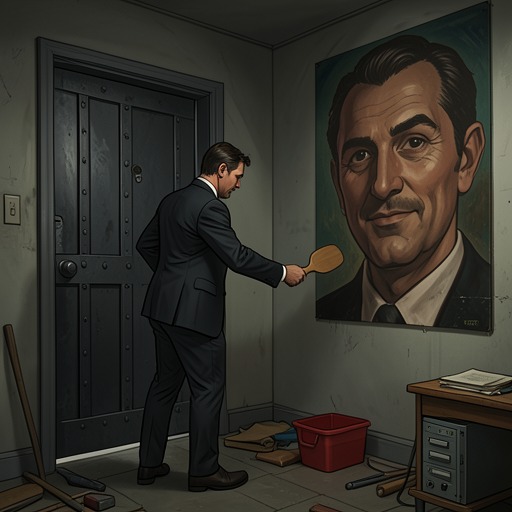
On June 21, 1923, the Count hesitates over what to wear for his weekly trip to the barbershop and a meeting with Mikhail Fyodorovich (Mishka) at Shalyapin. The gray blazer seems suitable until he recognizes the date: it is the anniversary of the day he last set foot outside The Metropol. The hotel’s significance is therefore measured not simply by its rooms but by the boundary it imposes on his movement. His confinement turns an ordinary calendar date into a question of whether an enforced limitation should be marked at all.
By the last day of spring in 1930, the hotel appears at first glance much as a returning Muscovite might remember it, though the apparent continuity contains small changes. Pavel Ivanovich still stands on the front steps in his greatcoat, despite trouble with his hip on foggy afternoons. The young porters in blue caps still carry luggage, but now answer to Grisha and Genya rather than Pasha and Petya. Vasily remains at the concierge’s desk, near Arkady, who spins the register and offers a pen. Mr. Halecki still occupies the manager’s office, while a new assistant manager, whose smile recalls an ecclesiastic’s, interrupts his reveries over minor breaches of hotel rules.
The hotel’s social life has also adapted to a changed political order. In Piazza, Russians with access to foreign currency gather over coffee and encounter acquaintances. The formal remarks and late arrivals once associated with the Assemblies now belong to Dinners of State in the ballroom. The familiar venue persists, but the gathering it hosts has changed: the Metropol carries older social forms into a new regime without leaving them untouched.
Public Rooms and Private Routes
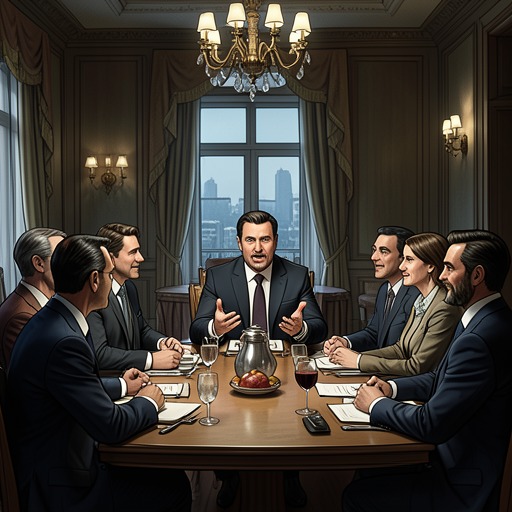
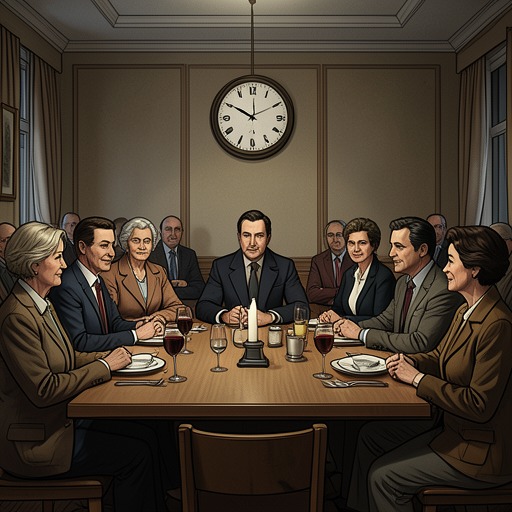
The Metropol’s rooms support different kinds of encounter and constraint. The Piazza and Shalyapin bring guests together, while the ballroom accommodates official dinners; the Boyarsky Restaurant, by contrast, has been defined for nearly fifty years by candlelight. During a countrywide blackout, two waiters carrying trays collide in the Piazza, and customers in Shalyapin spill their drinks, while guests descend from the upper floors and the night staff cannot bring themselves to answer thirty ringing telephones. The Boyarsky Restaurant continues serving without interruption. The contrast makes the hotel feel less like one uniform interior than a set of adjoining worlds, each with its own habits and vulnerabilities.
The building also offers less visible connections between spaces. On the night of his anniversary, after the failed attempt to mark it on a wall, the Count returns toward his rooms but feels a summer breeze on the back of his neck. He follows it down a hallway where every door is shut and discovers, behind pipes and flues, a wall-mounted ladder leading to an open roof hatch. The route carries him from the enclosed corridor into the night air. From the roof he sees Moscow and the illuminated Kremlin, while the summer breeze recalls earlier nights in Saint Petersburg and at Idlehour Estate. The hotel’s architecture briefly opens onto both the city outside and the Count’s life before confinement.
A different concealed route becomes important to Sofia. For her departure, the Count brings her through the closet door into the hidden study, a space he had ushered her into sixteen years earlier. The room has been prepared for a farewell meal: a candelabra burns on the bookcase, two high-backed chairs face one another across the Countess Rostov’s oriental coffee table, and linen, flowers, and the hotel’s finest silver turn the hidden room into a dining place. The concealed interior is not merely a refuge; it is a space the Count can arrange to mark a relationship and a departure.
Confinement, Care, and Departure
For the Count, The Metropol is the fixed boundary of house arrest, but it is also the setting in which his life acquires routines and attachments. The anniversary of his last exit gives the restriction a measurable duration. His route to the roof shows that enclosure is not absolute, while the secret study allows him to make a private interior within the hotel’s larger one. These spaces do not cancel his confinement; they give it a human scale, shaped by habits, memory, and acts of care.
The hotel community makes Sofia’s departure a shared event. When Marina goes outside to call a taxi, Arkady, Vasily, Audrius, Andrey, and Emile fall back by apparent agreement, leaving the Count and Sofia a few final words alone. Father and daughter embrace, and Sofia passes through the endlessly revolving doors. Returning to the sixth floor, the Count looks around his bedroom and finds it unnaturally quiet. The familiar room has not changed, but the person whose presence gave it meaning has gone; the hotel’s enclosure now contains the feeling of an empty nest.
The Exit and the Hotel’s Significance
The Metropol’s revolving doors mark Sofia’s passage outward, but the Count’s eventual departure takes place amid a very different kind of threshold scene. At midnight, thirty telephones ring simultaneously. The night staff run from one phone to another without answering; the drunken crowd spills out of Shalyapin, and guests awakened upstairs come marching down the stairs. In the confusion, the Count quietly puts on a journalist’s hat and coat, shoulders his rucksack, and walks out of The Metropol.
The escape depends on the hotel’s own crowded, interdependent life. Its phones, public rooms, stairways, and guests generate the commotion that diverts attention, while the Count’s departure is deliberately quiet. The same building that has defined his confinement also supplies the conditions of his exit. Across the novel, its spaces hold together imposed limits and improvised freedom: a closed door may conceal a study, a corridor may lead to the roof, and revolving doors that have watched others leave finally turn for the Count himself.