Twice-daily clock chimes as a rule for daily life
A Gentleman in MoscowTwice-daily clock chimes as a rule for daily life is the principle embodied by the clock commissioned for Count Alexander Ilyich Rostov’s father: attend seriously to life, but do not let the clock govern every moment. Its noon toll calls the morning to account; its midnight toll rebukes a day misused or prolonged. More than a device for telling time, the clock gives a daily shape to the contrast between purposeful work and unhurried liberty.
The clock and its governing idea
Count Alexander Ilyich Rostov explains that his father commissioned the clock from Breguet in 1882. The firm was known for accurate chronometers and elaborate ways of marking time, but the Count’s father asked for a deliberate exception: a clock that tolled only twice a day. The restriction was not a rejection of precision so much as a judgment about the proper place of timekeeping in a human life. A person should attend closely to what life required, his father believed, without measuring every activity against the watch.
That belief drew on his father’s study of the Stoics and Montaigne’s Essays. The day was divided not into a succession of clock-governed appointments, but into two different kinds of time. Morning was reserved for industry. Afternoon, once its work was done, belonged to liberty: a walk among willows, reading, conversation beneath a pergola, or reflection by the fire. Such pursuits had no appointed hour and did not need one; they were allowed to begin and end according to their own nature.
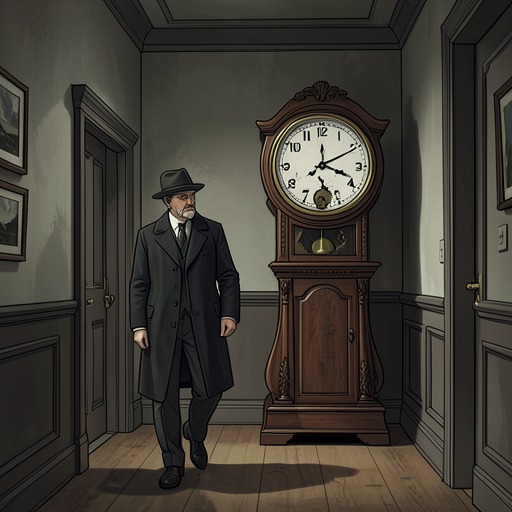
The clock itself makes this philosophy tangible. Its white enamel face is about the circumference of a grapefruit, and its lapis lazuli body slopes from top to base. Its jeweled workings were made by craftsmen renowned for precision, so the quiet between the two tolls is not a failure of the mechanism. It is the point of the design. When Count Alexander Ilyich Rostov reads, he can hear every tick; the clock measures time continuously, but announces it only at the moments his father considered meaningful.
Noon as reckoning, afternoon as freedom
The first toll sounds at noon, when the diligent person can take stock of the morning’s labor and sit down to lunch with a clear conscience. The same sound carries a different judgment for someone who has squandered the morning in bed, over newspapers at breakfast, or in idle conversation. In his father’s scheme, the noon chime is therefore both a marker and a reckoning: it makes visible the difference between a morning used well and one allowed to slip away.
This division does not make the afternoon another work shift measured against a deadline. Having been industrious before lunch, a person should spend the remaining daylight in wise liberty. Walking, reading, visiting with a friend, and reflecting are not presented as obstacles to life’s necessities; they are part of a well-used life precisely because their value cannot be reduced to a schedule. The rule distinguishes attention from clock-watching: discipline belongs to the morning, while the afternoon should have room for beginnings and endings that are not appointed in advance.
The second toll, at midnight, is not an invitation to begin a new task. In the father’s view, a person who has lived the day well—in industry, liberty, and religious observance—should already be asleep. The chime is a remonstrance to anyone still awake, suggesting that daylight has been spent so poorly that activity must now be sought in darkness. The two signals thus judge opposite ends of the day: noon asks what has been made of the morning, and midnight asks why the day has not been allowed to end.
The rule in the Count’s experience
The clock’s meaning is not merely theoretical for Count Alexander Ilyich Rostov. On one occasion, the noon chime becomes the eagerly awaited hour of an appointment. He has tried to keep his attention on Montaigne’s Essays, but repeatedly finds his gaze drawn back to the clock. The moment reverses the usual emphasis of his father’s rule: instead of reckoning with completed labor, the Count waits for a particular hour. The clock’s restraint makes the toll more significant, since its rare announcement gives the appointed noon an exceptional weight.
A year later, the Count confronts another measure of time: the anniversary of the day he last set foot outside the Metropol Hotel. At five o’clock on June 21, 1923, he hesitates before his closet over whether to wear a plain gray blazer. He is preparing for his weekly visit to the barbershop and then a meeting with Mishka at Shalyapin; the date also marks one year of confinement. The circumstances make celebration seem at once understandable and potentially humiliating. Yet the Count considers how people isolated at sea or in prison mark the passage of a year, sometimes with 365 notches cut into wood or scratched into a cell wall. Such accounting can honor not only the life continuing beyond confinement, but also a hardship endured and survived. The clock’s daily measure resonates here with a larger measure in years: endurance can itself be counted.
The Count’s earlier ideas about time sharpen the contrast. As a young man, he prided himself on being unmoved by ticking clocks and rejected the modern impulse to time breakfast, a walk to work, or even the hanging of a hat. He disdained wearing a watch and preferred a leisurely lunch or a stroll to racing toward an appointed hour. In his valuation, tea and friendly conversation could deserve immediate attention, while banking appointments or catching trains might wait. The inherited rule and the Count’s own habits converge in their resistance to treating every minute as a task station, even as the Count’s later confinement gives the passage of time a harder, more consequential edge.
Timekeeping, discipline, and lived order
The novel places this philosophy beside other forms of procedure. At the Boyarsky Restaurant, the assistant manager introduces a tightly documented ordering system: a waiter writes an order, a bookkeeper records it and issues a cooking slip, the kitchen logs and prepares the food, and a confirmation slip and stamped receipt authorize its retrieval. This process tracks each stage through written records. It is not the clock rule, but the contrast helps distinguish two kinds of order: one that accounts for every transaction, and the father’s attempt to reserve only two daily tolls for public judgment of time.
That contrast also clarifies why the clock’s silence matters. Its mechanism is exact, yet its daily instruction is not to convert the whole day into a chain of deadlines. The noon toll requires an honest reckoning; the long interval afterward protects activities that need no assigned hour; midnight warns against carrying wasted daylight into the night. In a life shaped by confinement, appointments, and repeated routines, the rule offers a form of order that is neither wholly imposed by the clock nor wholly indifferent to time. It asks for attention where attention is due, and leaves the rest of the day room to be lived.