1731 Serbian vampire epidemic
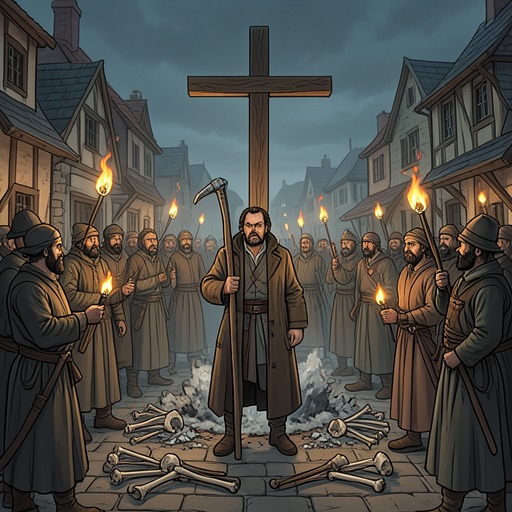
A History of the Vampire in Popular CultureThe 1731 Serbian vampire epidemic was the first fully documented vampire outbreak, transforming a sequence of village deaths into an official investigation whose written record helped give European vampirism an enduring factual appearance. Thirteen deaths in one Serbian village unsettled the community, whose residents rejected a medical explanation and insisted that vampires were responsible. The resulting exhumations, inspections, and decapitations reveal how fear converted disease and ordinary postmortem changes into a coherent supernatural crisis.
Causes and Historical Setting
The epidemic occurred during the eighteenth-century vampire craze, when reports of suspected vampires were spreading through eastern Europe and entire villages were digging up corpses to stake them. The wider setting was one in which medical knowledge remained incomplete and supernatural explanations could compete successfully with professional diagnoses. The account also belongs to a period of profound cultural uncertainty: the nineteenth-century comparison made later in the book describes a society increasingly willing to treat witchcraft and spiritual claims as factual, but the Serbian investigations show an earlier version of the same tension, in which official observers entered a community already organized around vampire explanations.
The immediate crisis involved thirteen deaths in one Serbian village occurring close enough together to alarm the population. A doctor who specialized in infectious diseases was sent to determine the cause and concluded that malnutrition was almost certainly responsible. The villagers considered that explanation inadequate. For them, the deaths were not an impersonal medical pattern but the result of attacks by vampires, and their insistence persuaded the doctor to exhume the suspected bodies rather than allowing the matter to end with his diagnosis.
This conflict illustrates the epidemic’s competing models of causation. The villagers identified a dead person as an active agent who could continue to damage the living, while the doctor offered a material explanation based on living bodies and their nutritional condition. In circumstances where repeated deaths created fear but offered no visible culprit, vampirism supplied a target and a ritual response. The broader logic of vampire panic was that superstition could give shape to otherwise unmanageable disaster: the dead were imagined to steal the life force of surviving relatives, making a household’s sequence of illnesses appear purposeful rather than random.
Investigation and Official Witnesses
The first examination produced findings that seemed to confirm the villagers’ fears. The exhumed bodies did not appear to have undergone major decomposition, and the mouths of the corpses appeared to contain what the examining doctor believed was fresh blood. These observations turned the local belief into an administrative problem. Officials in Vienna, unwilling to accept the initial report without further scrutiny, dispatched Johann Flückinger, a respected military surgeon, together with other doctors and army officers as witnesses.
Flückinger and his companions reported that many of the bodies showed no major decomposition and appeared, if anything, to have become plump. Their presence gave the episode an unusual documentary authority. Rather than surviving only as oral folklore, the outbreak was examined by medical and military personnel and entered an official report. The book therefore presents it as the first Serbian vampire epidemic to be fully documented, while also stressing that Flückinger accepted vampirism as the only logical explanation for the strange physical evidence he believed he had encountered.
The investigation’s authority depended on a striking reversal. The professional investigators had been sent to check a local claim, but their report did not simply dismiss the claim as peasant superstition. Instead, their observations were incorporated into a narrative in which the corpses themselves became testimony. Bodies that seemed undecayed, unusually full, or marked by blood were treated as evidence of an ongoing condition rather than as signs requiring a different account of decomposition. The corpse became both the object of examination and the supposed perpetrator’s surviving trace.
Stana and the Child in the Grave
Among Flückinger’s detailed cases was Stana, a twenty-year-old woman who had died in childbirth after a three-day illness and had been buried for two months. Before her death, she had reportedly said that she had painted herself with the blood of a vampire. According to the report, she feared that both she and her child would become vampires; the child had died immediately after birth and, because of careless burial, had been partly eaten by dogs.
The report described Stana as complete and undecayed. When her body was opened, the investigators claimed to find a quantity of fresh blood in the chest cavity. They also reported that the arteries, veins, and ventricles of the heart were not filled with coagulated blood as they expected, while the lungs, liver, stomach, spleen, and intestines appeared fresh, resembling those of a healthy person. These details transformed bodily inspection into a catalogue of supposed vampiric signs, with internal freshness standing against the normal expectation of decay.
The report added a further image of renewal. The skin on Stana’s hands and feet and her old nails were said to have fallen away, while completely new nails and fresh, vivid skin appeared beneath them. The account thus represented the corpse not as a body moving toward dissolution but as one undergoing replacement and restoration. The dead woman’s physical condition was interpreted as a process of vampiric persistence, making the grave a site of transformation rather than final separation from life.
The child was given the same status. Flückinger recorded that an eight-day-old infant, buried for ninety days, was likewise in a condition of vampirism. The detail connects the epidemic with older vampire narratives in which women are accused of killing babies and children. In the absence of modern explanations for sudden infant death, malnutrition, and other early mortality, the death of a child could be attributed to a supernatural agent, especially when a mother, wet nurse, or recently dead person occupied the surrounding story. In the Serbian report, the infant’s grave extends the suspected contagion across both generations and the boundary between childbirth and death.
Ritual Resolution and Documentary Afterlife
The investigators did not end the crisis by persuading the villagers to accept the medical diagnosis. To prevent a recurrence, Flückinger and his men cut the heads off the suspected vampire corpses before reburying them. Decapitation functioned as both a physical intervention and a declaration that the dead had to be rendered incapable of further action. The bodies were not merely returned to the earth; they were altered so that their alleged power could not continue to circulate through the village.
The epidemic’s later importance lies in the way its report preserved the vocabulary of fear while also inviting retrospective scrutiny. Accounts of disinterred corpses with blood around their mouths or in their stomachs predate modern medical knowledge of postmortem change. Purge fluid, produced as tissues break down, can be forced from the body through the mouth and nose; it may appear red-black and be mistaken for blood. Pressure from decomposing gases can also produce sounds when a corpse is pierced, offering a possible material explanation for stories of a body shrieking when staked.
Those explanations do not erase the historical event. They clarify how the villagers and investigators selected certain signs as proof of vampirism, and how an official report could stabilize those signs as cultural knowledge. The epidemic therefore occupies a double position: it records real deaths, exhumations, witnesses, and bodily observations, yet the meaning assigned to those observations was shaped by a local disease model in which the dead could attack the living. Its enduring power comes from that unresolved collision between the physical corpse and the story imposed upon it.
Medical Explanations and the Management of Fear
The epidemic becomes more intelligible when placed beside other historical cases in which unfamiliar bodily processes were translated into vampirism. During the nineteenth-century New England vampire panic, tuberculosis was understood by some communities as a force through which the dead drained the life of surviving relatives. In Exeter, Rhode Island, Lena “Mercy” Brown’s body was exhumed after tuberculosis had killed her mother, her sister Mary Olive, and then Mercy herself; the apparent freshness of her corpse was explained by winter cold and the storage of her coffin in a crypt, but her heart and lungs were nevertheless removed and burned. The ashes were mixed with water and given to her ailing brother Edwin, whose death on 2 May 1892 demonstrated the tragic consequences of substituting ritual action for effective treatment.
The Serbian episode likewise shows how a medical crisis could become a social explanation. When deaths arrived in close succession and no one could know who would be next, identifying a vampire created a visible source of danger and a procedure for confronting it. The accused corpse could be opened, inspected, staked, or decapitated. Such measures offered the community a sense of agency, even though the underlying causes of illness remained untouched. The same pattern appears in the book’s broader account of vampire panic: fear is made bearable by giving it a target, while the target’s destruction creates the appearance of control.
Sources, Authority, and the Making of a Vampire Case
The epidemic’s documentary significance was reinforced by Johann Flückinger’s report, which described individual bodies in extensive detail and treated vampirism as the only logical explanation for their unusual condition. The report did not merely preserve what villagers believed; it converted local testimony, autopsy-like observation, and official intervention into a written case. That process gave the outbreak a special authority. The event could thereafter be cited not only as folklore but as something witnessed by doctors, military officers, and officials.
Antoine Augustin Calmet later helped carry this evidentiary style into learned European discussion. His The Phantom World, first published in 1746 and revised and expanded in 1751, quoted an account from Jewish Letters describing a sixty-two-year-old man from Kivsiloa who appeared to his son three days after burial and asked for food. After the son died, five or six villagers reportedly fell ill and died in succession, prompting officers from the tribunal of Belgrade and an executioner to investigate. Although this was a related report rather than the 1731 Serbian epidemic itself, its inclusion shows how accounts from the region circulated together and strengthened a wider archive of revenant testimony.
Calmet’s importance lies in the tension between his subject matter and his method. A Benedictine monk and respected scholar, he examined reports of revenants and vampires while also proposing natural or psychological explanations. He allowed that corpses might shed fluid blood after burial and suggested that terror could produce such violent physiological effects that people might die from the belief that vampires had attacked them. He further connected revenant traditions with burial customs in which food and wine were left at graves for the poor: a symbolic offering could, in a credulous society, be reimagined as nourishment consumed by the dead. The Serbian report thus entered an intellectual world in which supernatural claims were being collected, compared, and debated even by religious scholars inclined toward skepticism.
Afterlife in Cultural Memory
The epidemic’s afterlife depended on repeated retelling. Its corpses, official witnesses, strange blood, apparent bodily renewal, and final decapitations supplied the durable components of a vampire narrative: a cluster of unexplained deaths, a suspected dead agent, physical signs treated as proof, an investigation, and a violent method of containment. Later readers could detach these elements from their original medical and social setting and reuse them in literature, journalism, film, and popular discussions of the undead.
That circulation also shows why documentary detail can intensify rather than weaken supernatural belief. Precise ages, intervals of burial, anatomical descriptions, named investigators, and formal reports create the surface of factual history. Yet precision does not determine interpretation. The same body could be read as evidence of vampirism, as a normal product of decomposition, or as a record of the limits of eighteenth-century medical knowledge. The epidemic remains culturally powerful because the archive preserves both the observed corpse and the explanatory system imposed upon it.
The event therefore belongs to the history of vampire folklore not because it proves the existence of vampires, but because it demonstrates how vampirism was made credible. A local succession of deaths became a village conviction; that conviction compelled exhumation; official observers recorded the exhumations; and later writers transformed the record into historical evidence. The 1731 Serbian vampire epidemic survives at the boundary between disease history, religious imagination, administrative authority, and narrative memory, where uncertainty about death could be organized into the enduring figure of the vampire.