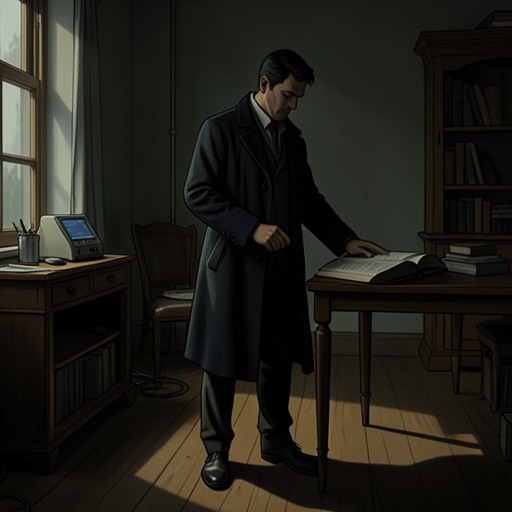
Annie Sawyer
A History of the Vampire in Popular CultureAnnie Sawyer is the dead third occupant of the house shared by Mitchell and George Sands in Being Human. Her decisive significance lies in the way her ghostly existence completes an otherwise impossible domestic arrangement: a vampire, a werewolf, and a dead woman become a household whose members are bound not by normality but by their shared difficulty in belonging anywhere else.
Identity and Introduction
Annie is introduced as being of a similar age to Mitchell and George, but with the fundamental difference that she is already dead. The house initially becomes a refuge for Mitchell, who is trying to live without surrendering entirely to his vampiric nature, and George, who is struggling with the consequences of being a werewolf. Annie changes the meaning of that refuge when she appears as its unexpected third occupant. Her condition is not merely a background fact: death determines the terms on which she can inhabit the house and on which others can recognize her.
Mitchell and George are the only people able both to see and to interact with Annie’s ghost. That restriction separates the three from ordinary human society while giving them a rare form of mutual recognition. Annie is invisible to the wider world in a literal sense, just as Mitchell and George must conceal their supernatural identities in order to pass through it. The house therefore gathers three different forms of exclusion under one roof: vampirism, lycanthropy, and death.
Place in the Household
Annie rapidly becomes close friends with Mitchell and George. The friendship is significant because it offers stability to characters whose identities otherwise threaten to isolate them. Mitchell welcomes the steadiness of his relationship with George, and the arrival of Annie extends that fragile arrangement into a three-way bond. Their companionship is not presented as an easy escape from danger; it is a practical and emotional alliance formed by people who can understand one another’s hidden conditions.
Annie’s presence also makes the home a threshold space. It is neither fully human nor wholly supernatural, and it is neither simply a place of the living nor a site reserved for the dead. Her ability to remain there as a ghost gives domestic life an afterlife, while Mitchell and George bring the dangers of the nonhuman world into ordinary rented accommodation. The resulting household reverses the usual separation between haunted place and living home: the ghost is not an intruder who must be expelled, but a resident whose relationships make the house function.
Relationships and Conflict
Annie’s closest relationships are with Mitchell and George, and each friendship answers a different form of vulnerability. George is described as an unlikely and unassuming werewolf, while Mitchell is a vampire who has been forced to live with a condition he resents. Annie, like them, is unable to participate in human life on ordinary terms. Their shared household consequently becomes a small social world in which concealment is replaced by recognition.
Mitchell’s conflict intensifies the importance of Annie’s friendship. He has lived for decades with the fear that the people closest to him would despise him if they saw the full extent of his cruelty and bloodlust. George and Annie are the secure part of his life, and he cannot afford to lose them. Annie is therefore not simply one companion among others; she belongs to the emotional structure Mitchell protects while trying to remain more human than monster.
The friendship also creates a contrast between Annie’s condition and Mitchell’s. Annie is dead but retains a social presence, while Mitchell is technically alive in the world yet feels permanently separated from humanity. George occupies another unstable position, living as a human while carrying the potential for transformation into a wolf. Their bond makes these distinctions less absolute without erasing their consequences.
Narrative Function and Thematic Significance
Annie embodies the book’s recurring uncertainty about what death means. Elsewhere, apparent signs of vampirism can be produced by tuberculosis, decomposition, purge fluid, premature burial, or adipocere, while communities interpret frightening bodily changes through supernatural explanations. Annie differs from those mistaken cases because the narrative treats her ghost as an active presence who can see, communicate, and form attachments. Her existence nevertheless belongs to the same imaginative field: she makes visible the fear that the dead may not remain neatly separated from the living.
Her character also gives the supernatural a domestic and relational scale. Vampire stories often focus on predation, contagion, or the spectacle of the corpse returning to the grave. Annie instead shows what an afterlife might look like when it is organized around rent, friendship, and the need for companionship. The haunting is not only an event to be explained; it becomes a condition of shared life.
Against Mitchell’s desperate wish to be human, Annie offers a different version of otherness. She cannot return to ordinary human existence, but she can still participate in loyalty, intimacy, and friendship. In that sense, the household does not solve the characters’ exclusion. It gives exclusion a form in which they can care for one another. Annie’s narrative role is consequently both connective and unsettling: she helps create the most stable relationship in Mitchell’s life while ensuring that the home remains permanently suspended between the living and the dead.