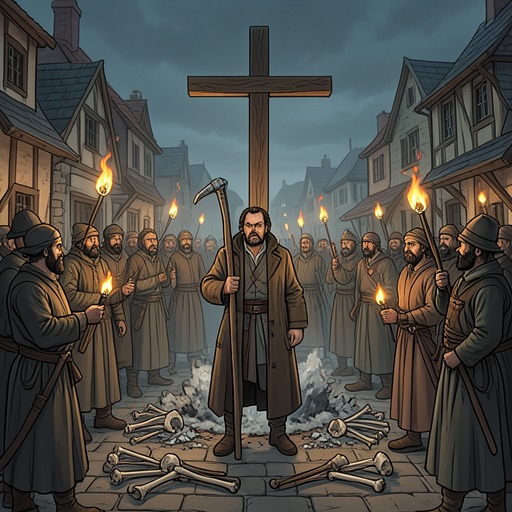
Arnold Paole
A History of the Vampire in Popular CultureArnold Paole was a Serbian hadjuk whose death in 1726 became one of the best-known early cases in the eighteenth-century vampire craze. After fellow villagers fell ill, they treated his earlier account of a vampire encounter as an explanation for the sickness and concluded that Paole had become a vampire himself. The exhumation and destruction of his body turned a local sequence of misfortune into a durable narrative of supernatural contagion, later echoed in other vampire reports.
Identity and Background
Paole was a hadjuk, a term that roughly describes a member of an irregular peasant infantry. He died in 1726 in Trstenik, a village on the banks of the West Morava River in central Serbia. His death was not initially attributed to a vampire: he broke his neck after falling from a hay wagon. It was the illnesses that followed, rather than the circumstances of the accident, that made his body the focus of communal fear.
The account places Paole in a landscape where reports of vampire attacks could shape explanations of sickness and death. The book describes the eighteenth-century vampire craze as a period in which entire villages became convinced they were threatened by vampires, sometimes digging up suspected corpses in order to stake them. Paole’s case is presented as an earlier outbreak in the same region, not as the later investigation of a different Serbian village by Johann Flückinger in 1731.
The Reported Vampire Encounter
Before his death, Paole had said that a vampire had plagued him some years earlier, probably in the area now known as Kosovo. He claimed to have escaped by eating soil from the vampire’s grave and covering himself with blood. The account preserves these actions as Paole’s own reported means of protection; it does not establish that the encounter occurred or that the ritual had any effect.
The detail of the blood covering carries an unsettling contradiction: the alleged remedy against a blood-drinking creature involved smearing oneself with blood. The book draws attention to that incongruity rather than resolving it. In the villagers’ later interpretation, however, Paole’s story supplied a causal link between an earlier supernatural attack and the sickness that appeared after his death. The claim that he had been infected made his death seem less like the end of an accident’s aftermath and more like a transfer of danger to the living.
Death, Illness, and Exhumation
When villagers began to fall ill not long after Paole’s death, they concluded that the vampire in Kosovo had infected him and that he had now become a murderous creature of the night. The sequence gave the community a target and an explanation: sickness among the living was connected to a dead neighbor whose own story already contained a vampire. The account does not identify the illnesses or establish a medical cause for them.
Paole’s body was disinterred. The horrified villagers reportedly found no signs of decomposition, and it was said that the nails on his hands and feet had fallen off and been replaced by new growth. When the body was staked, it was reported to have shrieked and bled from the wound. These observations were narrated as evidence of vampirism, but they remain reported signs rather than a verified account of supernatural life.
The book’s broader discussion offers ordinary bodily processes as possible explanations for some recurring features of such stories, without establishing what happened to Paole’s particular corpse. Skin and soft tissue can shrink as a body dehydrates, making nails appear to have grown; fluid produced during decomposition can emerge from the mouth or nose and be mistaken for blood. Gas released under pressure could also produce a sound when a corpse is pierced. These possibilities complicate the villagers’ interpretation, but the available account does not let them be applied as a definitive diagnosis of Paole’s remains.
Cremation and the Case’s Afterlife
Paole’s former neighbors chose what they considered the safest response and cremated his remains. The action closed the immediate episode by destroying the body they believed to be dangerous, while also preserving the story’s central pattern: a death followed by illness, an apparently unchanged corpse, and a ritual intended to stop further harm. In this account, cremation follows the staking report; it is not presented as a medical intervention or as proof that the villagers’ fears were correct.
The case acquired a second life through later retellings. A newspaper story published in 1870 about a supposed Serbian vampire outbreak included details closely resembling Paole’s story, especially the claim that a man had protected himself from vampirism by eating soil from his attacker’s grave and covering himself with blood. The book judges that later account almost certainly fictitious and suggests that Paole’s story supplied material for it. The resemblance shows how a reported local incident could become a reusable narrative, with distinctive details migrating into a new tale while lending it the appearance of corroboration.
Paole’s importance in the book is therefore not that his vampirism is established, but that his case shows how a community’s interpretation of sickness could become an enduring vampire report. A broken-neck death, subsequent village illness, claims about a body that resisted ordinary decay, and the decision to burn it were assembled into a story of infection from the grave. Later explanations of corpse changes challenge the supernatural reading, while the account’s transmission reveals how the accusation itself could survive and circulate as cultural evidence.