Arnold Paole vampire case
A History of the Vampire in Popular CultureThe Arnold Paole vampire case was a 1726 Serbian episode in which the accidental death of a hadjuk was followed by sickness among fellow villagers and interpreted as evidence that the dead man had become a vampire. Its decisive significance lies in the way a local chain of death was transformed into a supernatural case: Arnold Paole’s earlier account of surviving a vampire attack supplied the story’s origin, while the reported condition of his exhumed body supplied its most disturbing evidence.
Death and Suspicion
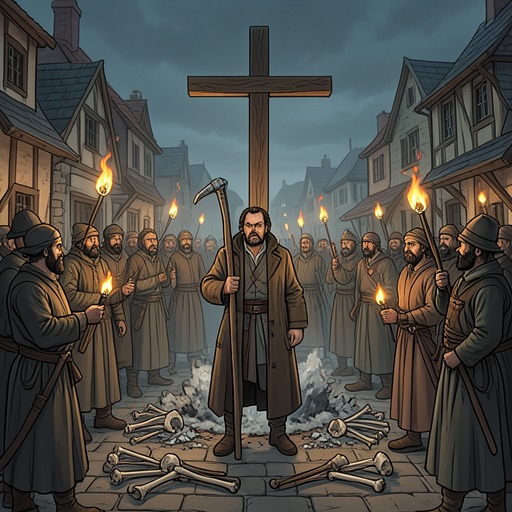
Arnold Paole was a Serbian hadjuk, a term roughly meaning a member of an irregular peasant infantry. In 1726 he died in the village of Trstenik, on the banks of the West Morava River in central Serbia, after falling from a hay wagon and breaking his neck. The death itself was accidental, but the explanation imposed upon it was not. When villagers began to fall ill soon afterward, they connected the sickness with Paole’s death and concluded that he had returned as a murderous creature of the night.
That conclusion drew on Paole’s own earlier report that he had been plagued by a vampire, probably in the region now known as Kosovo. He claimed to have escaped by eating soil from the vampire’s grave and covering himself with blood. The strange protective ritual became central to the later account because it allowed the villagers to imagine Paole not merely as a victim of vampirism but as someone who had been infected by it and subsequently transmitted the condition. The case therefore joined an individual testimony to a communal theory of contagion: the vampire was understood as a force that could pass from an attacker to a survivor and from that survivor to a village.
Exhumation and Corpse Evidence
Paole’s body was disinterred after the villagers attributed the subsequent illnesses to him. They reportedly found no signs of decomposition. The account further claimed that the nails on his hands and feet had fallen away and been replaced by apparently fresh growth, a detail that made the corpse seem to be undergoing transformation rather than ordinary decay. When the body was staked, Paole was said to have shrieked and to have bled from the wound.
The villagers treated these reported signs as confirmation rather than as questions requiring further investigation. They cremated Paole’s remains, choosing destruction as the safest way to prevent another outbreak. In the chronology of vampire belief, the case is recorded as a 1726 death in Serbia followed by sickness attributed to Paole’s transformation into a vampire; the episode thus became one of the documented precedents for later investigations of alleged undead outbreaks.
Medical Explanations and Historical Afterlife
The reported signs at Paole’s exhumation belonged to a wider pattern in which ordinary processes of decomposition were interpreted as proof of vampirism. Accounts of disinterred corpses often described blood around the mouth or in the stomach, but these observations predated modern knowledge of what happens after death. As a corpse decomposes, purge fluid forms when body tissues break down; pressure can force the red-black liquid from the mouth and nose, where it may be mistaken for blood. A stake could also release fluid accumulated in the body cavities, creating the appearance that the corpse was bleeding. The alleged shriek attributed to Paole may likewise have resulted from gases building inside the body and escaping under pressure, rather than from renewed life.
Other physical changes could produce the appearance of continued growth or unusual preservation. Dehydration causes skin and soft tissue to shrink, making nails and hair seem to lengthen after death even though neither can grow without a living host. Airtight coffins or heavy clay soil can slow decomposition by limiting bacterial activity and access by insects and animals. A further possibility is saponification, the anaerobic bacterial hydrolysis of body fat that produces adipocere, or corpse wax; this wax-like substance can preserve facial features and inhibit ordinary decay. Such explanations do not erase the historical reality of the villagers’ fear, but they show how ambiguous bodily evidence could be converted into a coherent supernatural diagnosis.
Paole’s case also belonged to a broader eighteenth-century atmosphere of credulity, curiosity, and institutional uncertainty. During the nineteenth century, tuberculosis outbreaks in New England would similarly be understood through the idea that the dead were stealing the life force of surviving relatives, while earlier European communities had responded to clusters of deaths by hunting and staking suspected vampires. In each setting, a sequence of unexplained illnesses created pressure for a visible cause and a practical remedy. The corpse became the place where communal anxiety sought confirmation, and exhumation, staking, cremation, or decapitation offered a ritual sense of control even when the underlying disease remained untouched.
Cultural Transmission and Institutional Memory
The Arnold Paole vampire case acquired significance beyond the village because reports of alleged undead outbreaks circulated through increasingly authoritative channels. The 1726 episode was later associated with the wider eighteenth-century vampire craze, when communities in eastern Europe hunted suspected vampires and opened graves to examine corpses. In 1731, Johann Flückinger investigated a separate Serbian outbreak in which thirteen deaths had occurred in one village; his report was mentioned in The London Journal in 1732 and became the first known reference to vampires in the English press. Flückinger and his companions ultimately cut the heads off the suspected vampire corpses before reburial, demonstrating how medical inspection and ritual prevention could operate together rather than as clear alternatives. Arnold Paole’s case thus belonged to a developing documentary tradition in which local testimony, official inquiry, military observation, and printed reportage helped turn a village belief into portable historical knowledge.