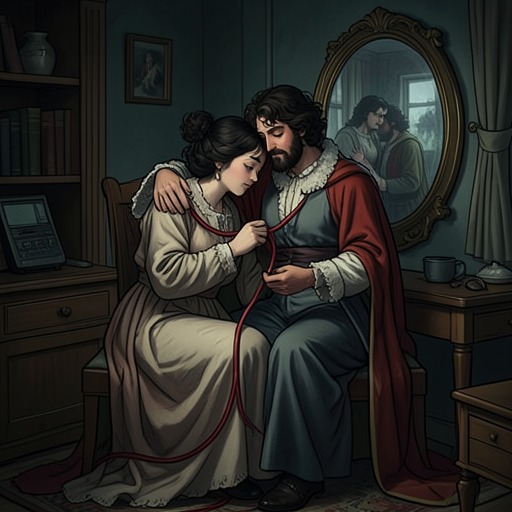
Baron Vordenburg
A History of the Vampire in Popular CultureBaron Vordenburg is the learned authority who brings Carmilla’s mystery to its violent resolution. In Sheridan Le Fanu’s 1872 novella, he joins Laura and General Spielsdorf after their investigation has linked a series of deaths to the same woman, and his intervention finally destroys the vampire hidden behind the names Carmilla, Millarca, and Mircalla. His importance lies less in personal drama than in the way he converts suspicion, memory, and inherited legend into an organized act of identification and exhumation.
Identity and Introduction
Baron Vordenburg enters the narrative at the point where private fear must become public knowledge. Laura and her father have encountered General Spielsdorf, whose niece Bertha died after befriending a mysterious young woman called Millarca. The circumstances of Millarca’s arrival closely resemble Carmilla’s earlier entrance into Laura’s household, while the name itself is an anagram of Carmilla. The investigation therefore turns on recognizing that apparently separate identities belong to one predatory being.
Vordenburg joins Laura and the General in travelling to the nearby town of Karnstein, where they seek Mircalla’s tomb. His appearance marks a change in the investigation’s character. Before his arrival, the evidence consists of grief, resemblance, repeated patterns, and Carmilla’s evasive conduct; with him, the group gains the specialist knowledge needed to interpret those clues and act upon them.
Knowledge and the Unmasking of Mircalla
The Baron’s central function is to establish that Carmilla, Millarca, and Mircalla are not three women but three names for the same vampire. This recognition explains the repeated structure surrounding Laura and Bertha: each young woman receives an apparently vulnerable visitor, forms an intense connection with her, and becomes exposed to nocturnal predation. The identity concealed by changing names is thus also the mechanism by which the vampire repeatedly enters protected domestic spaces.
Vordenburg’s knowledge counters the uncertainty that has allowed Carmilla to evade the General. When the General and Laura are alone, Carmilla appears and reacts with rage, again avoiding the General’s attempts to kill her. Her ability to survive these efforts demonstrates that personal courage and direct violence are insufficient by themselves. The Baron’s contribution is the interpretive and procedural authority that the earlier confrontation lacks: he helps direct the search toward Mircalla’s tomb rather than treating Carmilla as merely an unusually dangerous living woman.
Destruction and Narrative Consequence
The Baron finally destroys the vampiric Mircalla. This act ends the immediate threat to Laura and completes General Spielsdorf’s effort to avenge Bertha, whose death first exposed the pattern. It also resolves the tension between the vampire’s shifting present identities and her buried historical identity. Carmilla can move through contemporary society under borrowed names, but the tomb supplies the material continuity that her disguises conceal.
The ending gives Vordenburg a distinctly practical heroic role. He does not rescue Laura through romance or supernatural transformation; he restores a boundary between the living household and the dead predator by locating and destroying the body that anchors the vampire’s return. His victory is therefore both physical and epistemological: the monster is defeated only after the group learns who she is and where her past remains.
Historical and Thematic Significance
Vordenburg belongs to a nineteenth-century vampire tradition in which older revenant beliefs were being reshaped into more recognizable literary mythology. Earlier accounts imagined the dead returning from the grave, while Varney the Vampire introduced sharpened, fang-like teeth and made vampirism part of the expanding Penny Dreadful culture. Carmilla developed another modern convention: the elegant night creature who sleeps through the day, selects victims with increasing discrimination, and feeds through an emotionally charged intimacy.
His role also clarifies the novella’s tension between attraction and threat. Carmilla is presented as emotionally and physically predatory, sleeping through the day, moving by night, making romantic overtures toward Laura, and refusing to join the family’s prayers. Vordenburg stands on the opposite side of that seduction: he makes the hidden danger legible and turns its erotic, aristocratic surface back into a mortal case requiring investigation. The contrast helps explain why Carmilla became so influential even as later vampire fiction moved toward more sympathetic, glamorous, or morally ambiguous figures.
That later flexibility is part of the character’s wider historical setting. Modern vampires may be heroes, villains, openly integrated figures, or objects of self-conscious comedy, while the goth subculture that emerged from early-1980s Britain’s post-punk clubs transformed the undead into a living musical and fashion identity. Against those later reinventions, Vordenburg remains tied to an older narrative requirement: before the vampire can be accepted, aestheticized, or made sympathetic, someone must determine what it is, expose the name beneath its aliases, and end its power.