Belgrade
A History of the Vampire in Popular CultureBelgrade functions in the vampire history recounted here less as a scenic setting than as a center of examination and certification. In the Serbian cases of the early eighteenth century, reports from villages were sent to the tribunal of Belgrade, whose officers, accompanied by an executioner, opened graves and recorded what they found. The city therefore stands at the intersection of local fear, imperial administration, bodily evidence, and the production of a documented vampire epidemic.
Administrative Center of the Vampire Panic
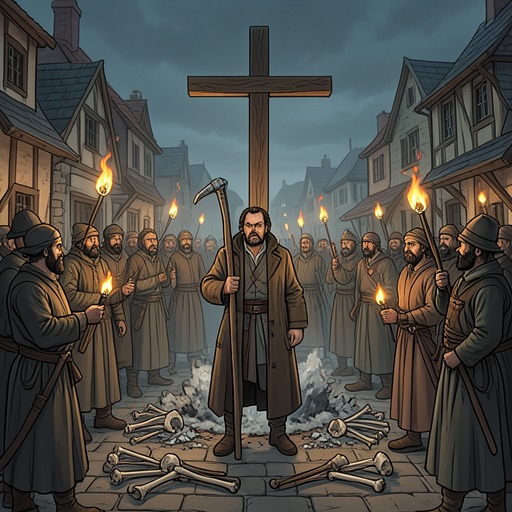
In the eighteenth-century vampire craze, eastern European communities responded to clusters of deaths by hunting suspected vampires and exhuming corpses. Belgrade appears as the authority to which one Serbian village appealed when thirteen deaths occurred in 1731 in close succession. A local doctor attributed the deaths to malnutrition, but the villagers rejected that explanation and insisted that vampires were responsible. Their conviction transformed a local health crisis into an administrative investigation, with the tribunal at Belgrade dispatching officials and an executioner to examine the graves.
The investigation shows how supernatural explanations could become embedded in official procedure rather than remaining purely oral folklore. The villagers supplied the accusation, while Belgrade supplied personnel, jurisdiction, and a method of inquiry that included opening graves and judging the condition of the dead. The resulting record did not simply dismiss popular belief; it preserved the villagers’ interpretation in a form that could travel beyond the community.
The Belgrade Tribunal and the Serbian Bodies
The tribunal’s involvement is especially important in the account later associated with Johann Flückinger’s vampire investigation. Officials in Vienna sent Flückinger, a respected military surgeon, to verify the findings reported by a doctor in the region, accompanied by other doctors and army officers as witnesses. The chain of inquiry thus connected village testimony to Belgrade’s tribunal and then to wider imperial scrutiny. Belgrade was the bureaucratic hinge through which alleged vampirism became a matter for officers, surgeons, and official reports.
The corpses examined after six weeks of burial were described as lacking major decomposition and as having acquired a plump appearance. Such observations were treated as evidence of vampirism, although the wider account also records the period’s limited understanding of disease, death, and post-mortem change. Flückinger’s report became the first fully documented account of a Serbian vampire epidemic, giving the claims an archival durability that ordinary village testimony would not have possessed.
Evidence, Authority, and Competing Explanations
Belgrade’s role reveals a conflict between different systems for explaining death. In the nineteenth-century New England vampire panic, tuberculosis spread through households and was interpreted as the dead stealing the life force of surviving relatives. In Exeter, Rhode Island, the exhumation of Lena “Mercy” Brown followed the deaths of her mother Mary, her elder sister Mary Olive, and then Mercy herself; the family hoped that removing and burning Mercy’s heart and lungs might save Edwin. The remedy failed, and Edwin died on 2 May 1892. These cases show how fear sought a target when disease seemed uncontrollable.
The Serbian investigations similarly converted uncertainty into a physical narrative. Blood in a corpse, apparent freshness, and bodily fullness were selected as signs that the dead were active. Yet Antoine Augustin Calmet, writing from a religious world that still accepted reports of revenants, also proposed physiological and psychological explanations. He argued that corpses might sometimes shed fluid blood after burial and that people terrified by imagined vampires could suffer such violent shock that they died. He further connected vampire beliefs to burial customs in which food and wine were left at graves, suggesting that symbolic offerings could be reinterpreted as proof that the dead returned to eat.
From Official Report to Cultural Memory
The Belgrade material gained authority because it was presented as juridically attested by officers and witnesses considered reputable. That authority did not eliminate uncertainty; it made uncertainty legible as a problem of testimony, inspection, and interpretation. A report could admit that physics supplied no adequate cause while still treating the documented event as true. Belgrade consequently became part of the historical machinery by which vampire belief was not merely imagined but recorded, certified, debated, and reproduced.
Later vampire panics demonstrate the continuing circulation of this pattern through other institutions. In 1954, newspaper coverage of the Gorbals Vampire hunt in Glasgow blamed imported horror comics for children’s hysteria and pressed the government to ban the genre. The resulting debate concerned the legal meaning of obscenity under the Obscene Publications Act 1857 and the proposed power to restrict publications considered harmful to children. Set beside the Serbian tribunal, this episode shows a recurring movement from fear to public accusation, from accusation to institutional intervention, and from intervention to a durable cultural record.
Narrative Significance
Belgrade’s significance lies in this passage between the village and the archive. It represents the moment when a community’s dread entered the language of tribunals, officers, medical inspection, and written evidence. The city does not resolve whether the Serbian dead were vampires. Instead, it exposes how explanations of death acquire authority: through witnesses, official dispatches, bodily signs, legal procedures, and the willingness of institutions to preserve claims that remain scientifically unresolved. In the book’s larger history, Belgrade is therefore both a location and a mechanism for turning local terror into a lasting vampire narrative.