British horror-comics censorship campaign
A History of the Vampire in Popular CultureThe British horror-comics censorship campaign was a mid-twentieth-century moral panic in which a sensational vampire story, amplified by newspapers and public officials, was treated as evidence that illustrated horror was corrupting children. Its decisive outcome was the Children and Young Persons (Harmful Publications) Act 1955, a law prompted almost entirely by the Gorbals Vampire incident and still in force despite the uncertainty built into its definition of harmful material.
The Gorbals Vampire and the Birth of a National Scandal
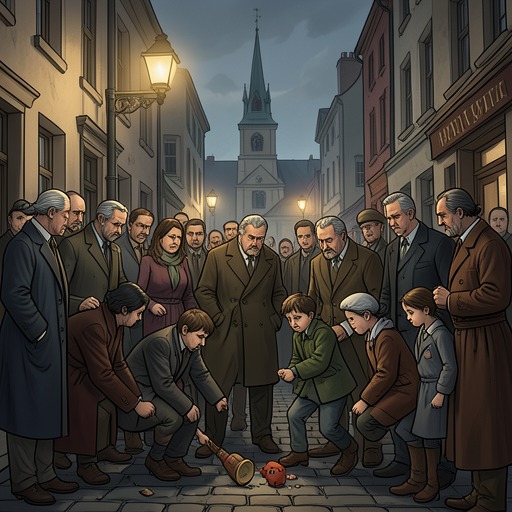
The campaign gathered force after the Gorbals Vampire incident in Glasgow in September 1954. Hundreds of schoolchildren converged on the Southern Necropolis after rumours spread that a vampire with iron teeth had killed two local children and remained at large. No child murders or disappearances had been reported that year, but the absence of evidence did not prevent the rumour from becoming an organizing fact. The children carried stakes and knives, and some brought dogs; police attempting to clear the cemetery were overwhelmed by the numbers moving through its neglected grounds, which contained nearly a quarter of a million graves.
The press converted the episode into a national spectacle. The Daily Mirror placed it on its front page on 25 September 1954 under the headline “AMAZING SCENE AS HUNDREDS OF CHILDREN STORM A CEMETERY,” with “The Toddlers Joined In” as its sub-header. The article mocked the story as a “stupid tale,” yet its own dramatic scene showed children clinging to the reporter and asking whether he had come to shoot and kill the vampire so that they could sleep. The reporting therefore performed the same amplification it appeared to condemn: ridicule and sensationalism carried the legend farther than the original local rumour could have done.
The story was soon connected to imported horror comics. A local mother said that her seven-year-old son, frightened by what he had read, had run home sobbing and begged her to close every window because the vampire would get into the house. The Education Officer of Glasgow, Dr H. S. Mackintosh, argued that horror comics had gone beyond acceptable limits and called for active government intervention. The press then suggested that civic and welfare leaders might seek a complete ban, turning a cemetery disturbance into a question of national child protection.
From Newspaper Hysteria to Political Pressure
The campaign depended on a widening chain of accusation. Children were presented as both victims and agents of the panic; comics became the alleged source of their fears; parents supplied emotionally powerful testimony; newspapers supplied repetition; and politicians supplied the prospect of legislation. On 1 October 1954, Alice Cullen, the Member of Parliament for the Glasgow constituency of Gorbals, was reported as asking Home Secretary Sir David Maxwell Fyfe to introduce legislation banning the sale of horror comics in the United Kingdom. Her request followed the cemetery invasion of the previous week, giving the vampire story a direct route into parliamentary debate.
The Daily Mirror intensified the pressure on 27 September by asking whether the city might demand a ban on horror comics and by attributing the hysteria to American publications. On 1 October, it reported another outbreak of fear in which children attacked a family of travellers in a caravan with stones while shouting that the occupants were witches. The episode broadened the supposed danger from supernatural belief to collective aggression, making the argument for regulation appear to concern not merely frightening images but the behaviour those images were said to produce.
The proposed remedy was legally difficult. A confidential government memo of 25 November 1954 noted that an entire genre of comics could not easily be prohibited because the existing law had no precise definition of what counted as “obscene.” Under the Obscene Publications Act 1857, obscenity was generally understood to apply to sexually explicit publications. The memo nevertheless argued that comics could be harmful to children even when they were not legally obscene, and that courts should possess comparable powers to prevent their circulation. This distinction was central to the campaign: the material was declared dangerous while remaining outside the established legal category that would have made suppression straightforward.
The 1955 Act and Its Definition of Harm
The Children and Young Persons (Harmful Publications) Act 1955 was introduced by Home Secretary Gwilym Lloyd George in May 1955 and came into force on 6 June. Its passage was driven almost entirely by the drama surrounding the Gorbals Vampire incident. Rather than naming a single title or narrowly defining horror comics, the Act targeted any book, magazine, or similar work likely to reach children or young persons that consisted wholly or mainly of picture stories, with or without written matter, and portrayed crimes, violence or cruelty, or incidents of a repulsive or horrible nature in a way that might corrupt a child or young person.
The wording gave the campaign a durable but imprecise instrument. It linked pictures to possible moral corruption without requiring proof that a particular comic had caused a particular offence. The final test concerned whether the work as a whole would tend to corrupt its young reader, a formulation broad enough to support official concern but vague enough to make consistent application difficult. The Act remains in force, although its lack of precision may help explain why there have been barely any prosecutions under it.
The legislation also revealed how moral panic can convert an unverified threat into institutional common sense. The alleged vampire was never established as a real killer, and the children’s expedition may have developed from local environmental imagery rather than imported American comics. The Southern Necropolis stood beside Dixon’s Blazes, an ironworks whose furnaces illuminated the night with red light and smoke. One child later recalled that the glow made gravestones appear to leap and figures seem to walk behind them. A traditional local story may therefore have supplied more of the legend than the comics blamed by newspapers and officials.
Cultural Context and the Scapegoating of Media
The campaign belonged to a broader culture in which rapid social change encouraged both curiosity and credulity. The nineteenth century had already combined industrial development, scientific discovery, spiritualism, and reports of witchcraft treated as fact. Epidemic disease could be explained through the belief that the dead were returning to drain the living, while village communities in eastern Europe had hunted and staked supposed vampires during the eighteenth-century vampire craze. In such settings, supernatural narratives offered a target for fear when medical or social explanations seemed inadequate.
The same structure reappeared in modern form around the Gorbals incident. The vampire became an identifiable threat, while the comics became the alleged mechanism by which that threat entered children’s minds. The scale of the reaction far exceeded the evidence of actual harm. A rumour with no recorded child victims produced newspaper campaigns, parliamentary demands, official memoranda, and legislation. The campaign thus exemplifies moral panic and deviance amplification: media attention magnified an uncertain event, public anxiety made the magnification appear justified, and the resulting policy confirmed that the original anxiety had been a legitimate national problem.
The episode also belongs to a longer history of using vampires to mark outsiders. Vampire stories have repeatedly served as metaphors for intruders, immigrants, sexual outsiders, and other people regarded with simultaneous fascination and suspicion. The censorship campaign displaced that older fear onto a commercial medium and its youthful audience. Horror comics were labelled contaminating objects, while children were imagined as especially vulnerable bodies whose moral boundaries required adult and governmental protection.
Legacy and Historical Significance
The immediate legacy of the campaign was legal: the 1955 Act created a continuing basis for restricting illustrated publications that portrayed crime, violence, cruelty, or horror in a potentially corrupting manner. Its historical significance is broader. It demonstrates how a local cemetery rumour can become a national policy issue when newspapers provide a vivid image, officials identify a convenient cause, and politicians translate anxiety into protective legislation.
The campaign also leaves an irony at its centre. The material condemned as socially dangerous included stories of cowboys, private detectives, Frankenstein, and Captain Marvel, publications that can appear innocent to modern eyes. Yet their selection and submission to Winston Churchill symbolized the seriousness with which the state received the campaign. The resulting law did not prove that comics had created the Gorbals panic; it proved that the panic had successfully created a new legal category of cultural danger.
In this sense, the British horror-comics censorship campaign was not simply an attempt to remove frightening pictures. It was a struggle over who could define childhood, corruption, evidence, and acceptable imagination. The Gorbals Vampire supplied the memorable image, the press supplied circulation, and the state supplied permanence. What began as a rumour about an iron-toothed creature ended as a lasting example of how fear can move from folklore into journalism, from journalism into public policy, and from public policy into law.