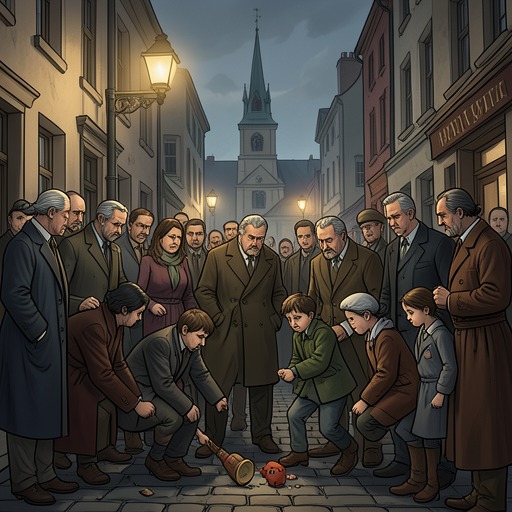
Children and Young Persons (Harmful Publications) Act 1955 enactment
A History of the Vampire in Popular CultureThe Children and Young Persons (Harmful Publications) Act 1955 marked the moment when a local story about a supposed vampire, hundreds of frightened children, and an overcrowded cemetery became national policy. Prompted almost entirely by the Gorbals Vampire incident, the Act treated illustrated depictions of crime, violence, cruelty, and horror as a potential danger to the young, converting media anxiety into a lasting legal mechanism whose vagueness helped it remain in force.
Causes and Background
The Act emerged from a period in which social change repeatedly made old fears available for new use. The nineteenth century had already shown how disease, industrial transformation, and uncertainty could encourage supernatural explanations: tuberculosis was interpreted in New England as the work of the dead draining the life force of surviving relatives, while the eighteenth-century vampire craze had turned unexplained deaths in eastern Europe into campaigns of exhumation and staking. By the twentieth century, the same pattern could operate through mass media. Stories, newspapers, and comics supplied visible objects for anxieties that were otherwise diffuse.
Postwar Britain provided a particularly receptive setting for this process. Horror comics were condemned as foreign imports, while the country was already negotiating rapid cultural change and fears about juvenile behaviour. The Gorbals episode supplied an apparently concrete demonstration of danger. On the night of 23 September 1954, hundreds of schoolchildren gathered in Glasgow’s Southern Necropolis after rumours spread of a vampire with iron teeth that had killed two children. Many carried stakes and knives; some brought dogs. Police struggled to clear the children from a neglected cemetery containing nearly a quarter of a million graves, even though there had been no reports of child murders or disappearances that year.
The episode became a media event before it became a legislative argument. The Daily Mirror placed it on its front page on 25 September under the headline “AMAZING SCENE AS HUNDREDS OF CHILDREN STORM A CEMETERY,” adding the sub-header “The Toddlers Joined In.” Reports of children pleading that the vampire be killed so they could sleep, and of a seven-year-old fearing that the creature would enter through an open window, made the danger seem immediate and domestic. The newspaper then pressed the question of banning horror comics, while Glasgow civic and welfare leaders attributed the hysteria to American publications. The press therefore presented the comics not merely as entertainment but as a causal agent capable of turning fantasy into collective action.
Legislative Course
The political response began before the Act itself. On 1 October 1954, Alice Cullen, then Member of Parliament for the Glasgow constituency of Gorbals, was reported to have asked Home Secretary Sir David Maxwell Fyfe to introduce legislation banning the sale of horror comics in the United Kingdom. A confidential memorandum circulated on 25 November among the Secretary of State, the Home Office, the Secretary of State for Scotland, and the Minister for Education acknowledged the difficulty of banning an entire genre. Existing law offered no clear definition of what was obscene: under the Obscene Publications Act 1857, obscenity was generally understood to concern graphically sexual material.
The memorandum nevertheless argued that the comics could be as harmful as, or more harmful than, publications already classed as obscene. That distinction was crucial. The proposed intervention did not claim that horror comics were obscene under the existing statute; it demanded that courts receive comparable powers to restrict their circulation because of their presumed effect on children and young persons. The policy thus extended the logic of obscenity regulation from sexual content to imagined psychological and moral influence.
Home Secretary Gwilym Lloyd George introduced the Children and Young Persons (Harmful Publications) Act 1955 in May 1955, and it came into force on 6 June. The legislation was aimed at books, magazines, and similar works likely to fall into the hands of children or young persons that consisted wholly or mainly of picture stories, with or without written matter. Its focus was not a named character, publisher, or isolated issue, but a form of visual storytelling considered dangerous in itself when its overall effect was judged corrupting.
Scope and Operation
The Act covered illustrated works portraying the commission of crimes, acts of violence or cruelty, or incidents of a repulsive or horrible nature. The decisive test was whether the work as a whole would tend to corrupt a child or young person into whose hands it might fall. This language gave the statute a broad reach. It joined the concrete categories of crime, violence, cruelty, and horror to the less precise judgment of corruption, leaving considerable room for interpretation by authorities and courts.
The law’s breadth also reveals the structure of the panic that produced it. The supposed vampire was not treated as the primary problem; the problem became the circulation of images through which children might encounter violence or horror. The children of the Gorbals were therefore recast from frightened participants in a rumour into evidence that printed fantasy could produce public disorder. The legislation transformed a disputed chain of influence—comic books leading to fear, fear leading to a cemetery hunt—into a presumption that certain illustrated narratives required preventive control.
The government reinforced the seriousness of its position by sending Winston Churchill samples of the supposedly offensive publications. To modern eyes, the collection reportedly included relatively innocent stories about cowboys and private detectives, as well as Frankenstein and Captain Marvel. Whatever Churchill made of the material, the comics were deemed unsuitable and were subjected to the new legal climate. The contrast between the ordinary appearance of the samples and the severity of the political response exposes how much authority the surrounding narrative of danger had acquired.
Consequences and Aftermath
The Act was part of a wider British horror-comics censorship campaign, but its immediate political energy came from the Gorbals Vampire incident. The newspapers’ insistence that imported comics had caused hysteria gave officials a ready-made explanation for an event that may instead have grown from local conditions. The Southern Necropolis stood beside an ironworks known as Dixon’s Blazes, whose furnaces cast red light and smoke across the cemetery; one child later described the gravestones seeming to leap and figures appearing in the red glow. The legend may therefore have drawn on a traditional local story and an alarming landscape rather than on imported comics alone.
The episode also shows how media amplification can outrun evidence. The Daily Mirror repeatedly escalated the story, and the alleged vampire hunt was followed by reports of children attacking a travelling family’s caravan while shouting that its occupants were witches. Public fear expanded from an unverified cemetery rumour to a broader suspicion of children’s reading, strangers, and imagined contamination. The Act supplied institutional form to that escalation, making the state a participant in defining which images counted as socially dangerous.
Despite the vagueness of its final test, the Act remains in force. There have been barely any prosecutions under it, perhaps partly because the uncertainty of the wording makes enforcement difficult. Its endurance therefore matters as much as its direct use. The statute preserved the principle that pictorial narratives may be regulated not only for what they depict but for the moral effect authorities believe they may have on young readers.
Historical Significance
The enactment belongs to the recurring history of moral panic surrounding the Vampire as metaphor. Earlier communities turned tuberculosis, decomposition, and unexplained deaths into stories of revenants; the Gorbals episode turned children’s fear and a cemetery spectacle into an argument about mass entertainment. In each case, uncertainty was narrowed by assigning responsibility to a recognisable object: a corpse, a foreign vampire, a disease, or a comic book.
The Act’s significance lies in that conversion of cultural fear into legal language. It did not establish that horror comics had caused the Gorbals panic, nor did the reported incident establish that a vampire had harmed children. Instead, a rumour, press campaign, and political response formed a feedback loop in which each supplied credibility to the next. The resulting law outlasted the event that inspired it, preserving a postwar belief that the state might protect children by controlling the stories and images through which they encountered violence and horror.