Claudia
A History of the Vampire in Popular CultureClaudia is one of the defining figures in Anne Rice’s Interview with the Vampire and its 1995 film adaptation. Created after Louis de Pointe du Lac feeds on her in desperation, she becomes both the gift that Lestat de Lioncourt uses to keep Louis from leaving and the presence that ultimately makes their household impossible to sustain. Her decisive significance lies in the contradiction she embodies: Claudia possesses an immortal, developing consciousness while remaining outwardly a child, turning the fantasy of eternal life into a study of arrested embodiment, coercive family power, and ethical unease.
Identity and Creation
Claudia enters the story through Louis’s moral collapse rather than through an independent choice of her own. Louis is already a widower at twenty-four, devastated by the deaths of his wife and child and deliberately courting danger in the hope of escaping his grief through death. Lestat recognizes him as a possible companion and transforms him into a vampire, but Louis retains enough empathy to recoil from attacking human beings. In a moment of desperation, Louis feeds from the orphaned Claudia. Lestat then takes control of the situation, turning the child into a vampire and presenting her to Louis as a gift.
The language of the gift conceals a transaction. Claudia is not created because her own wishes matter, nor because the adults have considered what immortality will mean for a child. Lestat uses her as a token in his struggle to keep Louis attached to him: she becomes a bribe, a shared responsibility, and a new reason for Louis to remain within the relationship. Her transformation therefore establishes the household’s central imbalance from the beginning. Louis experiences Claudia as a child requiring care and protection, while Lestat treats her as an instrument of personal politics and companionship.
Development and Arrested Body
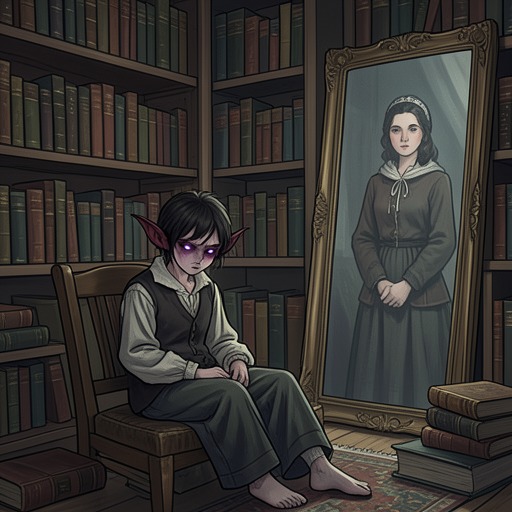
Claudia’s body remains physically immature even as her mind develops. She does not grow toward adulthood in the ordinary biological sense; instead, the passage of immortal time intensifies the distance between her appearance and her consciousness. The result is not merely a youthful vampire but an adult intelligence confined to a prepubescent form, a condition that makes every domestic and emotional relationship around her unstable.
This contradiction gives Interview with the Vampire its particularly uneasy atmosphere. Modern vampire culture often presents vampirism as inherently sexual, associating immortality with seduction, physical beauty, and adult desire. Claudia interrupts that pattern. Her body signifies childhood while her mind acquires the experience, knowledge, and agency of an adult woman. The visual and narrative clash cannot be resolved by calling her simply a child or simply an adult: she is both categories at once, and neither description is sufficient.
The same structural contradiction appears in Eli from Let the Right One In, another vampire whose outward age conflicts with the maturity and danger of the consciousness within. Claudia consequently belongs to a wider pattern of vampire figures whose bodies expose the false promise that eternal life preserves a person intact. Immortality does not halt change altogether; it can instead preserve one aspect of the self while allowing another to become increasingly alien to it.
Relationships and Family Conflict
Claudia’s relationship with Louis is shaped by tenderness, guilt, and dependence. Louis has already been transformed against the background of unbearable bereavement, and Claudia becomes a new focus for his need to love and protect someone. Yet his role is morally compromised because he is involved in the act that makes her immortal. His sympathy cannot undo the fact that Claudia has been condemned to a condition she did not choose.
Her relationship with Lestat is more openly political. Lestat’s decision to transform her is a tactic designed to preserve his connection with Louis, and Claudia’s presence helps him construct the appearance of a family. That appearance is deeply unnatural: the adults who create and control her can continue changing emotionally and physically, while Claudia is locked into the image of the child they have made. The household therefore turns parental language into a form of possession. Claudia is loved, but she is also managed; she is treated as family, yet her existence serves the interests of the beings who created her.
Claudia’s importance grows because she is not a passive ornament within this arrangement. The evidence describes her as uncontrollable, and her continuing mental development makes the limits imposed by her body increasingly intolerable. The childlike appearance that initially allows Louis and Lestat to imagine a family eventually becomes the visible sign of the household’s deception. Claudia’s very presence reveals that the domestic structure is founded on unequal power rather than mutual consent.
Actor, Adaptation, and Reception
In Neil Jordan’s film, Claudia was played by Kirsten Dunst, who was eleven during production. The performance required Dunst to portray an adult woman trapped inside an immortal child’s body, making the role technically and emotionally difficult. She later described the required intimacy with Louis’s actor, Brad Pitt, as deeply uncomfortable because she regarded him as an older brother figure. As an adult reflecting on those earlier remarks, she continued to insist that the experience had been disturbing rather than romantic.
Those comments illuminate the adaptation’s ethical problem rather than standing outside it. The film asks a child performer to enact adult emotional and sexual situations precisely because Claudia’s character is built around the collision between adult consciousness and childlike appearance. The discomfort is therefore not incidental to the role. It reflects the same contradiction that makes Claudia narratively powerful: the story wants the audience to recognize her as an adult mind, but the image of the child’s body cannot be made to disappear.
Dunst’s performance earned a Golden Globe nomination for Best Supporting Actress in 1995. The recognition confirms Claudia’s importance within the film, but it does not neutralize the disturbing premise. Her success as a character depends on the audience holding two incompatible perceptions together, seeing the intelligence and agency of an adult while remaining aware that the body presented on screen is that of a child.
Narrative and Thematic Significance
Claudia is described as the force that proves to be the undoing of the vampire household. Her transformation begins as Lestat’s attempt to secure Louis, but it creates the conditions for the collapse of the arrangement it was meant to preserve. The family that Lestat manufactures cannot contain Claudia’s developing mind, because the adults around her have fixed her permanently in a role she increasingly outgrows psychologically.
Her arc also complicates the usual moral division between victim and monster. Claudia is a predator, but she is first a child made into one by adults whose grief, loneliness, and desire for control take precedence over her autonomy. Her murderous potential cannot be separated from the coercive circumstances of her creation. At the same time, the narrative does not reduce her to innocence: her mental growth, emotional force, and lack of physical maturation make her dangerous in ways that ordinary categories of childhood cannot explain.
Through Claudia, Interview with the Vampire transforms eternal life from a glamorous escape into a condition of permanent disjunction. The body becomes a prison, the family becomes a mechanism of control, and the promise of endless time becomes inseparable from the loss of ordinary development. She is therefore not merely one member of Louis and Lestat’s vampire household. She is the figure through whom the story makes immortality look less like freedom than an irreparable mismatch between what a person is allowed to become and what the body is forced forever to display.