Daily Mirror
A History of the Vampire in Popular CultureDaily Mirror played a decisive role in converting the Gorbals Vampire incident from a local rumour into a national controversy about children, horror comics, and public morality. Its reporting did not merely record the cemetery disturbance: through headlines, emotional testimony, and repeated suggestions of comic-book influence, it amplified the event until the alleged vampire became evidence in a wider campaign for censorship.
The Cemetery Story and Its Front-Page Transformation
Daily Mirror gave the incident prominent national exposure on 25 September 1954, when it placed the story on its front page under the headline “AMAZING SCENE AS HUNDREDS OF CHILDREN STORM A CEMETERY”. The sub-header, “The Toddlers Joined In”, emphasized that the excitement had spread beyond older children. The report described the vampire as a “stupid tale”, signalling the writer’s scepticism while simultaneously presenting the episode as an extraordinary spectacle worthy of national attention.
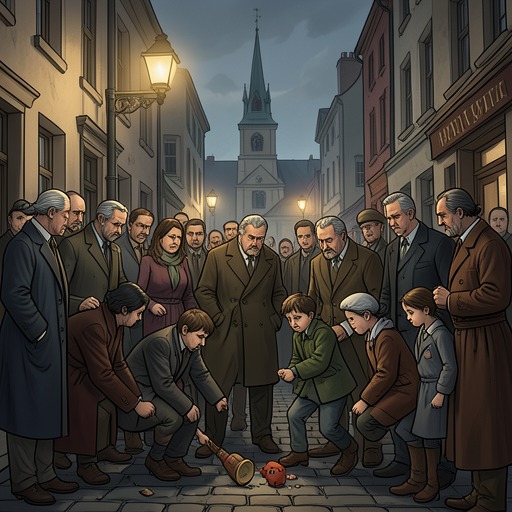
The article’s most memorable detail was a scene narrated by its reporter while walking through the cemetery at dusk. Children clung to his coat and shouted, “Have you come to shoot him, Mister? Kill him, so we can sleep tonight!” The quoted plea gave the story a vivid emotional centre: children appeared both frightened victims and eager participants in a supernatural hunt. By reproducing their words, Daily Mirror made the rumour legible as a public emergency even while dismissing its literal truth.
The underlying incident involved hundreds of young people gathering in Glasgow’s Southern Necropolis after rumours spread of a “vampire with iron teeth” that had killed two local children and remained at large. There had been no reports of child murders or disappearances that year, but the absence of evidence did not prevent the legend from mobilizing the crowd. Children carried stakes and knives, some brought dogs, and police struggled to clear them from a neglected cemetery containing nearly a quarter of a million graves.
From Local Excitement to Comic-Book Hysteria
Daily Mirror continued the story after the front-page report, allowing it to develop into an argument about imported horror comics. On 27 September, the newspaper proposed the headline “City may ask: Ban the horror comics”, reporting that civic and welfare leaders in Glasgow believed American horror comics were responsible for the hysteria and might seek to have them banned. The paper therefore shifted the story’s focus from what the children had believed to what adults believed had made them believe it.
The newspaper intensified that connection on 1 October, declaring, “Horror comic hysteria struck again here tonight,” after children attacked a family of travellers in a caravan by throwing stones and calling the occupants witches. The mother described a crowd that may have reached three hundred children, while a local resident said that traffic had been held up as the children surged across the road. By placing this attack alongside the cemetery hunt, Daily Mirror presented a pattern of comic-induced disorder rather than two separate episodes of collective fear.
The paper’s reporting also circulated the anxieties of local parents. One mother said that her seven-year-old son had run home sobbing and begged her to close every window because “the vampire will get us.” Such testimony made the alleged danger domestic and immediate. The vampire was no longer confined to a cemetery; through the child’s imagination, it had entered the family home. The newspaper’s method was characteristic of moral panic: a rumour, a frightened audience, and a supposedly corrupting cultural object were joined into a single causal story.
Political Pressure and Censorship
The Daily Mirror’s coverage coincided with growing demands for government action. On 1 October 1954, Alice Cullen, then MP for the Glasgow constituency of Gorbals, was reported as asking Home Secretary Sir David Maxwell Fyfe to introduce legislation banning the sale of horror comics in the United Kingdom. Her request followed the cemetery incident and showed how quickly a children’s rumour had moved from local streets into parliamentary debate.
Government officials recognized the legal difficulty of banning an entire genre. A secret memo circulated on 25 November 1954 noted that the existing law had no clear definition of what was “obscene”; under the Obscene Publications Act 1857, the term was generally associated with graphically sexual material. Yet the memo also argued that the comics were harmful to children and young people and that courts should have powers comparable to those used against obscene publications. The debate thus attempted to expand censorship beyond sexual obscenity toward violence, horror, and alleged psychological influence.
The pressure culminated in the Children and Young Persons (Harmful Publications) Act 1955, introduced by Home Secretary Gwilym Lloyd George in May and brought into force on 6 June. The Act targeted books, magazines, and similar picture-led works that portrayed crimes, violence, cruelty, or repulsive and horrible incidents in a form likely to corrupt children. Its passage was prompted almost entirely by the drama surrounding the Gorbals Vampire incident. Daily Mirror did not create the legislation alone, but its successive reports helped supply the images, anxieties, and public momentum through which the legislation became thinkable.
What the Newspaper Left in the Shadows
Later accounts suggest that the Gorbals legend may have arisen from local circumstances rather than imported comics. The Necropolis stood beside an ironworks known as Dixon’s Blazes, whose furnaces lit the night with red glare and smoke. One boy later recalled that the light and smoke made the gravestones seem to leap and produced the impression of figures moving in a red-lit background. The setting itself could therefore generate the visual conditions of a monster story without requiring an actual vampire or a comic-book cause.
A second local source was the poem “Jenny Wi’ the Iron Teeth”, written by Alexander Anderson in 1879 and included in the Scottish primary-school curriculum. Children hunting the creature would have known its imagery, including the warning to cuddle close to a mother. This possibility complicates Daily Mirror’s preferred explanation. The newspaper treated horror comics as an imported contaminant, whereas the legend may have drawn on industrial scenery, inherited folklore, school literature, and the imaginative life of the neighbourhood.
The contrast reveals the newspaper’s broader cultural power. Daily Mirror could dismiss the vampire as a fairy story while magnifying the social consequences of believing in it. Its dramatic treatment helped define who or what was dangerous: first the iron-toothed vampire, then the children who hunted it, and finally the comics accused of teaching them fear and violence. The resulting campaign belonged to a wider pattern in which media attention turns uncertain evidence into a public threat and encourages institutions to respond to the imagined danger.
Legacy of Media Amplification
The Gorbals coverage belongs to a history in which newspapers, officials, and public campaigners repeatedly connected popular culture with social disorder. In the United States, psychiatrist Fredric Wertham later argued that horror comics caused juvenile delinquency, reasoning from the prevalence of comic readers among children in reform schools to the conclusion that comics taught criminality. His testimony helped inspire the Comics Code Authority, whose restrictions censored words and images and required criminals to receive punishment at the end of stories.
Daily Mirror’s role was earlier and more specifically British, but the mechanism was similar. A spectacular public episode supplied a concrete image; frightened children and parents supplied emotional testimony; journalists proposed a cultural culprit; and political actors converted alarm into regulation. The resulting Act remains in force, although its vagueness has contributed to the rarity of prosecutions. The newspaper’s lasting significance therefore lies less in whether it believed the Gorbals Vampire was real than in how effectively it made an uncertain legend function as evidence of a real social menace.