Dioradati Villa Ghost Story Competition
A History of the Vampire in Popular CultureThe Villa Diodati ghost story competition was the decisive creative encounter through which nineteenth-century Gothic fiction acquired two of its most influential modern forms: the assembled scientific monster of Frankenstein; or, The Modern Prometheus and the seductive, socially powerful vampire of The Vampyre. What began as an improvised response to three days of confinement became a turning point in the cultural history of the undead, linking extreme weather, celebrity, literary rivalry, disputed authorship, and the later standardization of the Western vampire.
Setting and Participants
The competition took place in 1816 at Villa Diodati, a handsome house near the southern shore of Lake Geneva that Lord Byron had rented for the summer. Byron was seeking relief from intense attention in England, where his collapsing marriage and rumors of an affair with his half-sister had made him a constant subject of public discussion. His personal attendant, the young physician John William Polidori, accompanied him.
Byron’s close friends Mary Godstone and Percy Bysshe Shelley were staying nearby with Mary’s stepsister Claire Clairmont, and the three became regular visitors to the villa. Their personal circumstances already carried the charged mixture of scandal, intimacy, and social pressure associated with Gothic fiction: Mary had previously become pregnant by Shelley, who was still married, and the premature child survived for less than two weeks. The gathering therefore brought together not simply writers and companions, but a group living under the strain of reputational judgment and private upheaval.
Weather, Confinement, and the Contest
The external circumstances were unusually dramatic. The 1815 eruption of Mount Tambora in the Dutch East Indies produced a catastrophic fall in temperature, helping make 1816 known as the year without a summer. The continuing effects killed millions around the world and created weather patterns so unusual that they have also been associated with the atmospheric colors of some paintings by J.M.W. Turner. At Villa Diodati, the weather turned literary leisure into enforced confinement.
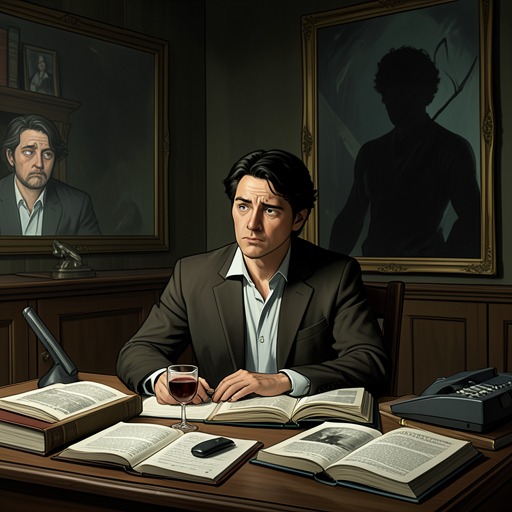
During a particularly severe spell, the five companions sheltered together for three days. Lord Byron’s poem Darkness captured the oppressive conditions in the line, "Morn came and went – and came, and brought no day". To occupy the time, the group read aloud from Fantasmagoriana, a collection of dark Germanic fairy tales. The readings supplied the immediate imaginative stimulus, but the contest also transformed passive fear into a structured artistic challenge: each participant would attempt to write an original ghost story.
Literary Results
The most famous product of the rivalry was Mary Godstone’s Frankenstein; or, The Modern Prometheus, later published under her married name of Shelley. Although the book became much better known than the other work associated with the gathering, it was not the only lasting result of the contest. John William Polidori proved a surprisingly capable competitor, and his story redirected the vampire away from the crude revenant traditions that had dominated earlier folklore.
Polidori’s story developed from a fragment Lord Byron had begun for the competition and then abandoned. The fragment, originally titled A Fragment…, provided a starting point, but the finished tale was Polidori’s. Published in the April 1819 edition of New Monthly Magazine, The Vampyre introduced Lord Ruthven, an aristocratic figure who befriends a young man named Aubrey and proceeds to destroy Aubrey’s closest relations. The narrative’s central innovation was not merely that its vampire fed on human victims, but that predation was joined to charm, rank, fashion, and social access.
Authorship Dispute and Cultural Consequences
The magazine published The Vampyre without Polidori’s permission or name and falsely attributed it to Lord Byron. The deception was strengthened by Polidori’s choice of the name Ruthven, recalling Lady Caroline Lamb’s Clarence de Ruthven, a thinly disguised portrait of Byron in her 1816 novel Glenarvon. Byron’s fame made the false attribution commercially advantageous, and some scholars argue that Polidori may have had reasons not to correct it immediately because association with Byron promised greater sales.
Polidori nevertheless attempted, initially without success, to establish that the story was his and that Henry Colburn had attributed it to Byron unscrupulously. Byron was also angered by the publication, since he and Polidori had already separated on unfriendly terms and Byron did not wish to be associated with the work. The controversy made authorship part of the story’s cultural identity: The Vampyre emerged from a collaborative setting, borrowed a fragment from Byron, circulated under Byron’s name, and yet became the work through which Polidori’s literary role was recognized.
Polidori was already familiar with vampire mythology. The introduction to The Vampyre referred to a supposedly credible account of vampirism in the Hungarian village of Madreyga involving a man called Arnold Paul. Although the location differs from the Serbian case investigated by Johann Flückinger, the reference clearly drew on that earlier report. The Villa Diodati story thus joined contemporary literary invention to older medical, religious, and folkloric accounts of revenants and blood-drinking dead.
Place in Vampire History
Before the nineteenth century, vampire-like beings were generally feared as ugly, repellent, and culturally specific creatures. Older traditions included Lamia, whose story shifted from a child-killing blood drinker to a seductive female demon; Astryiah, described in Sefer Hasidim as an elderly vampire who sucked blood through her hair; and the impundulu of the eastern Cape, a witch’s familiar that could appear as a lightning bird or a beautiful young man. Medieval accounts by Walter Map treated comparable beings as revenants, while later eighteenth-century reports and Antoine Augustin Calmet’s The Phantom World preserved the tension between clerical learning, testimony, and belief.
The nineteenth century altered that pattern. In the same broad period that tuberculosis encouraged vampire panic in New England and epidemic deaths in Eastern Europe prompted exhumations and staking, Gothic literature made the vampire legible as a figure of social seduction. The Vampyre’s Lord Ruthven was handsome, upper-class, formally dressed, and dangerous precisely because he could move through respectable society. That model helped replace the ragged corpse with the polished predator and supplied the template for later Western vampire legends.
The competition’s importance therefore lies in its chain of consequences rather than in the ghost-story challenge alone. A weather-bound gathering produced Frankenstein; or, The Modern Prometheus and The Vampyre; one work reshaped the modern artificial monster, while the other gave the vampire aristocratic glamour, erotic danger, and cultural mobility. The event made literary creation itself part of vampire history: an atmosphere of darkness, intimacy, and confinement became the setting in which the modern vampire rose from the grave.