Estrie
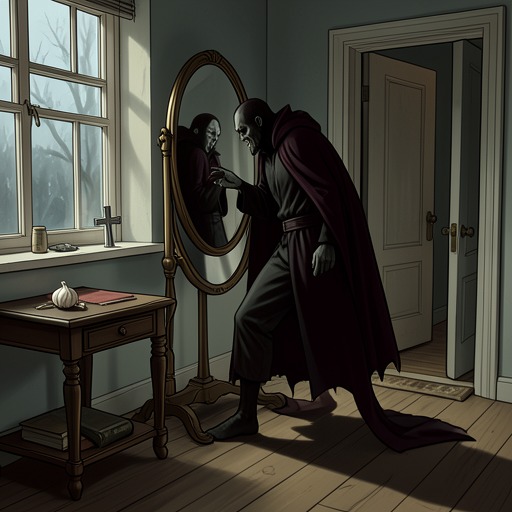
A History of the Vampire in Popular CultureEstrie is a folkloric vampire associated especially with Jewish tradition and the wider family of European blood-drinking beings. In the account preserved in Sefer Hasidim, the creature appears as Astryiah, an elderly woman who sucks blood through her hair; in the book’s interpretation, Astryiah is probably an estrie, a being capable of flight and shape-shifting. The tradition gives the creature both a bodily strangeness and a practical vulnerability: a victim of an estrie may supposedly be cured by eating the creature’s bread and salt, while a suspected estrie in the grave must be physically restrained so that its spirit cannot attack the living.
Identity and Folkloric Background
Estrie belongs to an older and more varied stratum of vampire lore than the elegant, seductive vampire established by modern Gothic fiction. Before nineteenth-century literature standardized the familiar vampire image, blood-drinking beings were generally feared, hated, and often described as physically ugly. The name vampire itself is uncertain in origin but is widely connected with the Hungarian vampir and the Old Church Slavonic opiri, while many early traditions came from Eastern Europe. Estrie therefore appears within a cultural field in which the boundaries between vampire, demon, witch, and revenant remained fluid rather than fixed.
The creature’s closest conceptual relatives include Lamia, whose myth developed from a grief-stricken woman into a child-killing blood drinker and, later, a seductive female demon resembling a Succubus. Estrie also resembles the Impundulu of the eastern Cape, a witch’s familiar that drinks human blood, changes between animal and human forms, and may turn against the witch who fails to feed it. These comparisons do not make the beings identical; they show a recurring folklore structure in which a female or feminized supernatural predator crosses the boundary between domestic care, sexuality, motherhood, and lethal consumption.
Astryiah and the Sefer Hasidim Tradition
The principal written account appears in Sefer Hasidim, a collection composed around the turn of the thirteenth century. It describes Astryiah as an elderly female vampire whose method of feeding is especially uncanny: she sucks the blood of victims through her hair. The source offers no further explanation of how this mechanism operates, and that absence is itself characteristic of folklore, where an arresting image may survive without a complete anatomy or consistent system of rules.
The book identifies Astryiah as probably an estrie, a creature believed to fly and assume different forms in order to catch and drain its victims. The possibility of transformation makes Estrie less a fixed monster than a threat capable of entering ordinary human spaces under uncertain appearances. Its danger lies not only in physical attack but also in the instability of recognition: the victim cannot rely on a single visible form to distinguish the creature from a human being.
The tradition also preserves an unusual remedy. Someone bitten by an estrie may supposedly be cured by eating the creature’s bread and salt. Food here is not merely nourishment but a substance that reverses or neutralizes supernatural contamination. The remedy connects the creature to domestic and communal practices, making the threat intimate: the same household substance that sustains ordinary life becomes part of the attempt to restore a victim after contact with the predator.
Grave, Spirit, and Methods of Destruction
A related passage in Sefer Hasidim concerns a witch identified as an estrie and explains how such a being might continue harming people after death. If an estrie is found in its grave with its mouth open, the passage warns that its spirit will attack the living. The proposed remedy is to hammer a spike through its mouth and into the earth, then fill the mouth with stones so that it can no longer consume human flesh or move against the living world.
This method places Estrie within the same practical imagination as the medieval Revenant. Walter Map, writing in De Nugis Curialium during the twelfth century, recounts stories of the undead rising from graves, and one clerical remedy calls for a corpse to be exhumed, decapitated with a spade, sprinkled with holy water, and returned to the grave. Another account describes a cross placed on the grave of a dead man who wandered in his shroud for more than a month; according to the story, the cross caused him to sink into the soil and remain there. The Estrie tradition likewise treats the grave as a contested threshold and the mouth as the decisive site through which predation, speech, breath, or spiritual attack may continue.
These narratives turn supernatural belief into a sequence of recognizable functions: a dangerous being is identified, its posthumous activity is diagnosed, the corpse is opened or physically fixed, and a religious or material barrier restores the separation between dead and living. The stake, stones, cross, holy water, and grave soil all serve as instruments for closing a boundary that death was supposed to make secure.
Historical Fears and Explanatory Models
The Estrie tradition belongs to a broader history in which unexplained deaths were translated into stories of life-sucking beings. Many early vampire narratives focus on women killing babies and children, a pattern that may reflect attempts to interpret sudden infant death, malnutrition, and the high infant mortality of earlier societies. Because most babies were breastfed by their mothers or wet nurses, the woman caring for a child could become the focus of blame when the child died unexpectedly. In communities where religious explanation carried more authority than medical science, an invisible predator could provide a comprehensible cause for an otherwise inexplicable loss.
The same process shaped later vampire panics. During the nineteenth century, tuberculosis spread through households in New England, and the disease’s apparent consumption of a victim’s health encouraged the belief that the dead were returning to drain the life force of surviving relatives. In Exeter, Rhode Island, the deaths of members of the Brown family led neighbors to persuade George Brown to exhume his relatives in the hope of saving Edwin. Lena “Mercy” Brown’s corpse appeared unusually fresh, a condition explained medically by the cold season and the storage of her coffin in a crypt, but her heart and lungs were nevertheless removed and burned. The ashes were mixed with water and given to Edwin as a cure; he died on 2 May 1892.
Earlier episodes followed a similar logic. During the eighteenth-century vampire craze, whole communities in eastern Europe dug up suspected corpses and staked them. In 1731, thirteen deaths in one Serbian village were attributed by residents to vampire attacks despite a doctor’s explanation that malnutrition was the likely cause. Johann Flückinger and other witnesses later reported bodies that seemed unusually intact and plump, observations that strengthened supernatural interpretations even though decomposition varies with environmental conditions. Estrie thus participates in a durable cultural response to helplessness: when disease and death seem uncontrolled, the vampire supplies a target, a narrative of causation, and a ritual means of resistance.
Transformation Through the Vampire Tradition
By the nineteenth century, a more credulous and curious social climate helped supernatural explanations circulate alongside rapid industrial and scientific change. Victorian Britain combined technological development with reports of witchcraft treated as fact, while spiritualism and séances attracted people seeking stability in a transforming world. In that setting, older beings such as Estrie could be absorbed into the emerging Gothic vocabulary without losing their earlier associations with blood, predation, female danger, and the grave.
Mass-market fiction and film later homogenized vampire expectations. The ugly, ragged revenant gave way to the dark, attractive, tempting figure who is evil yet vulnerable enough to invite fantasies of redemption through human love. The seductive female predator survived in forms such as Carmilla, whose immediate bond with Laura joins intimacy, desire, and predation. The Baobhan Sith likewise appears as a beautiful woman who lures hunters, drinks their blood, and leaves them dead, while dogs or horses can protect the survivors. Estrie’s shape-shifting and female identity place it in this same recurring pattern, even though the Sefer Hasidim account is older and less polished than later literary versions.
The creature’s meaning therefore lies less in a single fixed appearance than in the functions repeated across cultures: it threatens the vulnerable, crosses the boundary between woman and monster, turns the grave into an active site, and can be stopped only by a culturally authorized combination of recognition, food, force, and ritual. Later vampire rules about garlic, reflection, crucifixes, or invitations may vary, but the Estrie material demonstrates how such rules emerge from attempts to make an invisible danger legible and controllable. Its lasting significance is the record it preserves of vampire folklore before modern fiction converted a broad family of feared beings into one internationally recognizable type.