Exeter, Rhode Island
A History of the Vampire in Popular CultureExeter, Rhode Island, is remembered in the history of vampire belief as the setting of the Mercy Brown vampire incident, a case in which a cluster of tuberculosis deaths was transformed into a supernatural explanation. The town’s significance lies not in evidence that a vampire existed, but in the way disease, grieving, exhumation, medical uncertainty, and communal fear converged there in January 1892.
Disease and Local Fear
Over the nineteenth century, a vampire panic took hold in New England as tuberculosis spread rapidly through households. Known as consumption because it appeared to consume its victims’ health, the disease was highly contagious, yet its transmission and progression were not fully understood by the communities it devastated. When several relatives died in succession, survivors could interpret the first victim as returning from the grave to drain the life force of the living.
This pattern belonged to a wider historical response to unexplained mortality. Before modern medical knowledge, a child or adult could die after appearing healthy, leaving relatives without a convincing account of what had happened. Folk explanations gave disaster a visible cause and a target, offering a semblance of control when families could not know who would die next or why. In Exeter, that need for explanation became attached to the bodies of the dead and to the possibility that one corpse was harming the living.
The Brown Family and the Exhumations
Lena “Mercy” Brown was the nineteen-year-old daughter of George and Mary Brown. Her mother died of tuberculosis in 1883, and her eldest daughter, Mary Olive, died of the same disease in 1886. Mercy and Edwin, George’s remaining children, contracted tuberculosis in 1891, and Mercy died in January 1892. As Edwin continued to suffer, friends and neighbors persuaded a reluctant George to disinter members of his family in the hope of finding and stopping supernatural activity.
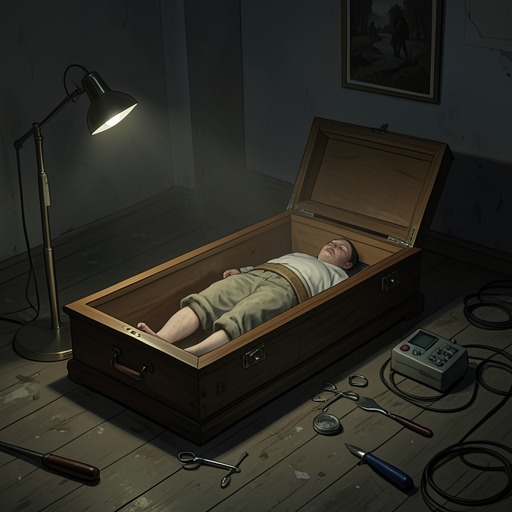
The exhumation produced a sequence of competing interpretations. Mary and Mary Olive’s bodies showed decomposition consistent with the length of time they had been buried. Mercy’s corpse, however, appeared “fresh,” a condition that those present treated as evidence of vampirism. The circumstances offered an ordinary medical explanation: she had been dead for less than two months during the coldest part of the year, and her coffin had been kept in a crypt because the frozen ground was too hard to dig. Those conditions could naturally delay decay, but the explanation failed to displace the supernatural interpretation.
A local doctor objected to the conclusion that Mercy was undead. He identified signs of tuberculosis in her lungs, and the disease had already been recognized by the medical profession since the early nineteenth century. His objections were ignored. Mercy’s heart and lungs were cut out and burned on a pyre built on nearby rocks, turning the examination into a protective ritual rather than a medical investigation.
Ritual Cure and Its Failure
The ashes of Mercy’s vital organs were mixed with water and given to Edwin as a medicinal concoction. The act joined the language of treatment to the logic of contagion and supernatural attack: if the dead girl’s organs were believed to be the source of Edwin’s illness, consuming their remains was imagined as a way to break the transmission.
The remedy failed. Edwin died on 2 May 1892, despite the exhumation, the burning of the organs, and the drink prepared from their ashes. The outcome exposed the limits of the ritual while also showing why such a ritual had seemed persuasive. It supplied a concrete action in a situation defined by helplessness, gave the family and community something to do, and converted an invisible disease process into an identifiable object that could be removed and destroyed.
Exeter in the History of Vampire Explanations
The Exeter case belongs to a broader history of interpreting corpses through incomplete knowledge of postmortem change. Stories of bodies with blood around the mouth or in the stomach predated modern understanding of decomposition. Purge fluid can emerge from the mouth and nose as tissues break down, and pressure inside a corpse can force decaying liquid from the body; its dark red or black appearance can be mistaken for blood. Staking a corpse can also release accumulated gases and perhaps produce a noise that witnesses describe as a shriek.
Other physical processes could likewise make a body appear strangely preserved. Airtight coffins or heavy clay soil can slow decomposition by limiting bacterial activity and access by insects and animals. Saponification, or adipocere formation, results from anaerobic bacterial hydrolysis of body fats and can leave a corpse with a waxlike appearance and facial features still intact. Such conditions help explain why an exhumed body might seem to resist ordinary decay, even though the observers understood it through the vocabulary of the undead.
Exeter therefore illustrates a social disease model as much as a medical misunderstanding. Tuberculosis supplied the biological crisis; the family’s deaths supplied the pattern; the corpse supplied apparently tangible proof; and communal belief supplied the ritual response. The town’s place in vampire history comes from this collision between grief and diagnosis, not from a confirmed supernatural event.