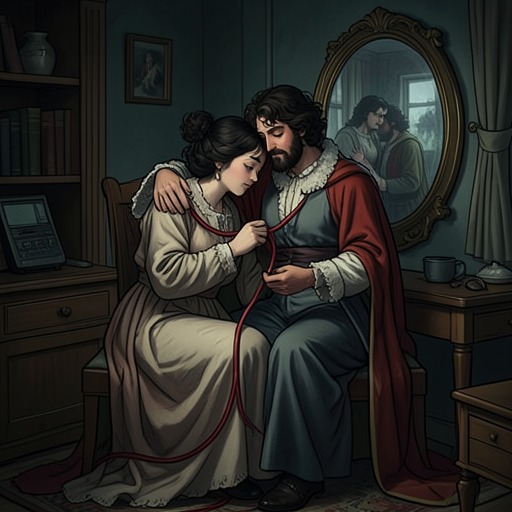
General Spielsdorf
A History of the Vampire in Popular CultureGeneral Spielsdorf is the uncle of Laura’s late friend Bertha and the decisive witness who turns a private tragedy into an identifiable supernatural pattern. His testimony connects Bertha’s mysterious death with Carmilla’s arrival at Laura’s home, reveals the identity concealed beneath the vampire’s aliases, and places the search for her tomb at the center of the final confrontation.
Identity and Background
General Spielsdorf enters the narrative through grief and investigation. Bertha, his niece, had died under mysterious circumstances after forming an intimate friendship with a young woman called Millarca. The General preserves the circumstances of that death and later explains them to Laura and her father, making him the character who carries the earlier case into the present action.
His position as Bertha’s uncle gives his account both emotional force and practical urgency. He is not merely reporting an old supernatural rumor: he is describing the fate of a close family member and identifying the circumstances that preceded it. The earlier loss also explains why he recognizes the danger surrounding Carmilla more quickly than Laura’s household does.
Recognition of the Pattern
Laura and her father meet General Spielsdorf while traveling without Carmilla, who is asleep because they leave during the day. The General explains that Bertha had befriended Millarca shortly before her death. Millarca’s name is an anagram of Carmilla, and her arrival in Bertha’s life occurred in circumstances almost identical to Carmilla’s arrival at Laura’s home.
These repetitions transform resemblance into evidence. The same kind of mysterious young woman appears, enters a vulnerable household through companionship, and is followed by a death. When the identities of Millarca, Carmilla, and Mircalla are recognized as belonging to one being, the General’s earlier experience becomes the key to interpreting Laura’s present danger.
Pursuit of Mircalla
After recognizing the connection, General Spielsdorf joins Laura and her father in traveling to the nearby town of Karnstein. Their objective is to locate Mircalla’s tomb so that the vampire can be destroyed permanently. The General therefore shifts from witness to active participant: memory supplies the warning, while the search for the tomb supplies a concrete method of resistance.
Carmilla appears while the General and Laura are alone and reacts with rage when confronted. Even then, the General’s attempts to kill her do not immediately succeed, allowing the threat to evade direct resolution. The encounter demonstrates both his determination and the difficulty of defeating an enemy whose identity and movements have repeatedly been concealed.
Conflict and Resolution
The pursuit reaches its conclusion when Baron Vordenburg joins the group. Vordenburg finally destroys the vampiric Mircalla, completing the task that General Spielsdorf had undertaken but could not accomplish alone. The General’s role in the ending is consequently collaborative rather than solitary: he supplies the crucial testimony, helps identify the tomb, confronts Carmilla, and remains part of the effort that makes her destruction possible.
His importance lies less in supernatural power than in accumulated knowledge. Bertha’s death might have remained an isolated mystery, and Laura’s experience might have been dismissed as an unsettling friendship, without the General’s comparison of the two cases. By placing the events side by side, he makes the hidden recurrence visible and gives the final action its rationale.
Narrative Role and Significance
General Spielsdorf functions as the narrative bridge between two victims and two apparently separate episodes. His account enlarges the story from Laura’s immediate household to a wider history of repeated predation, while the anagram of Millarca and the resemblance between the two arrivals turn identity itself into a weapon against concealment.
He also embodies the nineteenth-century response to the threat represented by Carmilla: personal bereavement, suspicion, religious and social judgment, and finally physical destruction. The evidence does not present him as a detached scholar. He is a grieving relative whose pursuit is driven by the need to explain and end the violence that claimed Bertha. Through him, the narrative converts mourning into recognition, and recognition into action.