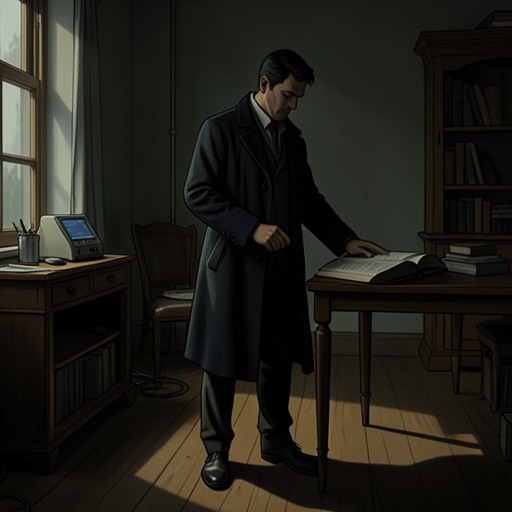
George Sands
A History of the Vampire in Popular CultureGeorge Sands is one of the central figures in the supernatural household of Being Human, defined less by spectacle than by the ordinary emotional needs he shares with his companions. Described as possibly the most unlikely and unassuming werewolf in the underworld, he becomes the practical and emotional counterweight to Mitchell’s vampire tragedy and Annie Sawyer’s condition as a ghost. His decisive importance lies in the way his friendship helps turn three incompatible supernatural existences into something resembling a home.
Identity and Background
George Sands is a werewolf whose appearance and manner resist the sensational image usually attached to supernatural creatures. He is characterized as unassuming, making him an especially striking contrast to Mitchell, whose presence carries an overtly seductive, Byron-esque intensity. The evidence does not supply a detailed account of George’s human background or the circumstances of his transformation, but it does establish that his supernatural identity places him in the same difficult social position as Mitchell: both are forced to negotiate life outside the ordinary human world while trying to pass within it.
George’s significance therefore begins with contradiction. He belongs to a category commonly treated as monstrous, yet his characterization is grounded in modesty and vulnerability rather than menace. The description of him as an unlikely werewolf makes his very ordinariness narratively important. He is not introduced as an emblem of uncontrollable violence, but as a person attempting to manage the consequences of being unable to fit comfortably into the outside world.
Life with Mitchell and Annie Sawyer
George and Mitchell rent a house together in Bristol while each is struggling to live alongside a supernatural condition that threatens ordinary social existence. Their shared domestic arrangement offers George a form of stability, even though the household is anything but conventional. Mitchell works as a hospital porter and tries to balance his existence as a vampire with his wish to remain connected to humanity; George’s companionship gives that effort a practical setting and an emotional anchor.
The house acquires a third occupant when Annie Sawyer, a woman of approximately the same age as the two men, is revealed to be dead. Mitchell and George are the only people able both to see and to interact with Annie’s ghost. This shared ability creates the basis for their rapid friendship, but it also makes the household a space where categories that normally exclude one another can coexist: the living and the dead, the human and the supernatural, the body governed by lycanthropy and the body governed by vampiric hunger.
George’s place within this arrangement is not merely functional. His friendship with Mitchell is described as a source of stability, and the three companions become close despite the radically different forms their lives have taken. The home does not erase their conditions; instead, it gives those conditions a social structure. George can remain a werewolf without being reduced to that identity, just as Mitchell can remain a vampire while struggling not to become a monster and Annie can remain a ghost while participating in a continuing relationship with the living.
Relationships and Conflict
George’s most important relationship is his friendship with Mitchell. The pair are presented as an unlikely partnership, joined by the difficulties of trying to fit into the outside world. Mitchell’s burden is the conflict between bloodlust and conscience: he has acted with terrible cruelty in the past, yet clings desperately to a remnant of humanity and ultimately chooses the human side when Herrick demands that he decide where his loyalty lies. George’s presence gives that inner conflict a continuing interpersonal context. Mitchell is not isolated in the abstract; he is part of a household whose trust he fears losing.
The friendship also establishes a contrast between the two supernatural men. Mitchell is socially skilled, charismatic, and visibly tormented by his vampirism, while George is quieter and more unassuming. Yet both require companionship because neither can live securely within ordinary society. Their bond is thus a form of mutual recognition between outsiders, built not on sameness but on the practical knowledge that each understands what it means to be treated as a threat.
George’s relationship with Annie Sawyer extends this recognition into a three-way friendship. Because he can see and interact with her ghost, Annie is not left outside the social world merely because she is dead. The evidence presents the trio as rapidly becoming close friends, making George one of the people through whom Annie’s posthumous existence becomes relational rather than purely spectral. His role is consequently connective: he helps sustain the household’s emotional coherence across the boundary between life and death.
Narrative Role and Significance
George embodies the series’ movement away from the idea that supernatural beings must function only as villains or threats. The broader discussion of modern vampire fiction emphasizes that such beings may be good as well as bad and may exist unnoticed among ordinary people. George belongs to the same revisionary impulse, although his identity is lycanthropic rather than vampiric. His ordinariness challenges the expectation that a monster should look or behave monstrously.
The household in Bristol also gives supernatural otherness a domestic and social form. Instead of isolating the vampire, werewolf, and ghost in separate horror plots, the narrative places them together in rented accommodation and makes friendship the mechanism by which they endure. George’s character is crucial to that design because his unassuming presence keeps the supernatural premise tied to everyday adaptation. The question is not simply what a werewolf can do, but how a werewolf can share a home, maintain trust, and participate in a community with beings whose conditions are different from his own.
Although the supplied evidence does not describe George’s later individual actions or ending, it firmly establishes his lasting narrative function. He is the unlikely werewolf whose friendship with Mitchell provides stability, whose ability to perceive Annie makes the shared household possible, and whose ordinariness helps the story treat supernatural identity as a difficult form of life rather than a shorthand for evil. Through him, the series makes belonging—not transformation, combat, or spectacle—the central measure of survival.