Glasgow Necropolis
A History of the Vampire in Popular CultureGlasgow Necropolis is a cemetery whose gothic atmosphere became inseparable from one of Britain’s most striking episodes of postwar vampire hysteria. In September 1954, stories of a “vampire with iron teeth” drew hundreds of children into the cemetery carrying stakes, knives, and even dogs. The episode transformed a local legend into a national controversy over children’s reading, media influence, and the power of fear to manufacture a public enemy.
Setting and Reputation
Glasgow Necropolis, also described in the evidence as the Southern Necropolis and associated with the Gorbals cemetery, was an unusually potent setting for supernatural rumour. It was an unkempt and dilapidated burial ground containing nearly a quarter of a million graves, a landscape in which darkness, monuments, and the presence of the dead could readily turn ordinary uncertainty into gothic spectacle. The cemetery’s gates and grounds are preserved in visual documentation as a place whose architectural and funerary character continues to evoke the episode.
The site’s atmosphere was intensified by the ironworks known locally as Dixon’s Blazes, which backed onto the Necropolis and regularly filled the night sky with the red glare and smoke of its furnaces. One boy who took part in the hunt later recalled that the light and smoke made the gravestones seem to leap and gave the impression of figures walking behind them, all outlined in red. The cemetery therefore did not need a supernatural inhabitant to appear uncanny: industrial machinery supplied a changing illumination in which familiar graves became moving forms.
The 1954 Vampire Hunt
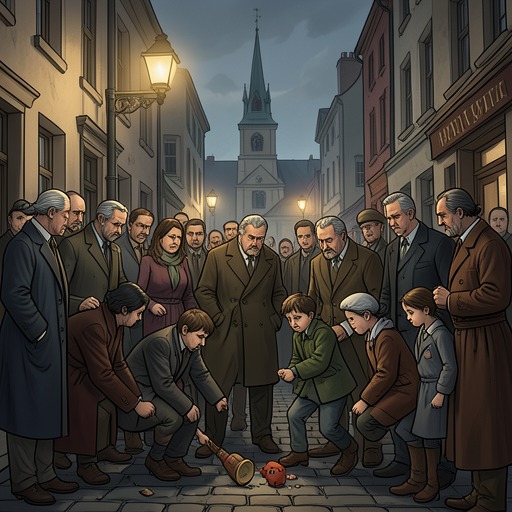
The immediate legend concerned a vampire with iron teeth that was said to have killed two local children and remained ready to attack more. No child murders or disappearances had been reported that year, but the absence of evidence did not prevent the story from spreading. On the night of 23 September, children gathered at the Necropolis in such numbers that police attempting to clear the grounds were overwhelmed. Many carried weapons associated with vampire lore, while others brought dogs, turning a rumour into a collective expedition.
The event became a spectacle beyond the cemetery itself. The Daily Mirror placed it on its front page on 25 September under the headline “AMAZING SCENE AS HUNDREDS OF CHILDREN STORM A CEMETERY,” adding “The Toddlers Joined In” as a sub-header. The report described children clinging to the journalist’s coat and asking whether he had come to shoot or kill the vampire so that they could sleep. The newspaper’s presentation both mocked the story as a “stupid tale” and amplified its dramatic force, ensuring that the local panic circulated nationally.
From Local Legend to Moral Panic
Once the story entered the national press, imported horror comics were blamed for the children’s behaviour. Glasgow’s Education Officer, Dr H. S. Mackintosh, argued that such comics had exceeded acceptable limits, while local mothers reported that children were frightened enough to run home sobbing and demand that windows be closed against the vampire. By 27 September, the Daily Mirror was openly discussing whether the comics should be banned, presenting civic and welfare leaders as preparing action against the alleged source of the hysteria.
The panic soon escaped the cemetery’s original boundaries. On 1 October, the newspaper reported that children had attacked a travelling family’s caravan with stones while shouting that its occupants were witches. The report claimed that hundreds of children had gathered, and residents again attributed the disturbance to the horror comics then under public scrutiny. The vampire hunt thus became evidence in a larger argument: children’s fears were treated not as a response to local tradition, industrial imagery, and sensational reporting, but as proof of the dangerous influence of popular culture.
That same day, Alice Cullen, then the Member of Parliament for the Glasgow constituency of Gorbals, was reported to have asked Home Secretary Sir David Maxwell Fyfe to introduce legislation banning the sale of horror comics in the United Kingdom. A confidential government memorandum later acknowledged the legal difficulty. Under the Obscene Publications Act 1857, “obscene” generally referred to sexually explicit publications, so horror comics did not fit the existing definition even if officials considered them harmful to children. The cemetery incident therefore helped move supernatural folklore into the territory of education policy, censorship, and parliamentary intervention.
Origins and Cultural Meaning
The Gorbals Vampire may not have originated in imported comics at all. Its imagery plausibly drew on older local material, including the poem “Jenny Wi’ the Iron Teeth,” written by Alexander Anderson in 1879 and taught in Scottish primary schools. Children familiar with the poem already possessed a vocabulary of iron teeth, threatening figures, and frightened appeals for maternal protection. The Necropolis, Dixon’s Blazes, and the poem’s remembered imagery could combine into a legend that felt both traditional and immediate.
The episode belongs to a wider history in which communities explain disease, death, social change, and unfamiliar people through stories of the undead. Earlier vampire panics in eastern Europe and New England arose amid epidemics, uncertain medical knowledge, and the need to locate a visible cause for otherwise uncontrollable disaster. Glasgow’s case shows a related process in a modern urban setting: industrial light became ghostly movement, a school poem became a monster narrative, and newspaper coverage converted children’s play and fear into evidence of a national cultural threat.
Glasgow’s broader reputation for vampire stories also reflects the symbolic role of port cities and multicultural districts. Vampirism has often functioned as a metaphor for outsiders and intruders—figures who fascinate while provoking suspicion. The city’s docks brought people, customs, and legends from many places, while areas such as Toxteth became associated with populations excluded from more affluent districts. In that context, the vampire could serve as a flexible scapegoat, absorbing anxieties about difference rather than revealing an actual undead presence.
Legacy of the Cemetery Panic
The campaign generated by the Necropolis incident contributed to the climate that produced stricter controls on horror comics. Government discussions treated the publications as potentially as harmful to children as legally obscene material, even though they did not meet the statutory definition of obscenity. In the United States, a comparable campaign led by psychiatrist Fredric Wertham helped bring the comics industry before the Senate Subcommittee on Juvenile Delinquency and contributed to the creation of the Comics Code Authority, whose arbitrary restrictions included words such as “zombie,” “crime,” and “terror.”
The Glasgow episode therefore demonstrates how a cemetery can become more than a backdrop for a ghost story. Glasgow Necropolis was the physical meeting point of graves, industrial light, schoolroom folklore, children’s collective action, newspaper sensationalism, and state anxiety. Its alleged vampire was never established as a real killer, yet the consequences were tangible: a mass hunt, attacks on suspected outsiders, parliamentary pressure, and a censorship campaign. The power of the site lies precisely in that contradiction. The cemetery contained no confirmed monster, but it gave fear a landscape in which the monster could be seen, pursued, reported, and used to justify authority.